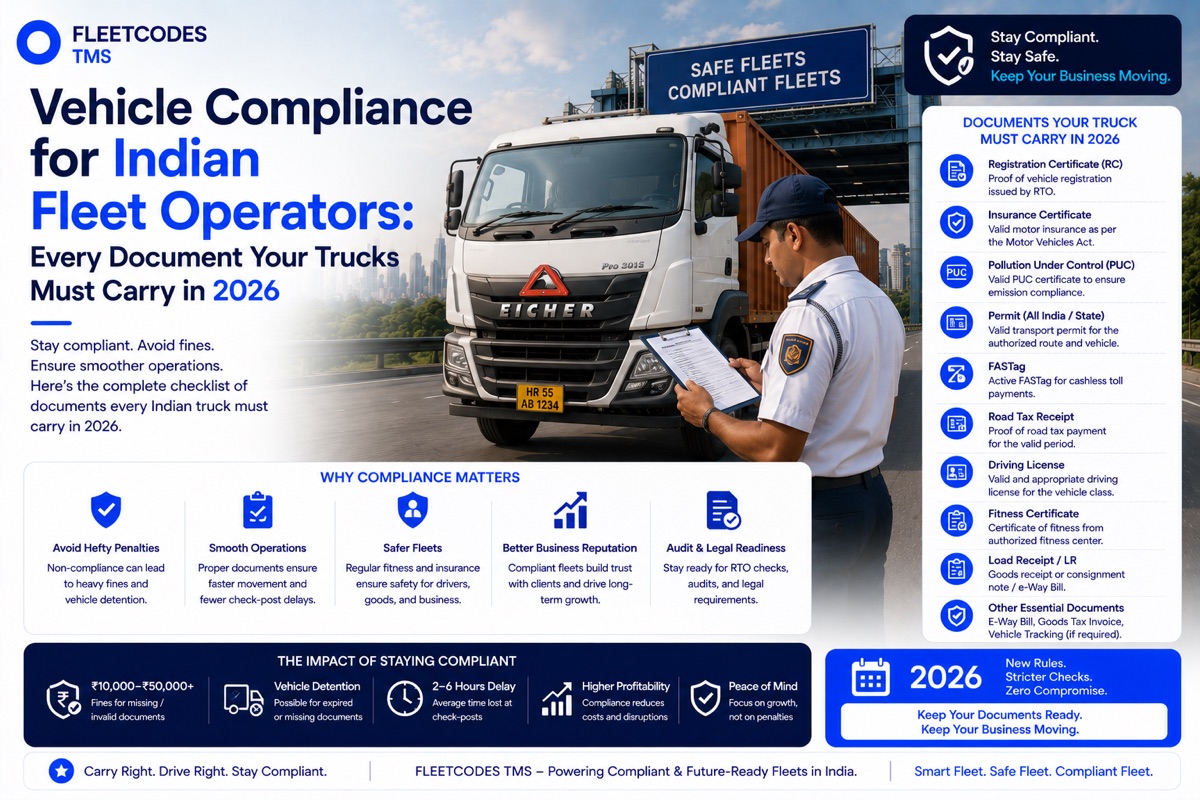
In a fleet of 50 vehicles, even a 90% document compliance rate means 5 trucks are operating with at least one expired or missing certificate at any given time. Each of those 5 vehicles is a checkpoint detention waiting to happen — and a financial penalty, a VAHAN record, and an operational disruption that could have been prevented with a ₹0 calendar alert.
Why Vehicle Document Compliance Is a Fleet-Level Problem
For an individual truck owner-operator, keeping one vehicle's documents current is manageable. For a fleet operator managing 30, 50, or 150 vehicles — each with 8–10 documents that expire on different dates, renewable through different government portals, with different renewal lead times — manual document tracking is a compliance liability that compounds silently until a checkpoint or audit makes it visible.
The consequences of document non-compliance in India are not theoretical:
- Detention at checkpoints: A vehicle stopped at a check post without a valid fitness certificate, permit, or insurance can be detained until the documentation is produced or regularised — causing delivery delays, driver downtime, and customer relationship damage
- Fines under the Motor Vehicles Act: Penalties for specific document violations range from ₹2,000 to ₹10,000 per offence
- VAHAN record: Violations recorded against the vehicle's VAHAN history affect future renewal processing and can complicate insurance and permit applications
- Insurance voidance: Operating a vehicle without valid insurance voids your coverage for any incident during that period — potentially exposing the fleet to uninsured liability for cargo damage, third-party injury, or vehicle loss
This guide covers every document required for Indian commercial vehicles in 2026, with renewal timelines and the practical fleet management approach to keeping all of them current.
The Complete Commercial Vehicle Document Checklist
1. Registration Certificate (RC)
What it is: The fundamental government document confirming the vehicle's legal registration, its owner, its technical specifications (including GVW), and its classification.
Who issues it: Regional Transport Office (RTO) of the state of registration
Validity: Permanent for initial registration; renewal required every 15 years for private vehicles (commercial vehicles may have different renewal periods depending on state regulations)
Penalty for non-compliance: ₹2,000 for first offence under Section 192 of the Motor Vehicles Act
What fleet operators must track: RC copy must be carried in the vehicle. Any change in ownership, address, or vehicle specification requires RC endorsement or transfer.
2. Certificate of Fitness (CF) — The Most Commonly Expired Document
What it is: A certificate confirming that the vehicle meets the roadworthiness standards required by the Motor Vehicles Act — brakes, lighting, tyres, emissions, body structure, safety equipment.
Who issues it: Authorised testing stations or RTOs through inspection
Validity: Initial CF issued for 2 years for new vehicles; renewed annually thereafter
Penalty for non-compliance: ₹2,000 fine + vehicle detention until CF is produced
Why this matters especially: The fitness certificate has the highest annual renewal frequency of any commercial vehicle document — meaning it expires most often. In a manual tracking system, it is the document most likely to lapse unnoticed. A vehicle operating after CF expiry is technically unfit for road use and faces both the fine and potential detention.
What fleet operators must track: CF renewal date per vehicle, ideally with a 30-day advance alert. Renewal requires physical inspection at an authorised centre — book in advance, particularly for large fleets.
3. Vehicle Insurance Certificate
What it is: Evidence of valid third-party motor insurance — mandatory under the Motor Vehicles Act. Comprehensive insurance (covering own damage) is commercial practice rather than a legal requirement, but third-party coverage is legally mandated for all vehicles.
Who issues it: Authorised general insurance companies
Validity: Annual (12 months); must be renewed before expiry without interruption
Penalty for non-compliance: ₹2,000 for first offence; ₹4,000 for repeat offence; potential prosecution. Operating without insurance also voids any claim arising from incidents during the uninsured period.
What fleet operators must track: Insurance expiry per vehicle with 30-day advance alert for renewal. Multi-vehicle fleet policies are available from most general insurers — consolidating renewal dates simplifies management.
4. Pollution Under Control (PUC) Certificate
What it is: Certification that the vehicle's emissions meet the prescribed pollution norms for its category and fuel type.
Who issues it: Authorised PUC testing centres at designated fuel stations and standalone centres
Validity: 6 months for petrol and diesel vehicles (renewed twice yearly)
Penalty for non-compliance: ₹10,000 fine under the Motor Vehicles (Amendment) Act 2019 — the highest single-document penalty in the compliance framework
Why this matters: The ₹10,000 PUC fine is significant — and the 6-month renewal cycle means PUC certificates expire most frequently of all mandatory documents. Automated SMS alerts from Parivahan (government vehicle portal) are available but unreliable. Fleet operators must maintain their own tracking.
What fleet operators must track: PUC expiry per vehicle with 15-day advance alert. Renewing PUC is a 10-minute process at any authorised centre — but only if the reminder triggers before the expiry date.
5. National Permit / State Permit
What it is: Authorization for the vehicle to carry goods — either across India (National Permit) or within specific states (State Permit / Counter Signature Permit).
Who issues it: State Transport Authority (National Permit issued by home state, counter-signed by other states)
Validity: National Permit: 5 years; State Permit: 1–5 years depending on category
Penalty for non-compliance: ₹5,000–10,000 plus vehicle detention in the state where the permit is not valid
What fleet operators must track: Permit type per vehicle (national vs state), states covered, and expiry date. For fleets operating across state borders, counter-signature permit validity in each state must be individually verified.
6. Goods Vehicle Permit (GVP) / Route Permit
What it is: Authorization to use the specific vehicle for commercial goods transport on specified routes or generally.
Who issues it: State Transport Authority
Validity: Varies by permit type — typically annual to 5-year
What fleet operators must track: Permit category (specific route vs general), validity, and any route or cargo restrictions that affect dispatch decisions.
7. Driver's Licence (DL) — Commercial Vehicle Endorsement
What it is: The driver's licence must carry the appropriate endorsement for the vehicle category being driven — Light Motor Vehicle (LMV), Medium Goods Vehicle (MGV), Heavy Goods Vehicle (HGV), or Hazardous Goods endorsement for relevant cargo.
Who issues it: RTO (Licensing Authority)
Validity: Driving licence: 20 years from date of issue or until age 50 (whichever is earlier), then renewed. HGV and hazardous endorsements require periodic medical fitness certification.
Penalty for non-compliance: ₹5,000 for driving without valid licence; vehicle detention
What fleet operators must track: Per-driver licence expiry date, licence category (must match vehicle type), and hazardous goods endorsement if applicable.
8. E-Way Bill (for each consignment)
What it is: The GST compliance document required for goods above ₹50,000 in value moving between states (and in many cases, within states). Covered extensively in our E-Way Bill 2.0 guide.
Validity: Per-trip, calculated by distance — 1 day per 200 km for standard cargo
What fleet operators must track: E-way bill validity per active trip, with extension alerts for long-haul or delayed consignments.
9. Vehicle Tax Token / Road Tax
What it is: Evidence of payment of state road tax for the vehicle.
Who issues it: State transport department / RTO
Validity: Annual or quarterly depending on state
What fleet operators must track: Road tax payment status per vehicle per state (for multi-state operators, road tax in each state of operation may apply).
How Fleetcodes Automates Document Expiry Tracking
Manual document tracking for a fleet — spreadsheets, physical file folders, calendar reminders — works at 10 vehicles. At 30 vehicles, it becomes unreliable. At 100 vehicles, it is effectively impossible without dedicated compliance staff.
Fleetcodes builds document compliance into fleet operations:
Per-vehicle document registry: Every vehicle in the fleet has a document profile — FC, insurance, PUC, permit, and DL for each assigned driver — with expiry dates stored and tracked continuously.
Tiered advance alerts: Configurable alerts at 30 days, 15 days, and 7 days before each document expiry — routed to the fleet manager, operations team, and assigned driver via the Fleetcodes app.
Dispatch compliance blocking: Vehicles with expired documents can be configured to be flagged or excluded from dispatch availability — preventing an expired vehicle from being assigned to a trip before the compliance team has been alerted.
DigiLocker integration awareness: For fleets using DigiLocker for digital document storage, Fleetcodes can surface the vehicle's RC, insurance, and other government-verified documents directly in the vehicle profile — reducing the paperwork burden at checkpoints.
Compliance dashboard: A single view of the entire fleet's document compliance status — which vehicles are current, which have documents expiring in the next 30 days, which have documents already expired — gives the compliance manager actionable visibility without manual audit.
FAQs
What documents must a commercial vehicle carry in India? Mandatory documents include: Registration Certificate (RC), Certificate of Fitness (CF), Third-Party Insurance Certificate, PUC Certificate, National or State Permit, Goods Vehicle Permit, and the driver's valid commercial licence. For each trip, the e-way bill for qualifying consignments must also be present.
How often must the fitness certificate be renewed for commercial vehicles? The Certificate of Fitness (CF) is initially valid for 2 years for new commercial vehicles, then renewed annually. It requires a physical roadworthiness inspection at an authorised centre. Missing the annual renewal is one of the most common compliance failures in Indian fleet operations.
What is the penalty for driving without a PUC certificate in India? The penalty for driving without a valid PUC certificate is ₹10,000 under the Motor Vehicles (Amendment) Act 2019 — the highest single-document penalty in the Indian commercial vehicle compliance framework.
Can expired documents be shown on a mobile phone at checkpoints? DigiLocker-stored documents (RC, DL, insurance) are legally valid at checkpoints as digital equivalents of physical documents under the IT Act. PUC certificates and fitness certificates issued by testing centres may or may not be available digitally depending on the testing centre's systems — physical or printable digital copies are advisable.
How can fleet operators manage document compliance across 50+ vehicles? Fleet management platforms like Fleetcodes store document expiry dates per vehicle and generate advance alerts before expiry. Combined with dispatch compliance rules that flag or block expired vehicles, this converts document compliance from a manual audit exercise into an automated background process.
One expired document is a checkpoint problem. Fifty vehicles with untracked document dates is a compliance crisis in slow motion. Automated tracking costs nothing compared to what it prevents. See How Fleetcodes Tracks Fleet Document Compliance →