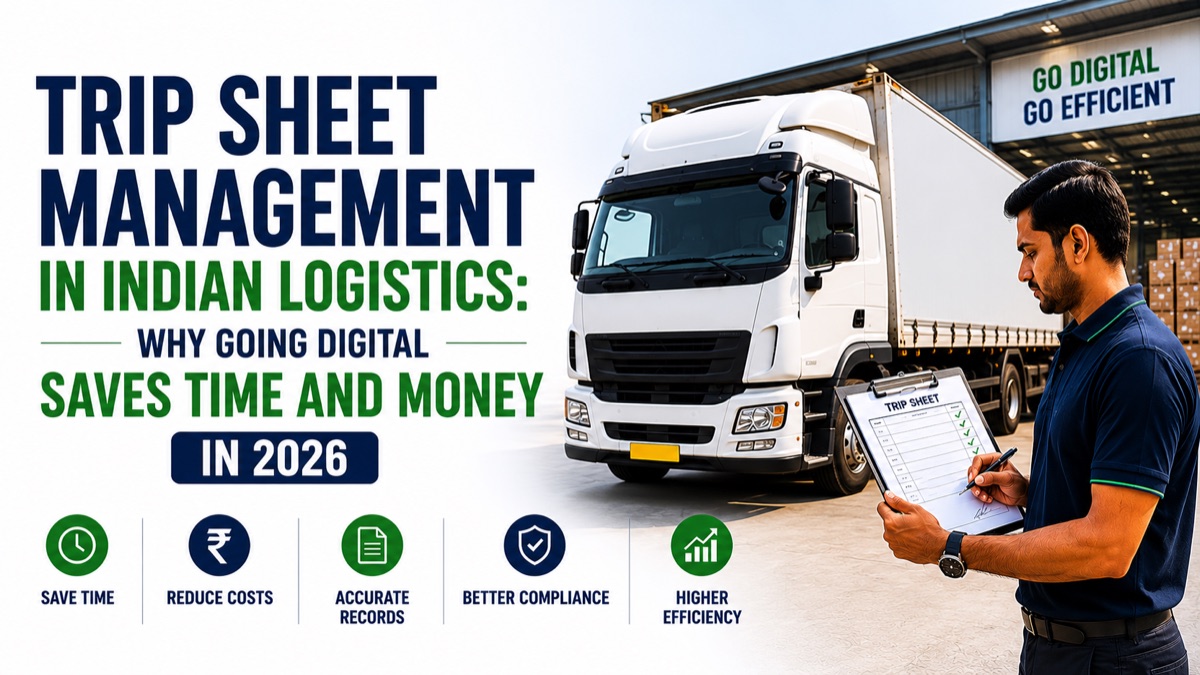
Every truck that leaves your yard carries a trip sheet. Every trip sheet that comes back late, illegibly filled, or not at all, delays your billing, complicates your driver settlement, and creates a gap in your operational record. In a 50-vehicle fleet running 500 trips per month, even a 10% trip sheet failure rate is 50 gaps per month in your billing and compliance records.
What Is a Trip Sheet and Why Does It Matter?
A trip sheet (also called a daily log, vehicle log, or trip register) is the document that records the operational details of each freight trip — departure time, destination, goods carried, driver details, fuel consumed, toll paid, distance covered, delivery confirmation, and any incidents during the journey.
In Indian logistics, the trip sheet serves multiple purposes simultaneously:
Operational record: What vehicle went where, carrying what, driven by whom. The source of truth for dispatch review.
Billing input: In manually managed fleets, the billing team uses the trip sheet to compile invoice data — trip details, km driven, goods delivered, applicable charges.
Driver settlement input: Trip sheets are the primary source for calculating driver pay — trips completed, km driven, expenses incurred, overnight stays.
Compliance documentation: In the event of a checkpoint query, accident, or customer dispute, the trip sheet is the first document examined.
Fuel and maintenance record: Fuel consumed, odometer readings, and any mechanical issues reported by the driver are captured in the trip sheet — or supposed to be.
When the trip sheet system works correctly, it is the operational backbone of the fleet. When it does not — when sheets arrive late, are filled inaccurately, or go missing — every downstream workflow is affected.
The Paper Trip Sheet Problem in Indian Fleets
Paper trip sheets create a systematic chain of operational failures:
Delay Between Event and Record
A driver completing a delivery at 6 PM fills in the trip sheet — or does not, intending to fill it in later. The sheet travels back to the office the next morning, or the day after if the driver is on a multi-day run. By the time the billing team sees it, 2-3 days have passed since the delivery.
For a fleet generating invoices from trip sheet data, this delay directly compresses the billing cycle — pushing invoice generation further from the delivery event, extending the period before payment terms begin.
Illegibility and Accuracy Errors
Handwritten trip sheets filled at the end of a long driving day, in the cab of a truck, are not always clear. Fuel amounts, odometer readings, and delivery details get transcribed incorrectly. The billing team interprets what they can and estimates the rest. Estimates create billing errors. Billing errors create disputes.
Lost Sheets Mean Lost Records
Physical trip sheets can be lost — in the cab, during transit, at the office filing stage. A lost trip sheet means a delivery with no documentation. In the best case, the driver recalls enough detail to reconstruct it. In the worst case, the delivery goes unbilled and the operational record has a gap.
Driver Settlement Disputes
When driver pay is calculated from trip sheets that the driver did not fill in themselves, or that were modified during transcription, disputes are inevitable. The driver's recollection of their trips, km, and expenses differs from the billing team's reading of the sheet. Without a digital record both parties can reference independently, the dispute has no objective resolution.
What Digital Trip Sheet Management Looks Like in Fleetcodes
Fleetcodes replaces the paper trip sheet with a connected digital workflow — where every data point that a paper sheet captures is recorded digitally, in real time, as each event occurs.
Pre-Trip Checklist Replaces the Manual Pre-Departure Form
Before a driver departs, the Fleetcodes driver app presents a pre-trip checklist — vehicle condition checks, fuel level confirmation, load verification, document check (e-way bill present, RC copy in vehicle). The driver confirms each item digitally. The checklist completion is timestamped and stored.
This replaces the pre-departure section of the paper trip sheet with a structured, verifiable digital record. No driver can skip the checklist and claim they completed it — the app records exactly what was confirmed and when.
In-Trip Updates Replace Manual Running Log
Throughout the journey, the driver updates status in the Fleetcodes app — departed, loaded, in transit, at delivery point, delivered, returning. Each status change is GPS-timestamped and position-tagged automatically.
The driver does not need to record km driven manually — the GPS tracks it continuously. They do not need to note departure and arrival times — the app records them at each status change. The "running log" portion of the paper trip sheet is captured automatically as a byproduct of normal driver app use.
Fuel and Expense Entry Replaces Paper Receipts
When a driver refuels or incurs a trip expense, they enter it in the Fleetcodes app with a photo receipt. The entry is timestamped and location-tagged. The accounts team reviews submitted expenses in the platform — approving or querying specific items with full documentation.
This replaces the paper expense receipt pile that drivers accumulate through a journey — and eliminates the reconciliation problem when receipts are lost, crumpled, or illegible.
Digital POD Replaces Physical Delivery Confirmation
As covered in our billing automation guide, the Fleetcodes driver app captures digital delivery confirmation — recipient signature, goods photo, geotag, and timestamp — at each stop. This is the delivery section of the trip sheet, captured digitally at the exact moment of delivery.
Post-Trip Summary Generated Automatically
At trip closure, Fleetcodes generates a complete digital trip record — departure time, route taken, km driven (GPS-verified), fuel consumed, tolls paid (FASTag records), deliveries completed (with digital POD for each), expenses submitted, and any incidents reported.
This is the complete trip sheet — assembled automatically from the data points captured throughout the journey, with no manual compilation required.
What Digital Trip Sheets Save
Billing cycle time: Invoices generated from digital trip data on the same day as delivery — not 2-3 days later when the paper sheet arrives.
Billing accuracy: Rate cards applied automatically, surcharges triggered by actual trip data, no manual transcription errors.
Driver settlement clarity: Settlement calculated from GPS-verified trip data visible to the driver throughout the month. No disputes because no ambiguity.
Compliance records: Every trip has a complete, timestamped, GPS-verified digital record — retrievable in seconds for any checkpoint query, customer dispute, or internal audit.
Management time: Operations managers reviewing digital trip records can search, filter, and analyse — instead of reading through handwritten sheets looking for specific information.
FAQs
What is a trip sheet in Indian logistics? A trip sheet is the operational document that records each freight trip — vehicle, driver, goods, route, fuel, expenses, and delivery confirmation. It is the source document for billing, driver settlement, and compliance records.
Why are paper trip sheets a problem for Indian fleet operators? Paper trip sheets arrive late (typically 1-3 days after the trip), are frequently inaccurate or illegible, can be lost, and create settlement disputes when driver and employer records differ. Each of these problems directly affects billing speed, billing accuracy, and driver satisfaction.
How does Fleetcodes replace paper trip sheets? Fleetcodes captures every trip sheet data point digitally through the driver app — pre-trip checklists, GPS-tracked km and route, in-trip status updates, fuel and expense photo submission, and digital POD at delivery. The complete trip record is assembled automatically, eliminating the paper sheet entirely.
The trip sheet is the foundation of your fleet's operational and financial records. When it is paper, that foundation is fragile. When it is digital, it is the most reliable record in your business. See How Fleetcodes Digitises Your Trip Sheet Workflow — Book a Demo →