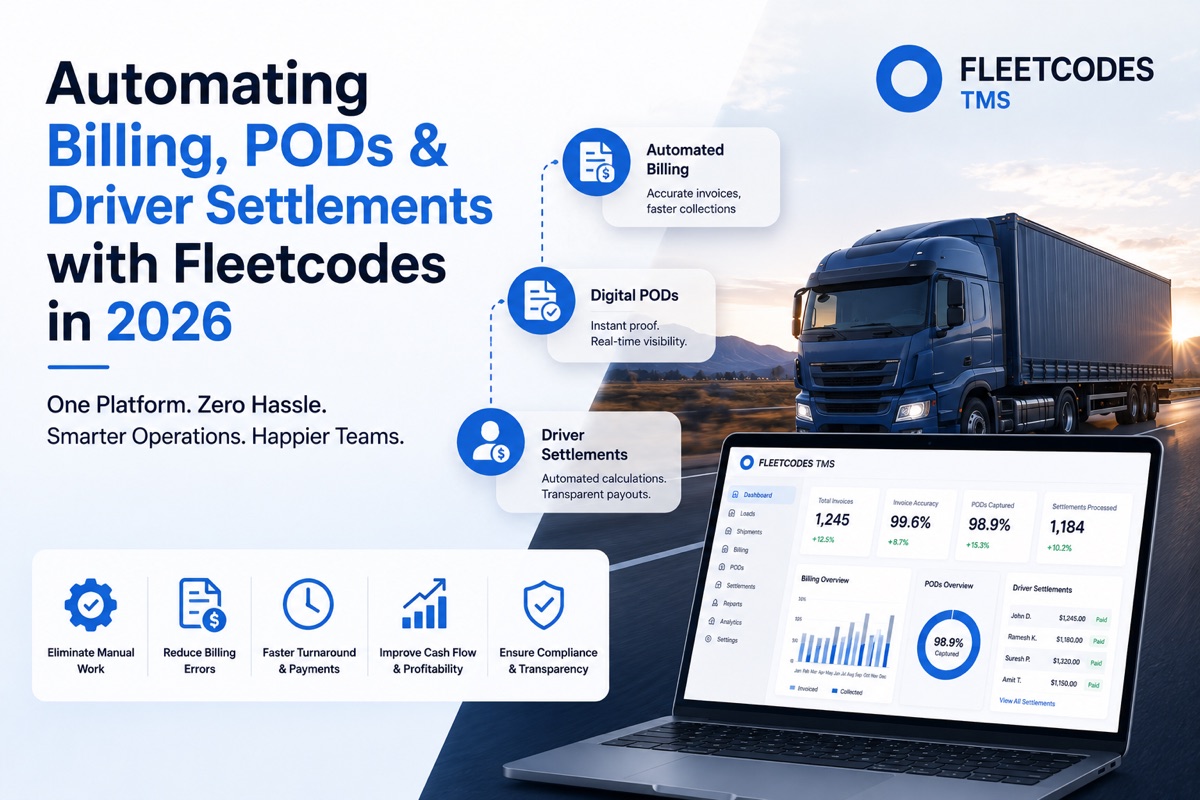
If your billing team is still waiting for physical paper PODs before raising invoices — and your drivers are waiting a week to know what they'll be paid — your back office is a bottleneck your business can't afford.
The Back-Office Problem That Slows Every Logistics Business Down
Ask any operations manager at a growing logistics company what their biggest headaches are, and billing delays and driver settlement disputes will appear near the top of every list.
The reason is almost always the same: manual, paper-based workflows that haven't evolved even as the business has scaled.
Here's what this looks like in practice:
- A delivery is completed. The driver carries a paper POD.
- The paper POD makes its way back to the office — sometimes the same day, sometimes three days later, sometimes never.
- The billing team waits for the POD before they can raise an invoice.
- The invoice goes to the customer. Payment terms start from that date.
- Meanwhile, the driver is waiting for their settlement — which can't be calculated until the trip is officially closed.
This chain of delays costs logistics businesses in two ways: delayed cash inflow and driver dissatisfaction that leads to attrition. In a sector where finding and retaining good drivers is already one of the hardest operational challenges, slow or disputed settlements are a serious problem.
Fleet management software built for 2026 eliminates every manual step in this chain.
See the full Fleetcodes automation workflow → Book a Free Demo
What Digital POD Actually Means (and What It Isn't)
Digital POD (Proof of Delivery) is not just taking a photo of a paper form. A genuine digital POD workflow in transport management system software means:
- The driver confirms delivery on a mobile app — capturing the recipient's digital signature, a timestamp, and a photo of the delivered goods
- That confirmation is instantly available in the TMS — no relay required
- The delivery status updates in real-time tracking dashboards for the operations team and the customer portal simultaneously
- The billing module receives an automatic trigger to raise the invoice based on the confirmed delivery
- The trip record is marked complete, and driver settlement calculations begin
This is what logistics automation looks like at the back-office level — not just route optimisation, but the entire trip-to-invoice-to-payment cycle running without manual intervention.
Three Workflows Fleetcodes Automates Completely
1. Digital POD to Invoice in One Step
With Fleetcodes, here's the new workflow:
Driver confirms delivery on the Fleetcodes driver app → Digital POD (signature + photo + timestamp) is captured → TMS marks trip complete → Billing module automatically raises invoice using the customer's pre-loaded rate card → Invoice is emailed to the customer → Operations dashboard updates fleet utilisation and delivery performance metrics
What used to take 2–5 days now happens in minutes.
The customer gets their invoice faster. Your accounts team doesn't need to chase PODs. And the data is clean because it flows directly from the field — no re-entry, no miskeying.
2. Automated Driver Settlement Calculation
Driver settlements are a pain point in almost every fleet management india private limited operation running more than 20 vehicles. The variables are complex:
- Base pay per trip or per kilometre
- Advance payments made during the month
- Expense claims — fuel, tolls, overnight allowances
- Deductions for damages or violations
- Incentive payments for on-time delivery performance
Fleetcodes' settlement engine pulls trip data, expense submissions, advance records, and performance metrics together automatically — generating a settlement summary for every driver at the end of the pay cycle.
No manual tally. No disputes about figures. Transparent, auditable, and fast.
3. Customer-Wise Billing Reconciliation
For fleets serving multiple customers across different rate structures, billing reconciliation is one of the most time-consuming tasks in the back office.
Fleetcodes manages rate cards for every customer — factoring in route, vehicle type, load weight, and contractual terms. Every invoice raised is automatically reconciled against the agreed rate, and exceptions are flagged before the invoice goes out.
This eliminates the back-and-forth with customers over billing disputes and significantly improves operational efficiency in the accounts team.
The Numbers: What Automation Delivers
Based on operational benchmarks from logistics businesses using integrated transport management system software:
| Metric | Before Automation | After Fleetcodes | |---|---|---| | Average invoice generation time | 3–7 days | Same day | | Billing disputes per month | High | Reduced by 60–70% | | Driver settlement cycle | 7–10 days | 1–2 days | | POD loss/non-receipt rate | 5–8% | Near zero | | Back-office staff time on billing | 60–70% of day | Under 20% |
These aren't marginal improvements. They represent a fundamental shift in how your back office operates — and what your team can focus on instead of chasing paper.
Why This Matters for Cost Saving and Cash Flow
The billing cycle is directly connected to your cash flow. Every day between delivery and invoice is a day your payment terms haven't started yet. For a fleet running 500+ deliveries per month, compressing invoice generation from 5 days to same-day could bring forward weeks of receivables at any given point in the month.
For fleet management shipping businesses operating on 30–45 day payment terms, this acceleration in the billing cycle can meaningfully reduce the working capital required to run the business.
Add to this the reduction in billing disputes (which delay payment further) and the elimination of unbilled trips (which happen when paper PODs are lost), and the cost saving impact of automating your back office is substantial.
What Drivers Experience with Fleetcodes
From the driver's perspective, Fleetcodes replaces paperwork with a simple, intuitive mobile app:
- Receive trip assignments with all details — pickup, delivery, load specs, customer instructions
- Update trip status at each stage — loaded, in transit, at destination, delivered
- Capture delivery confirmation with the recipient's signature and a photo
- Submit expense claims with photo receipts — no paper forms
- View their own settlement summary and trip history in real time
When drivers know exactly what they've earned, can see their settlement calculation, and get paid on time — attrition drops. That alone is worth a significant investment in fleet management software for any logistics business dealing with driver turnover.
Fleetcodes: The TMS Built for Back-Office Automation
Fleetcodes is purpose-built for logistics businesses in India that need to run a tighter, faster, more automated operation — without adding headcount to manage the complexity.
The platform brings together:
- Digital POD with driver app — real-time confirmation, signature, and photo capture
- Auto-billing engine — invoice generation triggered by delivery confirmation
- Customer rate card management — correct rates applied automatically on every trip
- Driver settlement module — automated calculation with full audit trail
- Real-time tracking dashboard — operations and customers always know where their freight is
- Billing reconciliation — disputes flagged before invoices go out
This is transport management system software that doesn't just digitise your existing processes — it replaces them with something fundamentally faster and more reliable.
FAQs
What is digital POD in fleet management? Digital POD (Proof of Delivery) is the electronic capture of delivery confirmation — including recipient signature, photos, timestamp, and GPS location — through a driver mobile app. It replaces paper POD forms and enables instant invoice generation.
How does Fleetcodes handle customers with different rate structures? Fleetcodes stores individual rate cards for every customer, factoring in route, vehicle type, load weight, and contract terms. The billing engine applies the correct rate automatically when an invoice is generated — no manual lookup required.
Can drivers use the Fleetcodes app without training? Yes. The Fleetcodes driver app is designed to be intuitive for drivers with basic smartphone familiarity. Most drivers are comfortable using it independently after a brief onboarding session.
Does Fleetcodes support partial deliveries and multiple drop points? Yes. The Fleetcodes TMS handles multi-stop trips and partial delivery confirmation, with separate POD capture at each drop point and automatic billing updates.
How does automated settlement reduce driver disputes? When drivers can see their own trip data, expense claims, advances, and settlement calculations in real time — all pulled from the same system — there's full transparency. Disputes fall dramatically because the numbers are verifiable by both parties.
From POD to invoice to driver payment — all automated, all in one place. Book Your Free Fleetcodes Demo →