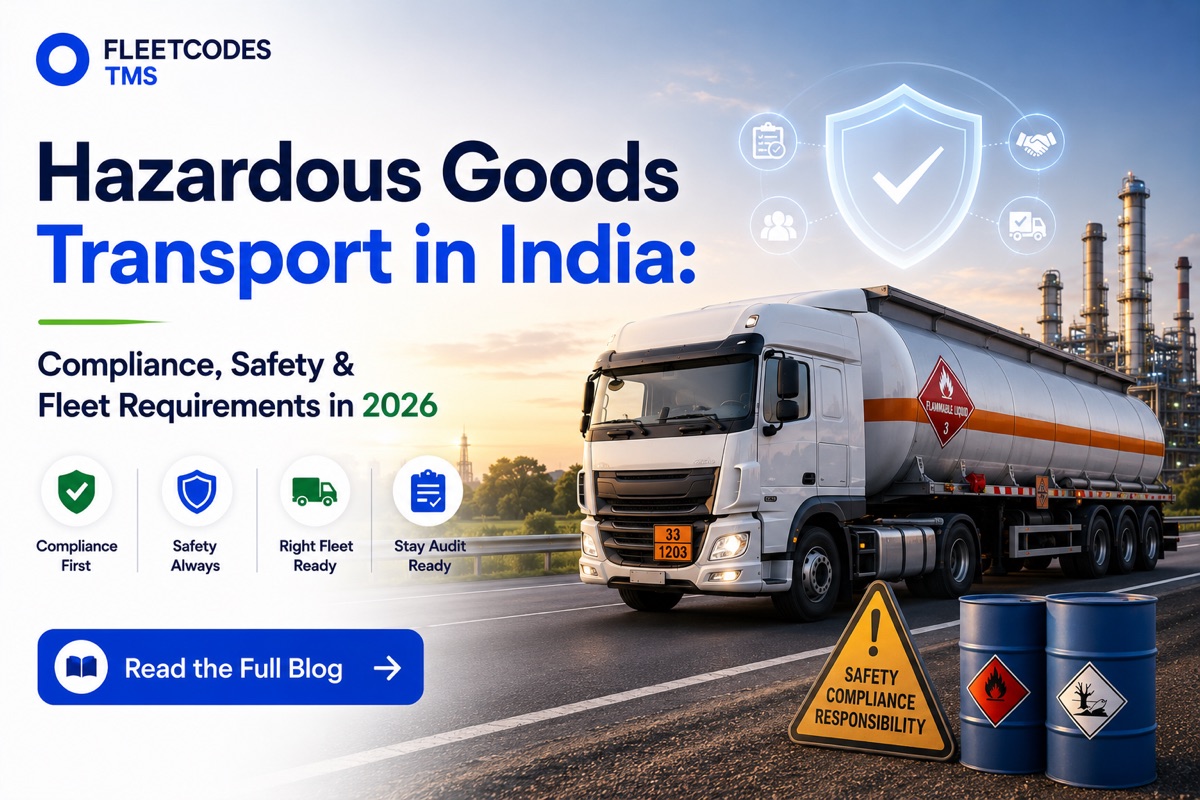
India moves over 300 million tonnes of hazardous chemicals, petroleum products, gases, and other dangerous goods by road annually. For fleet operators in this segment, the regulatory framework is the most demanding in road freight — and the consequences of non-compliance include not just financial penalties, but criminal prosecution, permit cancellation, and catastrophic liability in the event of an incident.
What Counts as Hazardous Goods Under Indian Law
The transportation of hazardous goods by road in India is governed primarily by:
- Central Motor Vehicles Rules (CMVR), 1989 — specifically Rules 129–137, which cover vehicles carrying dangerous goods
- Motor Vehicles Act, 1988 — which defines responsibilities and penalties
- Explosives Act, 1884 and Petroleum Act, 1934 — for those specific categories
Under CMVR, "dangerous or hazardous goods" includes any substance that by its nature, composition, or inherent danger could cause harm to persons, property, or the environment. The practical classification follows the UN Dangerous Goods classification system (Classes 1–9):
| Class | Category | Examples | |---|---|---| | 1 | Explosives | Ammunition, fireworks, mining explosives | | 2 | Gases | LPG, CNG, industrial gases, aerosols | | 3 | Flammable liquids | Petrol, diesel, paint, solvents | | 4 | Flammable solids | Sulphur, matches, certain metals | | 5 | Oxidisers & organic peroxides | Fertilisers, industrial bleaches | | 6 | Toxic and infectious substances | Pesticides, industrial chemicals, lab specimens | | 7 | Radioactive material | Medical and industrial radioactive sources | | 8 | Corrosives | Acids, batteries, caustic soda | | 9 | Miscellaneous | Environmentally hazardous substances, lithium batteries |
India's petroleum products (Class 3) represent by far the largest hazardous goods freight segment by volume — thousands of tanker trucks operating daily on every major highway. Industrial chemicals (Classes 5, 6, 8) form the second largest segment. Specialised classes (explosives, radioactive) carry the most restrictive requirements.
Vehicle Requirements for Hazardous Goods Transport
CMVR Rules 129–137 specify detailed vehicle requirements for carrying dangerous goods. These are not optional safety guidelines — they are mandatory legal requirements. A vehicle that does not meet these standards cannot legally carry hazardous cargo.
Mandatory Vehicle Features
Electrical system protection:
- All wiring must be properly insulated and protected from heat, mechanical damage, and vibration
- Battery master switch accessible from outside the cab for emergency disconnection
- No exposed electrical connections in the cargo area
Fire safety equipment:
- Minimum two fire extinguishers of specified capacity, accessible and operational
- Type and capacity requirements vary by hazard class (flammable liquids require different extinguisher specifications than corrosives)
- Spark arrestors on exhaust systems for vehicles carrying flammable materials
Cargo containment:
- Tanks, containers, and packagings must comply with relevant IS (Indian Standard) specifications
- No leakage, corrosion, or structural compromise
- Bonding and earthing connections for liquid flammable cargo (to prevent static build-up during transfer)
Vehicle markings:
- Hazardous goods placards displayed prominently on all four sides of the vehicle
- UN number and hazard class labels on the transport unit
- Emergency information panel (TREM card holder) accessible from outside the vehicle
Toolbox equipment:
- Broom and shovel
- Sand or absorbent material for spillage
- Warning triangles
Vehicle Inspection and Certification
Vehicles carrying dangerous goods must be inspected and certified by the state transport authority or an authorised inspecting authority before operating in the hazardous goods segment. This certification is in addition to the standard Certificate of Fitness and must be renewed periodically.
Driver Requirements for Hazardous Goods Transport
The driver of a hazardous goods vehicle carries specific legal responsibilities — and must meet requirements beyond those for standard commercial vehicle operation.
Mandatory Hazardous Goods Driver Licence Endorsement
A driver operating a vehicle carrying dangerous or hazardous goods must hold a driving licence with a specific hazardous goods endorsement — not just a standard heavy goods vehicle (HGV) licence. This endorsement requires:
- A specific training programme covering dangerous goods handling, emergency procedures, and relevant regulations
- A medical fitness certificate confirming the driver is fit to operate hazardous goods vehicles
- Periodic renewal — the endorsement must be kept current
Operators who deploy drivers without the appropriate endorsement are in violation of CMVR and face liability for any incident involving those drivers.
Emergency Response Training
All drivers on hazardous goods routes must be trained in:
- Identification of the goods they are carrying (UN class, hazard symbols, emergency contact information)
- Immediate response procedures for spillage, fire, and accident scenarios
- How to use the vehicle's fire extinguishing equipment
- Emergency contact numbers — including the National Chemical Emergency Centre (NCEC) hotline
TREM Card (Transport Emergency Card)
Every hazardous goods vehicle must carry a TREM card — a Transport Emergency Card — specific to the goods being carried. The TREM card provides:
- The UN number and proper shipping name of the substance
- Hazard classification and emergency action codes
- Personal protective equipment requirements
- Emergency action instructions for spillage, fire, and first aid
- Emergency contact numbers
The TREM card must be provided by the shipper or the substance's manufacturer — it is specific to each cargo and must correspond to the actual material being transported.
Documentation Requirements for Hazardous Goods Transport
Beyond the standard commercial vehicle documentation covered in our vehicle compliance guide, hazardous goods transport requires:
Dangerous Goods Declaration: A shipper-provided declaration confirming the nature of the goods, UN class, quantity, packaging type, and emergency contact information. The transporter should retain a copy.
Transport Emergency Card (TREM): As described above — specific to each substance carried.
Hazardous Materials Permit: Some state transport authorities require a specific permit for hazardous goods transport in addition to the standard goods vehicle permit. Requirements vary by state and substance class.
Material Safety Data Sheet (MSDS): For industrial chemical consignments, the MSDS provides detailed information on the substance's properties, hazards, and handling requirements. The vehicle should carry a copy for each substance type in the load.
Route Clearance (if applicable): Certain categories of hazardous goods — Class 1 explosives, Class 7 radioactive materials — require route pre-clearance and police escort in some circumstances. Requirements vary by state and cargo quantity.
Operational Restrictions on Hazardous Goods Vehicles
Several operational restrictions apply specifically to hazardous goods vehicles:
Urban area restrictions: Many metropolitan areas have specific restrictions on hazardous goods vehicle movement — time windows (typically night-time only), designated routes, and weight limits. Delhi, Mumbai, Bengaluru, and Hyderabad all have active hazmat vehicle restrictions that must be checked and planned around.
Prohibited road sections: Certain bridges, tunnels, and urban areas are designated as prohibited for specific hazard classes. Route planning for hazardous goods transport must verify that the planned route does not include prohibited sections.
Parking restrictions: Hazardous goods vehicles cannot park in populated areas, near public buildings, or in locations where an incident would create unacceptable public risk. Overnight stops must be at designated safe areas.
Driving hours: Hazardous goods drivers are subject to standard commercial vehicle driving hour limits. Given the higher consequence nature of fatigue-related incidents with hazardous cargo, compliance with these limits is more important, not less.
How Fleet Technology Supports Hazardous Goods Operations
The compliance and operational complexity of hazardous goods transport is significantly higher than standard freight — and the documentation requirements are more demanding. Fleet management technology addresses several of these requirements:
Route compliance verification: Fleetcodes' geofencing and route monitoring can be configured to flag deviations from approved hazardous goods routes — detecting if a vehicle is entering a restricted urban area or prohibited road section during transit.
Driver document tracking: The driver's hazardous goods licence endorsement expiry is stored and tracked in Fleetcodes, alongside standard licence validity. Advance alerts prevent a driver with an expired endorsement from being assigned to a hazmat load.
Real-time tracking for emergency response: In the event of a hazardous goods incident, knowing the vehicle's precise location in real time is critical for emergency response coordination. GPS integration in Fleetcodes provides live vehicle position continuously — accessible to both the operations team and, if required, emergency authorities.
Digital documentation management: Trip records for hazardous goods consignments — with timestamped departure, route history, and delivery confirmation — create the audit trail that regulatory authorities require in the event of an incident or compliance inspection.
Customer visibility: Shippers of hazardous goods — chemical manufacturers, petroleum companies, industrial gas suppliers — often require real-time visibility into their consignment's status and location. The Fleetcodes customer portal provides this visibility without requiring phone updates.
FAQs
What is the legal framework for hazardous goods transport in India? Hazardous goods transport in India is primarily governed by the Central Motor Vehicles Rules (CMVR), 1989 — specifically Rules 129–137 — along with the Motor Vehicles Act, 1988, and substance-specific legislation (Explosives Act, Petroleum Act). UN Dangerous Goods classifications are used for substance categorisation.
What licence does a driver need to carry hazardous goods in India? A driver carrying dangerous goods must hold a driving licence with a specific hazardous goods endorsement — not just a standard commercial vehicle licence. This endorsement requires specialised training and a medical fitness certificate, and must be periodically renewed.
What is a TREM card and is it mandatory? A TREM (Transport Emergency Card) is a substance-specific emergency response card that every hazardous goods vehicle must carry. It provides hazard classification, emergency action instructions, and emergency contact numbers specific to the substance being transported. It is a mandatory requirement under CMVR.
What fire safety equipment must a hazardous goods vehicle carry? At minimum, two fire extinguishers of specified capacity and type, appropriate to the hazard class of cargo being carried. Vehicles carrying flammable liquids have different extinguisher requirements from those carrying corrosives. Spark arrestors on exhaust systems are required for flammable cargo vehicles.
How does Fleetcodes support hazardous goods fleet operations? Fleetcodes supports hazardous goods operations through: route monitoring with geofence alerts for restricted zones, driver hazmat licence endorsement tracking and expiry alerts, real-time GPS tracking for emergency response support, digital trip documentation for compliance audit trails, and customer visibility portal for shipper tracking requirements.
Hazardous goods transport demands the highest standard of operational discipline in Indian road freight. The regulatory framework is demanding because the consequences of failure are severe. There is no substitute for full compliance. Explore Fleetcodes for Hazardous Goods Fleet Management →