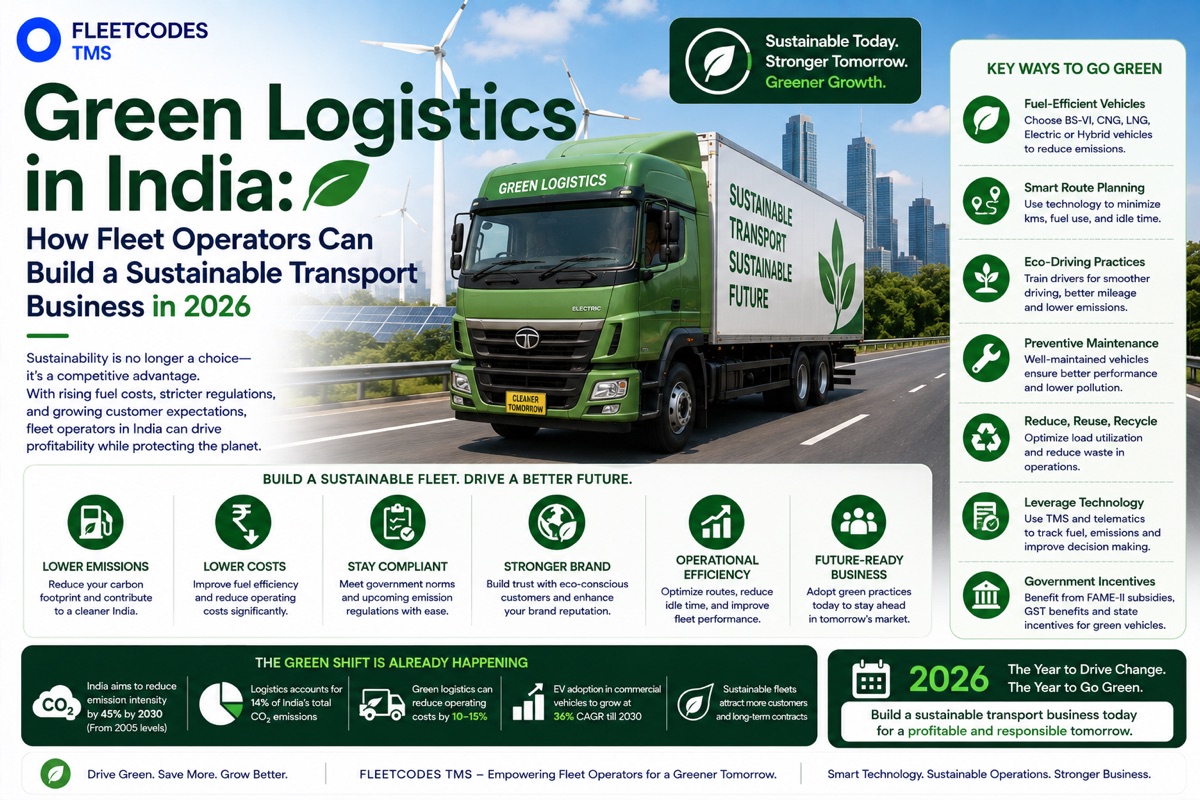
India's logistics sector accounts for approximately 330 million tonnes of CO₂ equivalent annually — about 6.6% of the country's total greenhouse gas emissions. As India's net-zero commitments harden and corporate ESG requirements reach deeper into supply chains, fleet operators who cannot demonstrate environmental performance are losing access to the most valuable shipper contracts.
Why Green Logistics Is Now a Commercial Issue, Not Just an Environmental One
Green logistics India has shifted from an aspirational corporate responsibility topic to a practical commercial decision driver in 2026. The shift is visible in three concrete ways:
Shipper procurement is changing. Large FMCG companies, pharmaceutical manufacturers, and e-commerce platforms with ESG commitments to their investors are embedding sustainability criteria into logistics vendor evaluation. Unilever India, Nestlé, Amazon India, and several major pharma companies have public commitments to scope 3 emission reduction — which includes their logistics providers' emissions. Transporters who cannot provide fuel consumption data, emission estimates, or sustainability credentials are increasingly excluded from formal tender processes.
Government policy is tightening. India's CAFE (Corporate Average Fuel Economy) norms for commercial vehicles, the BS6 Phase 2 emission standards enforced from April 2023, and state-level EV mandates for city logistics all represent a regulatory direction of travel that makes fleet decarbonisation a compliance trajectory, not just a voluntary choice.
The economics are improving. Diesel price volatility, EV total cost of ownership improvement, and fuel efficiency technology advancement mean that sustainability investments increasingly make direct financial sense — independent of any ESG motivation.
The Four Pillars of Green Logistics for Indian Fleet Operators
Pillar 1: Fuel Efficiency and Emission Reduction
The most immediately accessible sustainability improvement for any Indian road freight fleet is systematic fuel efficiency improvement — because fuel efficiency and emission reduction are the same thing. A vehicle that burns 10% less diesel emits 10% less CO₂.
Route optimisation reduces total vehicle kilometres, which is the most direct driver of fleet-level emissions. When Fleetcodes optimises routes for fuel efficiency — choosing the most efficient path between origin and destination, minimising unnecessary kilometres, and reducing the deadhead percentage — the environmental and financial benefits are identical.
Driver behaviour coaching — reducing idling, harsh acceleration, and speeding — delivers 15–25% fuel consumption improvement for the underperforming drivers in any fleet. A fleet where every driver operates at the efficiency of the top quartile consumes and emits significantly less than one where consumption variance is unchecked.
Empty mile reduction is the most carbon-efficient improvement in road freight, because empty kilometres generate zero freight value for 100% of their emissions cost. Reducing deadhead from 30% to 18% on a 50-vehicle fleet eliminates approximately 90,000 empty km per month — and the emissions that go with them.
Vehicle maintenance and fuel monitoring prevent the mechanical degradation that increases fuel consumption and emissions over time. A vehicle with a clogged injector or under-inflated tyres burns more fuel and emits more per tonne-km of freight carried. Preventive maintenance is green maintenance.
Pillar 2: EV Integration
As covered in our EV fleet management guide, electric logistics vehicle India adoption is accelerating — particularly for urban and peri-urban logistics. For the right routes and cargo types, EV deployment in 2026 is commercially rational, not just environmentally motivated.
Where EVs make sense today:
- Urban last-mile delivery (up to 100 km per day)
- Fixed-route intra-city distribution (FMCG distribution, e-commerce last-mile)
- Intra-facility or campus logistics
Sustainability credentials from EV deployment:
- Zero tailpipe emissions on electric legs
- Verifiable charging records (kWh consumed, charging source)
- If charged from renewable energy (solar rooftop at depot), near-zero lifecycle emissions
For fleet operators serving large corporate shippers with scope 3 commitments, even partial EV deployment — a dedicated electric vehicle for a specific customer's urban deliveries — creates a differentiator that can be quantified and reported.
Pillar 3: Carbon Measurement and Reporting
Sustainability in logistics is not self-certifiable. Shippers require evidence — calculated emissions figures, methodology disclosure, and year-on-year trend data that shows direction of travel.
Carbon footprint calculation for road freight is done using emission factors applied to actual fuel consumption. The standard approach:
- Collect actual fuel consumption data per vehicle per trip (from fleet management platform)
- Apply the IPCC emission factor for diesel: approximately 2.68 kg CO₂ per litre of diesel consumed
- Calculate total CO₂ equivalent per trip, per route, per customer, and per fleet
This calculation is only possible with per-vehicle, per-trip fuel consumption data — which manual fleet operations do not have and which integrated TMS platforms like Fleetcodes generate automatically.
Emission reporting per customer is the commercial-facing output. When a shipper can see the CO₂ emission for their freight movements — calculated from actual fuel data, not industry averages — they can use it for their own scope 3 reporting and you have a documented sustainability partnership rather than an undifferentiated carrier relationship.
Pillar 4: Vehicle Scrapping and Fleet Renewal
India's voluntary vehicle scrapping policy provides incentives for retiring pre-BS6 commercial vehicles and replacing them with newer, cleaner models. For fleet operators with older vehicles:
Scrapping incentives:
- Certificate of Deposit (CoD) from registered scrapping centres — exchangeable for discounts on new vehicle purchases
- Waiver of registration fees on new vehicles purchased against a scrapping certificate
- State-level incentives vary but are generally positive for commercial vehicle scrapping
Environmental logic: Replacing a BS4 or older vehicle with a BS6 model reduces particulate and NOx emissions by 80–90% for those specific pollutants. For urban logistics operations, transitioning to BS6 or EV vehicles provides measurable air quality improvement — and a verifiable compliance story with shippers and regulators.
The Business Case: How Sustainability Investments Generate Return
The hesitation most fleet operators have about sustainability investment is the upfront cost question. Here is how the returns flow:
Fuel efficiency improvement (no capital required): Route optimisation and driver behaviour coaching are software-enabled, not capital-intensive. The fuel savings from 10% efficiency improvement on a ₹10 lakh/month fuel bill is ₹1 lakh/month — recurring, with zero capital requirement beyond the TMS subscription.
EV deployment (capital required, positive TCO in target use cases): As covered in the EV guide, urban logistics EVs reach TCO break-even in 2–3 years on suitable routes. After break-even, operational savings are sustained.
Carbon reporting (minimal incremental cost): If you already have per-trip fuel consumption data from your TMS, generating CO₂ estimates is an analytics function — not an additional operational investment.
Commercial premium for green credentials: Transporters who can demonstrate fuel efficiency data, emission per-tonne-km metrics, and EV deployment are increasingly accessing rate premiums from large shippers with sustainability procurement requirements. This premium is hard to quantify generically but is observable in tender outcomes — transporters with sustainability credentials consistently rank better in formal evaluations.
Practical Green Logistics Roadmap for Indian Fleet Operators
Month 1–3 — Measure:
- Deploy fleet management software to capture per-vehicle, per-trip fuel consumption data
- Calculate your current fleet emission profile (total CO₂, CO₂ per tonne-km)
- Identify your highest-emission routes and vehicles
Month 3–6 — Reduce:
- Implement route optimisation — reduce empty km and total trip km
- Start driver efficiency coaching program using per-driver fuel analytics
- Schedule preventive maintenance to address any vehicles with elevated consumption
Month 6–12 — Report:
- Generate customer-facing emission reports for your top 5 customers
- Document year-on-year progress compared to your baseline
- Engage with any customers who have explicit scope 3 commitments about your data
Year 2 — Invest:
- Evaluate EV deployment for high-frequency, fixed-route urban runs
- Assess vehicle scrapping opportunities for pre-BS6 fleet
- Explore renewable charging at depot if EV fleet justifies it
FAQs
What is green logistics and why does it matter for Indian transporters? Green logistics refers to reducing the environmental impact of freight operations — primarily through lower fuel consumption, reduced emissions, EV adoption, and operational efficiency. For Indian transporters in 2026, it matters both environmentally and commercially — because large shippers are including sustainability criteria in vendor evaluation, making green logistics a prerequisite for premium contract access.
How can Indian fleet operators reduce their carbon emissions? The most accessible and highest-impact carbon reduction levers are: route optimisation to reduce total vehicle kilometres, driver behaviour coaching to improve fuel efficiency, empty mile reduction through better dispatch planning, preventive maintenance to prevent mechanical fuel efficiency degradation, and EV deployment on suitable urban routes.
What is scope 3 emissions and how does it affect logistics businesses? Scope 3 emissions are indirect emissions in a company's value chain — including the emissions from their logistics providers' vehicles. As Indian manufacturers, FMCG companies, and e-commerce players make scope 3 commitments, they require their logistics partners to provide emission data and reduction roadmaps. Transporters who cannot provide this data are increasingly disadvantaged in formal procurement.
How does fleet management software support green logistics? Fleet management software enables green logistics by: providing per-vehicle, per-trip fuel consumption data (the foundation of emission calculation), enabling route optimisation that reduces total km driven, surfacing driver behaviour metrics that drive fuel efficiency improvement, and generating the carbon data that customer-facing emission reporting requires.
Is EV adoption viable for all Indian logistics businesses in 2026? EV adoption is commercially viable today for urban last-mile and fixed-route intra-city logistics. Long-haul and variable-route operations are better served by fuel efficiency optimisation and BS6 diesel fleet renewal in the near term, with EV consideration as the technology and infrastructure mature on intercity corridors.
Green logistics is not a sacrifice. For Indian fleet operators in 2026, it is a combination of better economics, competitive positioning, and operational discipline — all pointing in the same direction. See How Fleetcodes Supports Fuel Efficiency and Green Fleet Operations →