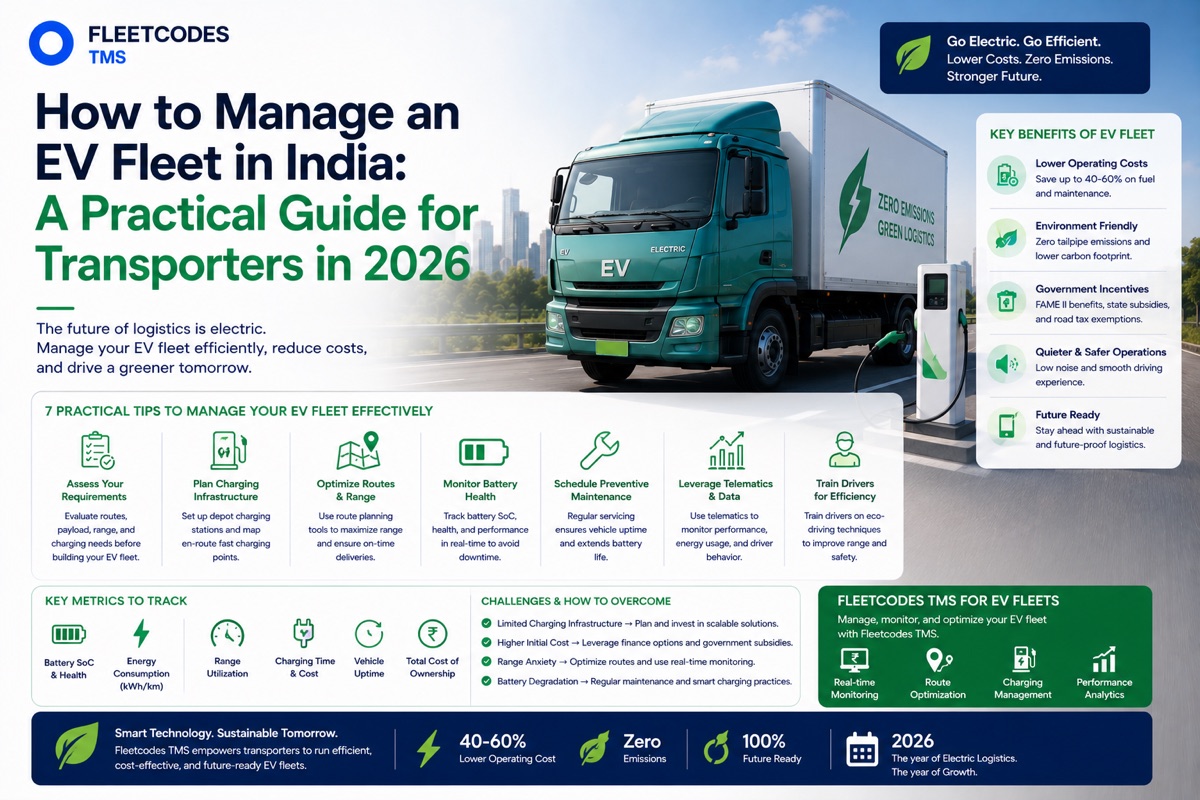
India's commercial EV transition is no longer a future event. With 3,000+ electric cargo vehicles already operating in logistics and investment flooding into EV infrastructure, the practical question for Indian transporters in 2026 is not whether to electrify — it is how to manage it well.
The State of EV Fleet Management India in 2026
EV fleet management India has moved from concept to operational reality faster than most logistics businesses expected. What accelerated the shift:
- Diesel prices have remained volatile and structurally elevated, making the per-kilometre cost advantage of EVs increasingly clear on short and medium-haul routes
- Battery technology has improved meaningfully — electric three-wheelers and LCVs now offer ranges of 150–250 km per charge, sufficient for most urban and peri-urban logistics use cases
- Charging infrastructure has expanded across highways, industrial zones, and urban logistics hubs
- Government support through the PM E-Drive and FAME II schemes has brought upfront costs closer to parity with diesel alternatives in certain segments
- Major e-commerce players — Amazon, Flipkart, Meesho — have committed to large-scale EV fleet deployment, sending a strong market signal to the entire ecosystem
The result: electric vehicle fleet India is no longer a sustainability initiative for large corporates. It is a commercially rational choice for mid-size and growing logistics businesses operating on city and peri-urban routes.
The Real Economics of an Electric Commercial Fleet
Before addressing how to manage an EV fleet, it is worth being clear on why the economics increasingly support fleet electrification India for the right use cases.
Operating Cost Comparison
| Cost Element | Diesel Vehicle | Electric Vehicle | |---|---|---| | Fuel/energy per km | ₹4.50–6.00 (diesel) | ₹0.80–1.20 (electricity) | | Maintenance cost per km | ₹1.50–3.00 | ₹0.40–0.80 | | Driver fuel receipt admin | Significant | Eliminated | | Fuel theft exposure | High | None | | Annual service intervals | 4–6 per vehicle | 1–2 per vehicle |
On a typical urban delivery route of 80–120 km per day, a comparable electric LCV can save ₹300–500 per day in fuel and maintenance costs relative to a diesel equivalent. Over 250 operating days per year, that is ₹75,000–1,25,000 per vehicle annually in operating savings alone.
The Total Cost of Ownership Calculation
The common objection to EVs is higher upfront cost. An electric cargo three-wheeler from brands like Euler, Mahindra, or Piaggio currently costs ₹3–7 lakh more than a comparable diesel vehicle in the same segment. An electric LCV can cost ₹5–12 lakh more.
But total cost of ownership (TCO) over 5–7 years tells a different story when you factor in:
- Cumulative fuel savings over the ownership period
- Lower maintenance expenditure (EVs have 60–70% fewer moving parts than diesel)
- Reduced insurance premiums on newer, safer vehicles
- Government subsidies available under FAME II and state-level EV policies
- Potential green freight premiums from customers with sustainability commitments
For urban logistics operations running vehicles 250+ days per year on fixed short routes, the TCO break-even is typically 2–3 years. After that, every day of EV operation is more profitable than the diesel equivalent would have been.
The Three Real Challenges of EV Fleet Management
Understanding the genuine operational challenges of electric vehicle fleet India management is what separates a successful transition from a difficult one. There are three areas that require genuine attention:
1. Range Management and Charging Planning
Unlike diesel — where any petrol pump within range is a refuelling solution — electric commercial vehicles require planned charging. Range anxiety is real, and it has operational consequences if it is not managed proactively.
The practical answer is depot charging. Fleets that install charging infrastructure at their own depot eliminate most range anxiety immediately. Vehicles depart each morning fully charged. For routes within the vehicle's comfortable range (typically 70–80% of rated range, to preserve battery health), no mid-route charging stop is required.
For longer routes, charging corridor planning becomes part of route design. The EV charging infrastructure fleet on India's national highway network has expanded significantly — NHAI-mandated charging stations at regular intervals on major corridors, with Tata Power, BPCL, and HPCL all expanding their networks. But for reliable fleet operations, route planning must account for charging availability explicitly.
2. Battery Health and Lifecycle Management
EV batteries degrade over time. For commercial fleet operators, battery state-of-health (SoH) directly affects both the vehicle's effective range and its residual value at disposal. Poor charging practices accelerate degradation — particularly frequent deep discharge cycles and exposure to extreme heat without thermal management.
Best practices for battery management in a commercial electric logistics vehicle India operation:
- Avoid routinely charging to 100% or discharging below 20% — keep the battery in the 20–80% range for daily cycling
- Use AC (slow) charging for overnight depot charging rather than DC fast charging for routine daily use — fast charging generates more heat and accelerates degradation over time
- Monitor battery temperature during operations in peak summer — Indian heat is among the most demanding conditions for battery management systems
- Track SoH per vehicle over time so you know when a battery replacement is approaching, not when the vehicle stops performing
EV fleet telematics platforms now include battery health monitoring as standard — displaying real-time charge level, estimated range, battery temperature, and SoH metrics for every vehicle in the fleet. This data is what makes proactive battery management possible at scale.
3. Driver Training and Behaviour Change
EV driving technique differs meaningfully from diesel. Drivers who apply diesel habits to electric vehicles will underperform both on range and on battery longevity.
Key differences drivers need to understand:
- Regenerative braking is most effective with gradual, anticipated braking rather than sudden stops — coaching drivers to look further ahead and brake progressively recovers more energy
- Aggressive acceleration in EVs depletes range much faster than steady, smooth acceleration — the instant torque of electric motors is powerful but expensive in energy terms
- Idling with air conditioning running depletes battery faster than idling in a diesel vehicle — drivers need to understand when to switch off cabin systems during long dwell times
Training is a one-time cost with ongoing returns. Fleets that invest in driver EV orientation before deployment consistently achieve 10–15% better range per charge than those that simply hand over the keys.
What EV Fleet Management Software Must Track
EV fleet management software has requirements beyond standard diesel fleet tracking. The telematics and management layer for an electric fleet needs to handle:
Charge Level Monitoring Real-time state-of-charge (SoC) per vehicle — visible to dispatchers so they can see at a glance which vehicles can run another trip and which need to charge first.
Range Prediction Dynamic range estimates based on current charge level, vehicle load, route topography, and historical consumption patterns for that vehicle on similar trips. Not the manufacturer's rated range — the actual expected range for this specific trip.
Charging Session Tracking Logging of every charging session — duration, energy consumed (kWh), cost, location — for fleet cost accounting and battery health analysis.
Battery State-of-Health Alerts Early indicators of battery degradation — when a vehicle's effective range drops below its expected threshold consistently, a maintenance alert should flag it before it becomes an operational failure.
Multi-Fuel Fleet Visibility Most fleets transitioning to EVs will operate mixed fleets for 3–5 years — some diesel, some electric, possibly some CNG. The management platform needs to handle all fuel types in one view, not require separate systems for diesel and electric vehicles.
For the operational management layer — dispatch, trip management, billing, driver settlement, and reporting — a platform like Fleetcodes handles EV vehicles within the same system as the rest of your fleet. EV vehicles appear alongside diesel vehicles in the dispatch dashboard, with charge level visible as a status field, so dispatchers can allocate loads based on actual vehicle availability — not assumptions about range.
The Right Routes for EV Deployment
Not every route in your operation is equally suited to electrification in 2026. The highest-ROI EV deployment strategy focuses first on:
Urban last-mile and city distribution — fixed, predictable, short-distance routes where depot charging overnight is sufficient, traffic conditions benefit from the lower noise profile, and diesel restrictions in certain zones create compliance advantages for EVs.
Hub-to-spoke feeder routes — regular, short-distance movements between distribution hubs and delivery points, where route and distance are consistent enough that charging planning is straightforward.
Fixed-route FMCG and e-commerce distribution — where the same routes run the same distances every day, making range planning simple and charging infrastructure investment at depots clearly justified.
Leave the long-haul national highway routes for diesel or CNG until heavy-duty EV infrastructure matures further. The technology and charging network for 500+ km intercity electric truck movements are still developing in India.
EV Fleet Incentives Available to Indian Transporters in 2026
FAME II (Faster Adoption and Manufacturing of Hybrid and Electric Vehicles) Government subsidies available on electric three-wheelers, LCVs, and buses registered for commercial use. Subsidy amounts vary by vehicle category and FAME II allocation status — check the current approved vehicle list on the Department of Heavy Industry portal before purchasing.
State EV Policies Maharashtra, Karnataka, Delhi, Tamil Nadu, and several other states offer additional incentives — road tax waivers, registration fee reduction, and in some cases direct purchase subsidies for commercial electric vehicles. State incentives stack with central FAME II subsidies in most cases.
NITI Aayog Green Freight Programme For large fleet operators committing to electrification targets, NITI Aayog's green freight programme offers recognition and facilitation for charging infrastructure access.
FAQs
What is EV fleet management in Indian logistics? EV fleet management covers the operational, technical, and financial management of commercial electric vehicles used for goods transport — including charge planning, battery health monitoring, driver training, route optimisation, and integration with dispatch and billing systems.
What are the best electric commercial vehicles for Indian logistics in 2026? Leading options include the Euler Turbo EV 1000 (1-ton urban cargo), Mahindra electric LCV range, Tata Ace EV (small cargo), and Piaggio Ape E-City for last-mile delivery. For larger cargo, Tata and Olectra both offer heavier-duty electric options suited to regional routes.
How does depot charging work for a fleet of 20+ vehicles? Depot charging involves installing commercial-grade AC chargers (typically 7–22 kW) at your operational base. For overnight charging of 20 vehicles, a phased charging system staggers vehicle charging through the night to manage grid load. Installation cost, grid upgrade requirements, and timeline vary by location — consult a certified EV charging integrator for your specific depot.
Is fleet management software for EVs different from standard TMS? Standard TMS platforms that have added EV support display charge level, range estimates, and charging session data alongside standard dispatch and tracking functions. The core dispatch, billing, and settlement workflows are identical. Fleetcodes manages EV and diesel vehicles in the same system, with charge level visible as a fleet status field in the dispatch dashboard.
What is the ROI timeline for EV fleet adoption in India? For urban logistics operations running 80–120 km per day, the typical TCO break-even is 2–3 years from vehicle acquisition. After break-even, each EV saves ₹75,000–1,25,000 per year in operating costs relative to a comparable diesel vehicle.
India's EV fleet transition is accelerating. The transporters building operational expertise now will be better positioned as electrification scales across the decade.