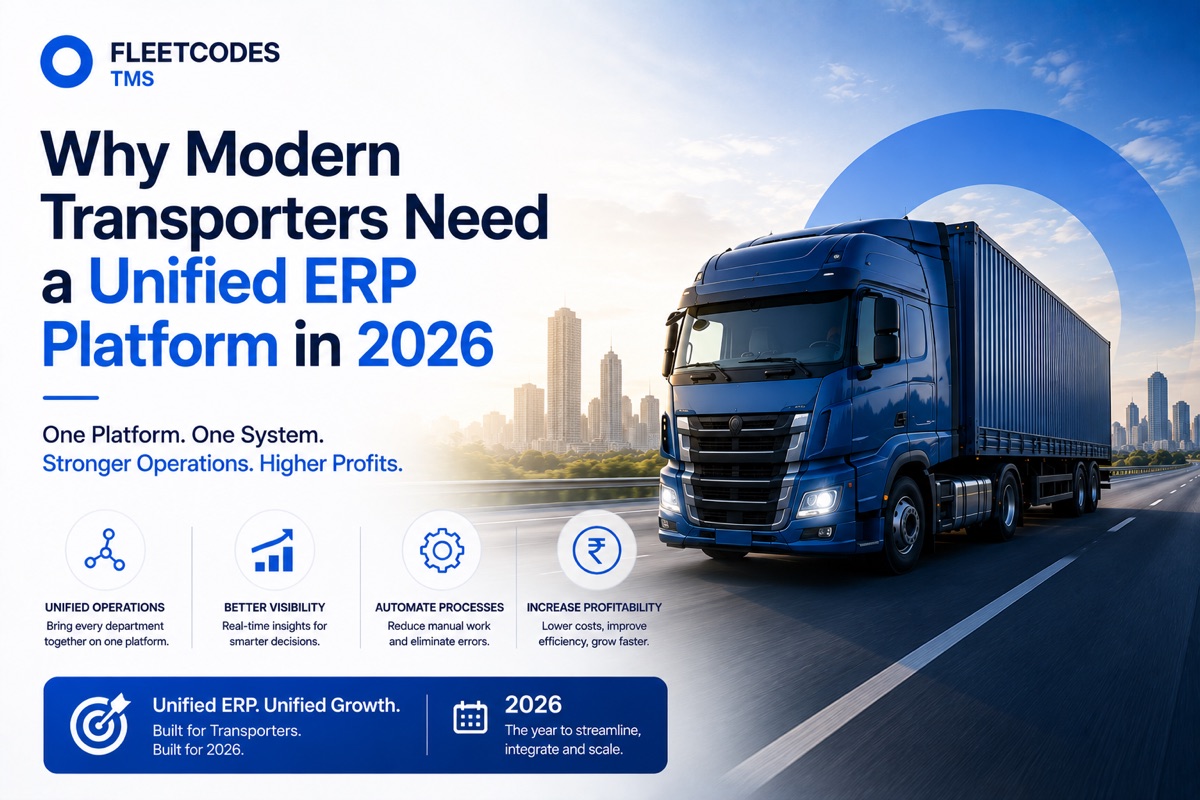
Running your logistics business on five disconnected tools isn't a systems problem — it's a profitability problem. In 2026, the transporters winning on margin are the ones operating on a unified ERP platform.
The Fragmented Systems Problem in Indian Transport
Picture a typical mid-size transport business in India. They have a GPS platform for tracking. A separate accounting tool for invoicing. A spreadsheet (or two) for dispatch planning. A WhatsApp group for driver communication. And a standalone payroll system for settlements.
Each system works in isolation. None of them talk to each other. Data that exists in the GPS platform has to be manually re-entered into the accounting tool. Driver trip records have to be exported, reformatted, and imported into payroll. Customer invoices have to be manually reconciled against rate agreements stored in a separate spreadsheet.
This is the operational reality for the majority of Indian transport businesses — and it has a direct, measurable cost in staff time, billing errors, delayed payments, and management decisions made on incomplete information.
The solution is a unified ERP platform — a single system that connects every function of the business — and in 2026, it's no longer a luxury reserved for large enterprises. It's the foundation of any transport business that wants to operate competitively.
See how Fleetcodes delivers a unified ERP platform for transporters → Book a Demo
ERP Platform Definition: What It Means for a Transport Business
An ERP platform definition in its broadest sense is an Enterprise Resource Planning system — software that integrates all core business functions into one connected platform. For a manufacturing company, that means finance, inventory, HR, and production. For a transport business, it means something more specific:
A unified ERP platform for logistics connects:
- Operations — dispatch, trip management, route planning, vehicle allocation
- Finance — customer billing, invoice generation, accounts receivable, GST compliance
- Driver management — trip assignments, expense claims, settlement calculations, attendance
- Fleet management — vehicle maintenance schedules, fuel tracking, cost-per-km analytics
- Customer experience — booking portal, real-time tracking, digital POD, invoice delivery
- Reporting and analytics — profit per trip, fleet utilisation, delivery performance, cost trends
When all of these functions live in one ERP software platform, data flows automatically between them. A trip created in operations instantly exists in billing. A POD confirmed by a driver instantly triggers an invoice. A vehicle flagged for maintenance is instantly removed from dispatch availability.
This is the difference between a connected business and a fragmented one.
Types of ERP Platforms: Why Transport Needs a Specialist Solution
Understanding the types of ERP platforms available helps explain why generic ERP isn't always the right answer for transport businesses.
Generic Enterprise ERP (SAP, Oracle, Microsoft Dynamics) Powerful and comprehensive, but built for manufacturing and retail. Adapting these platforms to transport operations requires expensive customisation, long implementation timelines (often 12–18 months), and ongoing IT support that most transport businesses can't afford.
Accounting-Led ERP (Tally, Zoho Books, QuickBooks) Strong on the financial side, but with minimal operational functionality. You still need separate tools for dispatch, tracking, and driver management — which brings back the fragmentation problem.
GPS-Centric Fleet Platforms Good for vehicle tracking, but thin on the business-process side. Billing, HR, and financial reporting still need to be handled elsewhere.
Transport-Specialist ERP / TMS Platforms (like Fleetcodes) Built from the ground up for the specific workflows of a transport business. These platforms handle operational and financial processes in one place — with the compliance requirements, vehicle types, and business logic that Indian transport businesses actually need.
For most Indian transporters, a transport-specialist ERP software platform delivers the best combination of operational depth, deployment speed, and commercial viability.
The Case for a Cloud ERP Platform in 2026
A cloud ERP platform delivers advantages that on-premise or server-based systems simply cannot match — and in 2026, the cloud is the only practical choice for most transport businesses.
Access from anywhere. Your operations manager can check fleet status from a site visit. Your MD can review the P&L on a phone. Your driver can update trip status from a highway. A cloud ERP platform makes the entire business accessible to everyone who needs it — from any device, anywhere.
No IT infrastructure. Cloud platforms require no servers, no IT department, and no maintenance overhead. Updates happen automatically. Backups are handled by the provider. Your team focuses on logistics, not on keeping software running.
Scale without re-implementation. Adding 50 vehicles to a cloud ERP platform means logging in and adding them — not purchasing new server capacity or re-licensing software. As your fleet grows, your platform grows with it.
Integration with modern tools. A cloud ERP platform connects easily with GPS hardware, government portals (for e-way bill), payment gateways (for FASTag and toll management), and bank APIs — creating a genuinely connected operational ecosystem.
Fleetcodes is built as a cloud-first ERP integration platform — giving transporters the full operational and financial depth of an enterprise system with the deployment simplicity of a modern SaaS product.
ERP Integration Platform: How Fleetcodes Connects Your Operation
The value of an ERP integration platform for transport businesses isn't just in what it does internally — it's in how it connects to the external systems and services your operation depends on.
Fleetcodes integrates with:
| System | Integration Type | Business Value | |---|---|---| | GPS / Telematics providers | Real-time data feed | Live vehicle tracking in dispatch dashboard | | Government e-way bill portal | Direct API | E-way bill generation without separate login | | FASTag / NETC | Payment integration | Automated toll tracking and cost allocation | | Accounting software | Bi-directional sync | Invoices and payments sync without re-entry | | Customer ERP systems | API connection | Direct order intake from large shippers | | Bank payment portals | Settlement integration | Driver payment disbursement from within platform |
This is the ERP integration platform model — not a standalone tool, but a connected hub that eliminates the gaps between the systems your business runs on.
What a Unified ERP Transforms in Your Daily Operations
Here's a before-and-after picture of how a transport business changes when it moves to a unified erp platform:
Before (Fragmented Systems)
- Dispatcher checks GPS platform, switches to spreadsheet, calls driver, manually enters load into billing tool — 4 systems for one trip
- Accounts team waits for paper POD before invoicing — 3–5 day billing delay
- Driver settlement requires manual tally of trip sheets, advances, and expenses — weekly process, prone to disputes
- MD reviews end-of-month report assembled manually from multiple systems — always looking backward, never real-time
After (Fleetcodes Unified ERP Platform)
- Dispatcher views all vehicle positions, load assignments, and availability in one screen
- Digital POD triggers invoice automatically — same-day billing
- Driver settlement calculated automatically at trip completion — transparent, auditable
- MD views live P&L, fleet utilisation, and cost trends on a real-time dashboard
The shift isn't just efficiency — it's the quality of decisions the business makes, and the speed at which it can respond to operational problems.
FAQs
What is an ERP platform definition for transport businesses? For a transport business, an ERP platform is an integrated software system that connects operations (dispatch, tracking, trip management), finance (billing, invoicing, settlements), driver management, and fleet management in one place — eliminating the need for multiple disconnected tools.
What are the types of ERP platforms available for Indian transporters? The main types include generic enterprise ERP (SAP, Oracle), accounting-led ERP (Tally, Zoho), GPS-centric fleet tools, and transport-specialist platforms like Fleetcodes. For most Indian transporters, a specialist transport ERP delivers the best combination of operational depth and deployment speed.
Why is a cloud ERP platform better than an on-premise system? A cloud ERP platform eliminates IT infrastructure costs, enables access from any device, scales without re-implementation, and integrates easily with external services like GPS, e-way bill portals, and payment systems — making it the practical choice for growing transport businesses.
How does an ERP integration platform reduce manual work? By connecting dispatch, GPS tracking, billing, driver management, and accounting in one system, an ERP integration platform eliminates the manual re-entry of data between tools — reducing errors, speeding up billing, and freeing staff to focus on operations rather than administration.
Is Fleetcodes a full ERP software platform or just a TMS? Fleetcodes is a transport-specialist ERP software platform. It covers the full operational and financial cycle of a transport business — from dispatch and tracking to billing, driver settlement, fleet maintenance, and management reporting — making it a complete operational foundation, not just a trip management tool.
One platform. Every function. Zero fragmentation. Book Your Free Fleetcodes Demo →