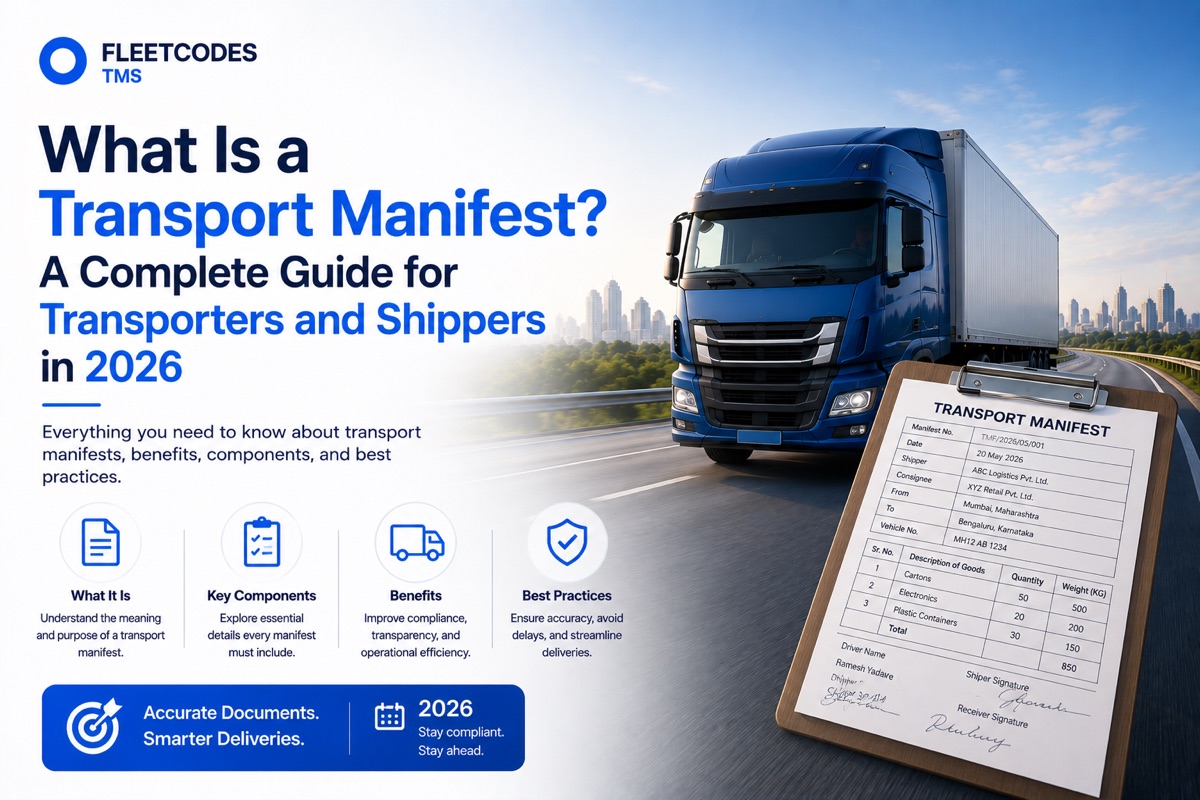
A transport manifest is one of the most important documents in logistics — and one of the most commonly misunderstood. Whether you're moving goods across a city or across borders, getting your manifest right protects your business legally and operationally.
What Is a Transport Manifest?
A manifest is a document that lists all the cargo carried by a vehicle, vessel, or aircraft on a specific journey. In road transportation, it's a formal record of every consignment loaded onto a truck — including the shipper, recipient, nature of goods, quantities, weight, and declared value.
For transporters and shippers in India, the manifest serves multiple purposes simultaneously:
- It's an operational document — giving the driver, carrier, and recipient a clear record of what's been loaded and what must be delivered
- It's a legal document — providing evidence of the contract of carriage between the shipper and the transporter
- It's a compliance document — required by customs authorities, tax departments, and transport regulators for certain cargo types and routes
- It's a financial document — forming the basis for freight billing and insurance claims
Understanding the manifest — its types, its legal requirements, and how to manage it efficiently — is essential for any logistics business operating in India in 2026.
See how Fleetcodes automates manifest generation and management → Book a Demo
Types of Transport Manifests
Road Transport Manifest
The standard manifest for truck movements — listing all consignments, their origins and destinations, goods descriptions, and carrier details. In India, this works in conjunction with the e-way bill for GST compliance.
Container Manifest
A container manifest is a document specific to containerised cargo — whether in road container transport, rail freight, or sea shipping. It lists every item packed within a container, including packaging details, commodity codes, and shipper/consignee information.
For international shipments, the container manifest is a critical document for customs clearance — customs authorities use it to verify that the declared contents match what's physically in the container. Errors, omissions, or discrepancies in a container manifest can result in customs holds, fines, and significant delays.
Customs Manifest
A customs manifest is a declaration submitted to customs authorities for cross-border movements — listing all goods entering or exiting a country. It includes detailed commodity descriptions, HS codes, declared values, and country of origin.
For Indian importers and exporters, customs manifest rules are governed by the Customs Act, 1962, and must be filed with the appropriate customs authority at the port of entry or exit. Non-compliance carries serious legal consequences — including seizure of goods and penalties.
Multi-Modal Manifest
When cargo moves across multiple modes of transport (road + rail, or road + sea), a multi-modal manifest consolidates the cargo record across the entire journey — ensuring continuity of documentation even as the goods change carriers.
What Must a Transport Manifest Include?
For Indian road transport, a properly structured manifest should include:
Carrier Information
- Transporter name, address, and registration
- Vehicle registration number
- Driver name and licence number
- Trip start date and expected delivery date
Consignment Details (for each item/shipment)
- Consignor (shipper) name and address
- Consignee (recipient) name and address
- Description of goods
- Quantity, weight, and volume
- Declared value
- E-way bill number (for GST-applicable goods)
- Any special handling instructions (hazardous material, fragile, temperature-sensitive)
Route Information
- Origin point
- Destination(s)
- Intermediate stops if applicable
- State border crossings (relevant for e-way bill validity)
Legal and Compliance References
- LR (Lorry Receipt) numbers for each consignment
- Insurance policy reference
- Relevant permits for controlled cargo
Missing or incorrect information in any of these fields can create legal complications at checkpoints, during customs inspections, or in the event of a cargo dispute or insurance claim.
The Legal Dimension: Why the Manifest Matters Under Indian Transport Rules
Under Indian transportation rules and the Motor Vehicles Act, carriers are required to carry documentation for all goods in transit. The manifest — combined with the e-way bill — forms the core of this documentation requirement.
Specific legal implications of manifest management include:
GST Compliance For goods valued above ₹50,000 (and for certain categories regardless of value), an e-way bill is required. The manifest must reference the applicable e-way bill numbers — and the physical goods must match the declared description. Mismatches are treated as GST evasion, with serious financial penalties.
Customs Authority Requirements For goods subject to customs control — including imported goods moving from ports to inland destinations, or exports moving to ports — the manifest must comply with customs authorities' documentation requirements. Customs officials have the right to inspect cargo against the manifest at any point — and discrepancies can result in seizure.
Carrier Liability The manifest establishes what the carrier accepted custody of. In the event of loss, damage, or theft, the manifest is the primary document establishing the carrier's liability. An accurate, detailed manifest protects both the carrier (by establishing what was actually loaded) and the shipper (by creating a clear record of what was consigned).
Insurance Claims Most cargo insurance claims require the manifest as supporting documentation. An inaccurate or incomplete manifest can complicate or invalidate an insurance claim.
How Fleetcodes Automates Transport Manifest Management
Managing manifests manually — typing consignment details, printing documents, distributing to drivers, and filing copies — is time-consuming and error-prone. For a fleet handling dozens of loads per day, manual manifest management is a significant back-office burden.
Fleetcodes automates the entire manifest workflow:
Automatic Manifest Generation When a trip is created in Fleetcodes, the system automatically compiles the manifest from the consignment data already entered — carrier details, vehicle, driver, consignor, consignee, goods description, e-way bill references. No separate document creation required.
Digital Distribution The manifest is available digitally to the driver on the Fleetcodes driver app — eliminating the need for printed documents (while still generating a printable version when required by authorities). The driver carries the complete documentation on their phone, accessible even offline.
E-Way Bill Integration Fleetcodes integrates directly with the GST e-way bill portal — generating or referencing e-way bills within the trip record and including them automatically in the manifest. This eliminates a separate step that most transporters currently handle manually through the GST portal.
Compliance Tracking For multi-state trips, Fleetcodes tracks e-way bill validity against the journey's expected duration and flags extensions needed before expiry — protecting transporters from compliance violations at state borders.
Digital Archive Every manifest generated in Fleetcodes is stored digitally and searchable by vehicle, date, consignee, or route — making document retrieval for audits, disputes, or insurance claims instant rather than a filing cabinet search.
Container Manifest and Customs: Special Considerations
For transporters handling container movements — particularly those involving imports and exports — the container manifest and customs documentation requirements add additional layers of complexity.
Fleetcodes supports container transport workflows with:
- Container number and seal number tracking within the trip record
- Documentation fields for HS codes and customs references
- Integration with bonded warehouse and CFS (Container Freight Station) workflows
- Customs authority reference documentation generated from trip data
For transporters regularly handling import/export container transportation, this capability reduces the manual documentation burden significantly — and ensures that customs authorities receive accurate, consistent information derived from the same source as your operational records.
FAQs
What is a transport manifest in simple terms? A transport manifest is a document listing all goods carried on a vehicle for a specific trip — including what's being transported, who sent it, who receives it, and where it's going. It's both a practical record for the carrier and a legal compliance document for tax and customs authorities.
What is a container manifest and when is it required? A container manifest is a detailed cargo list specific to containerised shipments. It's required for all container movements, particularly those crossing international borders, where customs authorities use it to verify cargo contents against declared information.
What are the legal requirements for transport manifests in India? In India, road transport manifests must comply with the Motor Vehicles Act documentation requirements and GST e-way bill rules. For customs-controlled goods, additional customs authority documentation requirements apply under the Customs Act, 1962.
How does Fleetcodes help with manifest compliance? Fleetcodes automatically generates manifests from trip data, integrates with the GST e-way bill portal, tracks e-way bill validity on multi-state routes, and stores all documentation digitally — reducing compliance risk and eliminating manual document management.
What happens if a transport manifest is incorrect? An incorrect manifest can result in GST penalties for mismatched e-way bill details, customs holds and fines for international cargo, complications in cargo insurance claims, and carrier liability disputes. Accurate manifest generation — which Fleetcodes automates — is essential for legal protection and smooth operations.
Compliant documentation. Automated generation. Zero manual filing. Book Your Free Fleetcodes Demo →