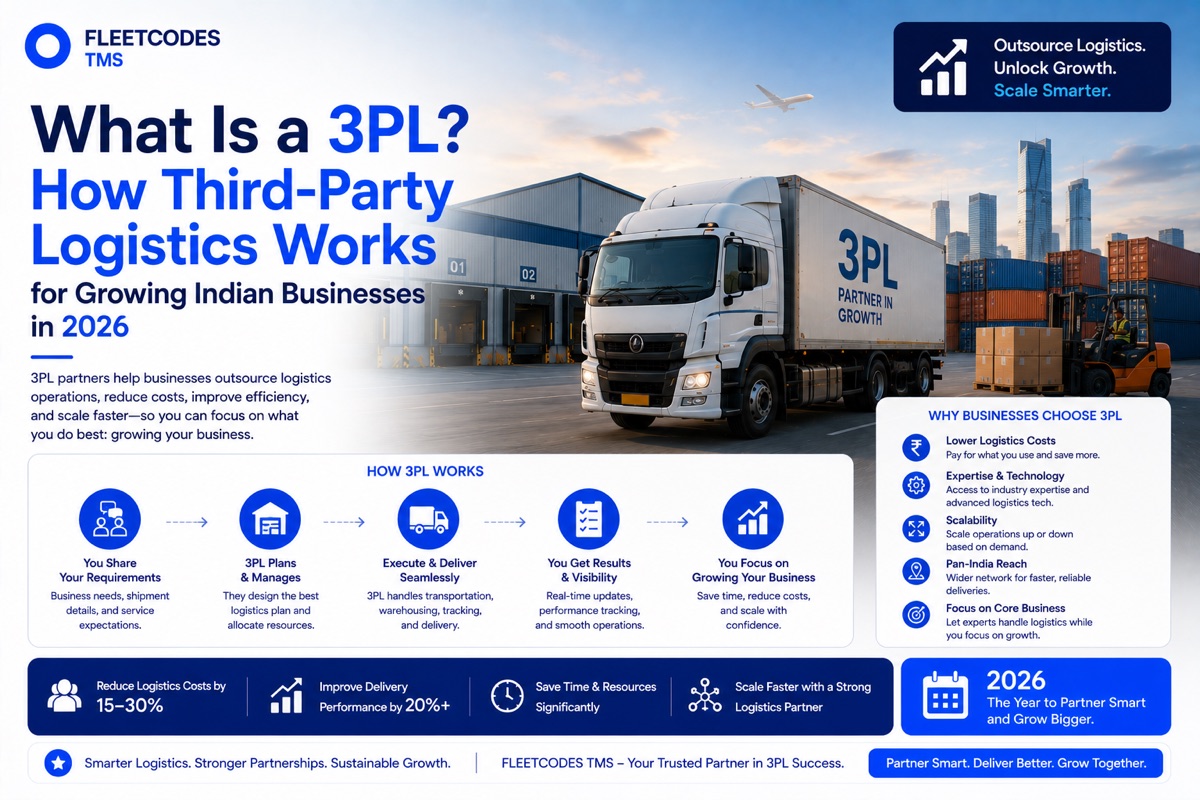
India's third-party logistics market is valued at $36 billion in 2026, growing at 6–14% CAGR toward a projected $48–73 billion by 2030. Understanding what a 3PL is — and when it makes more sense than running your own fleet — is now a fundamental business decision for every growing company in India.
3PL Definition: What It Actually Means
A 3PL India — Third-Party Logistics provider — is a company that provides logistics services on behalf of another business. Instead of a company managing its own warehousing, transportation, and supply chain operations, it contracts these functions out to a specialist logistics provider.
The "third party" terminology reflects the three parties involved: the seller (first party), the buyer (second party), and the logistics company managing the movement between them (third party).
In India, third party logistics India spans a wide spectrum of services — from simple trucking contractors who carry goods from A to B, to sophisticated integrated operators who manage warehousing, inventory, pick-and-pack, multi-modal transport, customs clearance, and returns processing in a single managed service.
The Four Types of Logistics Models in India
To understand 3PL, it helps to understand the full spectrum of logistics models:
1PL — First-Party Logistics
The business owns and operates its own transport and logistics infrastructure entirely. A manufacturing company with its own fleet of trucks and warehouses is a 1PL. Complete control, but also complete capital and operational responsibility.
2PL — Second-Party Logistics
The business contracts specific logistics assets — such as trucks or warehouse space — from a provider, but retains operational management. Leasing a fleet from a vehicle financing company and operating it yourself is a 2PL model.
3PL — Third-Party Logistics
The business outsources specific logistics functions to a specialist provider who takes operational responsibility. The 3PL provider brings its own assets, systems, and expertise. The contracting company pays for the service rather than owning the infrastructure.
4PL — Fourth-Party Logistics
A 4PL (or Lead Logistics Provider) manages the entire supply chain on behalf of a company — including coordinating multiple 3PL providers. The 4PL does not necessarily own assets but acts as the strategic integrator of the logistics network.
What Indian 3PL Providers Actually Offer in 2026
The range of 3PL companies India services has expanded significantly. A modern 3PL in India may offer:
Transportation management: Managing the movement of goods from origin to destination — including carrier selection, route planning, freight rate negotiation, and shipment tracking. This is the core of most 3PL relationships in India.
Warehousing and distribution: Managing warehouse operations — receiving, storage, inventory management, order picking, packing, and despatch — on behalf of the client. Many 3PLs operate multi-client warehouses where space is shared across clients.
Value-added services: Activities like kitting, labelling, re-packaging, quality inspection, returns processing, and product customisation at the warehouse level.
Technology and visibility: Providing clients with shipment tracking, inventory visibility, order management portals, and performance reporting through a TMS or WMS platform.
Cold chain and specialised logistics: Temperature-controlled transport and storage for pharma, food, and agricultural customers.
Cross-border and customs: For import/export customers, managing customs clearance, documentation, and multi-modal coordination to and from Indian ports and airports.
3PL vs In-House Logistics: The Core Decision Framework
For any growing Indian business, the decision between 3PL vs in-house logistics is one of the most financially significant strategic choices in supply chain design. Neither option is universally better — the right answer depends on your specific situation.
Arguments for Using 3PL
Capital efficiency: Building and operating your own fleet requires significant upfront and ongoing capital investment — vehicle acquisition, maintenance infrastructure, driver recruitment and management, TMS systems, and depot facilities. A 3PL converts these fixed costs into variable costs that scale with volume.
Speed to scale: Adding logistics capacity through a 3PL is faster than acquiring vehicles, hiring drivers, and building operational capability from scratch. For businesses in rapid growth phases, 3PL can provide logistics capacity that the business could not build fast enough internally.
Geographic coverage: A 3PL with an established pan-India network can provide coverage in regions where building your own operational presence would take years. For businesses expanding into new states or tier-2/3 cities, 3PL provides immediate reach.
Compliance and expertise: A specialist 3PL brings expertise in regulatory compliance (e-way bills, GST logistics, customs), specialised handling requirements, and industry-specific logistics knowledge that a business building its first logistics function may lack.
Focus: Running a logistics operation is a full-time management challenge. Outsourcing it allows a company to focus management attention on its core competency — manufacturing, retail, technology, or whatever the business actually does.
Arguments for In-House Fleet and TMS
Control and visibility: When logistics is core to your customer value proposition — when delivery speed, cargo safety, and service consistency are what differentiate your business — ceding operational control to a 3PL introduces a dependency that some businesses cannot afford. With your own fleet and TMS, you control every variable.
Margin retention: 3PL pricing includes the provider's margin. Businesses that reach sufficient logistics volume often find that in-house operations at the same volume are meaningfully more cost-effective — particularly when fleet management vs 3PL economics are modelled with proper cost accounting.
Brand and customer experience: A driver who works for you, drives a vehicle branded with your logo, and uses your processes creates a customer experience that a contracted 3PL driver on a shared fleet cannot replicate.
Data ownership: When your logistics is operated by a 3PL, the operational data — delivery times, route performance, driver behaviour, exception rates — belongs to the 3PL. With your own TMS, that data is yours — and it is one of the most valuable operational assets a logistics business accumulates over time.
Long-term economics: For businesses with predictable, consistent logistics volumes above a certain threshold, the per-trip economics of operating your own fleet — especially with modern TMS automation reducing overhead — are typically better than paying a 3PL margin on top of those same costs.
When the 3PL vs Own Fleet Decision Tips Each Way
| Factor | 3PL Makes More Sense | Own Fleet Makes More Sense | |---|---|---| | Volume | Variable, unpredictable, or growing rapidly | Stable, predictable, above breakeven threshold | | Geography | Multi-region, new territories | Established lanes and routes | | Capital | Limited capital; variable cost preferred | Capital available; fixed asset investment justified | | Management bandwidth | Core team focused on non-logistics | Logistics is core competency | | Service requirements | Standard handling | Specialised handling, brand-critical delivery | | Growth stage | Early-stage, pre-scale | Established, scaling efficiently |
How Modern TMS Changes the In-House Economics
One of the most significant changes to the logistics outsourcing India decision in 2026 is the accessibility of fleet management technology that was previously available only to large enterprises.
A decade ago, operating your own fleet efficiently required either a large investment in enterprise TMS software or an experienced operations team that could manage complexity manually. Neither was accessible to most growing Indian businesses.
Today, cloud-based in-house transport management platforms like Fleetcodes give businesses of any size access to AI-powered dispatch, real-time tracking, automated billing, digital POD, and management analytics — at a per-vehicle subscription cost that makes in-house operations economically competitive with 3PL at much lower volumes than previously.
The practical implication: the volume threshold at which owning your own fleet becomes more cost-effective than using a 3PL has fallen significantly. For a business running consistent volumes on fixed lanes with predictable cargo — in FMCG distribution, industrial supply, or retail replenishment — in-house fleet operations supported by modern TMS are often more economical than 3PL above 20–30 vehicles.
For Transporters: How 3PL Growth Creates Opportunity
For Indian transport businesses, the 3PL market growth is not just context — it is a commercial opportunity. The growing sophistication of shipper requirements is pushing the market toward 3PL providers who can offer:
- Integrated TMS with customer-facing visibility portals
- Digital documentation (e-way bill, digital bilty, digital POD)
- Performance reporting with on-time delivery rates, damage rates, and invoice accuracy metrics
- Specialised handling capability (cold chain, hazardous, oversized)
Transporters who build these capabilities — and can demonstrate them through a technology platform — are increasingly positioned to win 3PL contracts from shippers who previously used only large integrated providers.
The technology foundation that makes a transport business competitive in the 3PL market is the same TMS platform that makes their own fleet operations efficient. Investment in the right operational technology is investment in both directions simultaneously.
FAQs
What is a 3PL in simple terms? A 3PL (Third-Party Logistics provider) is a company that manages logistics operations — transport, warehousing, distribution — on behalf of another business. Instead of the business running its own logistics function, it contracts the service to a specialist provider.
What is the 3PL market size in India in 2026? India's 3PL market is valued at approximately $36 billion in 2026, growing at a CAGR of 6–14% with projections of $48–73 billion by 2030. Growth is driven by e-commerce expansion, organised retail, pharmaceutical logistics, and the shift toward outsourced supply chain management.
When does it make more sense to use a 3PL than to run your own fleet? 3PL typically makes more sense when: logistics volumes are variable or unpredictable, the business is in a rapid growth phase requiring fast capacity addition, geographic coverage is needed in new regions before own-fleet presence is built, or management bandwidth is better directed at core business activities.
How has technology changed the in-house vs 3PL decision? Modern cloud-based TMS platforms have made in-house fleet operations economically viable at much smaller scales than previously — because the overhead of managing a fleet efficiently no longer requires a large operations team or enterprise software investment. At consistent volumes above approximately 20–30 vehicles on fixed lanes, in-house operations with good TMS are often more cost-effective than 3PL.
Can a transporter position themselves as a 3PL provider? Yes. Transporters who invest in TMS technology, digital documentation, customer visibility portals, and performance reporting can position their services as managed 3PL rather than simple carrier — accessing higher-value contracts and less price-competitive procurement processes.
Whether you are evaluating 3PL for your business or building 3PL capability as a transporter, the technology foundation is the same: connected, data-driven fleet operations. See How Fleetcodes Powers Both Own-Fleet and 3PL Operations →