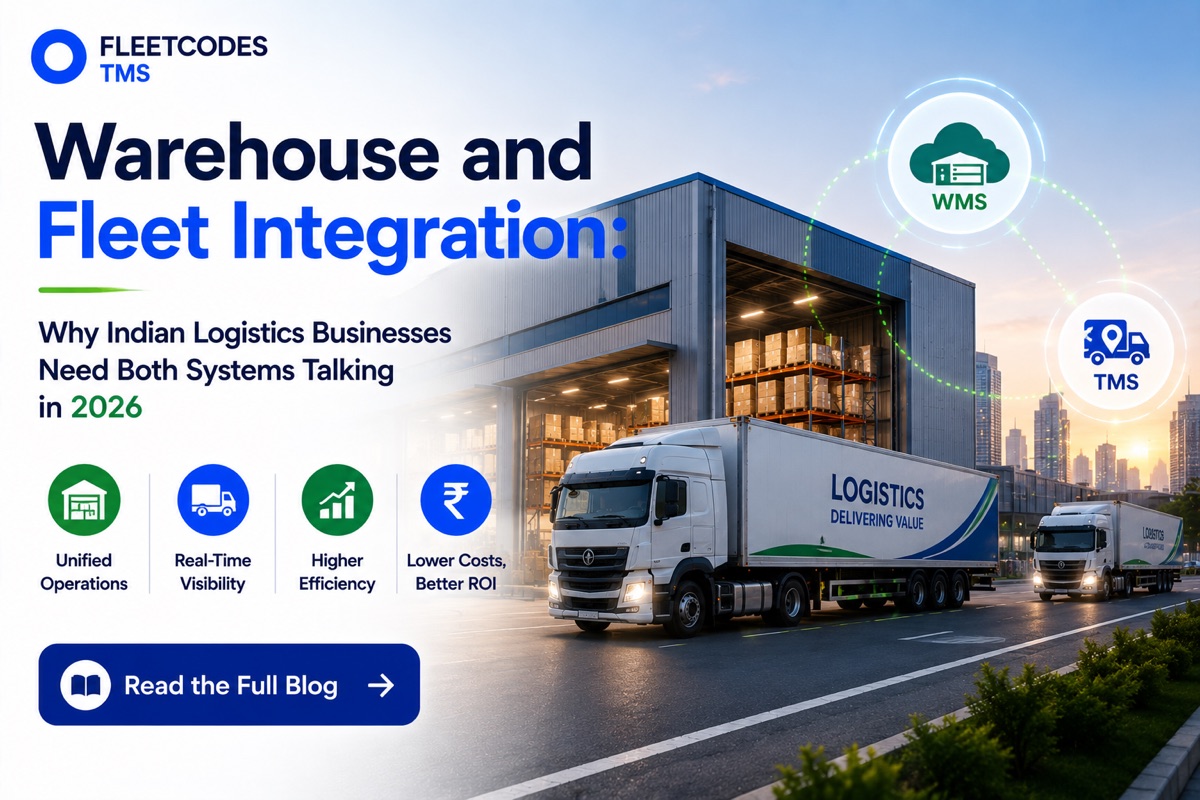
A warehouse that knows what is being picked but not when the truck is arriving. A fleet that knows when the truck will arrive but not what it will be carrying. This is the operational disconnect that India's most competitive logistics businesses are eliminating in 2026 — and the gap it creates costs more than most operations have ever measured.
The Warehouse-Fleet Disconnect in Indian Logistics
Walk through the operations of a typical Indian logistics business and you will find two operational worlds running in parallel:
The warehouse world: Goods are received, stored, picked, packed, and staged for despatch. The warehouse team knows what is outbound today, what the load contents are, what the customer's requirements specify, and what documentation the goods need. This world is managed through a WMS (Warehouse Management System) — or more commonly in mid-size Indian operations, through spreadsheets and physical staging areas.
The fleet world: Trucks are dispatched, drivers are assigned, routes are planned, and deliveries are executed. The fleet team knows which vehicles are available, which drivers are on duty, which routes are efficient, and what the delivery commitments are. This world is managed through a TMS (Transport Management System) — or in many operations, through a dispatcher's phone, WhatsApp, and memory.
The gap between these two worlds — the handoff point where goods move from warehouse responsibility to fleet responsibility — is where operational problems accumulate:
- Trucks arrive at the loading dock before the consignment is staged — waiting time burns fuel and driver hours
- Consignments leave the warehouse before the e-way bill is generated — creating a compliance gap at dispatch
- The fleet team does not know the load weight breakdown until the truck is loaded — making vehicle selection and GVW compliance checks reactive rather than proactive
- The warehouse team stages a 15-stop delivery in load order — not in delivery sequence — forcing the driver to work through a non-optimised stop order
Each of these friction points is a productivity and cost loss. Collectively, they represent a significant operational overhead that integrated warehouse fleet integration eliminates.
What Integration Between WMS and TMS Actually Delivers
When warehouse management and fleet management systems share data in real time, the operational picture transforms:
Dispatch Planning Before Loading
In an integrated system, the fleet team sees the outbound orders scheduled for despatch hours before the warehouse begins picking. This means:
- Vehicle selection and driver assignment can be done based on the actual load requirements — cargo type, total weight, number of stops — not approximations
- Route optimisation runs against the actual delivery list — not a planned list that may differ from what is actually packed
- E-way bills can be generated from the confirmed order data before the truck is loaded — not as a last-minute departure task
- GVW compliance can be verified against the confirmed load weight before any goods are staged for a specific vehicle
This pre-despatch planning window — created by data sharing between warehouse and fleet — is where the most significant operational efficiency gains are captured.
Real-Time Load Status Visibility
When the warehouse staging system communicates load completion status to the fleet management platform, the dispatcher knows when a consignment is ready for pickup — and can sequence truck arrivals accordingly.
Instead of trucks queuing at the loading dock because they arrived before the goods were ready (a common cause of unnecessary driver detention at origin), truck arrival times are coordinated with actual load readiness. The result is faster loading, less vehicle idle time, and drivers who are on the road — earning — rather than waiting at a dock.
Digital Handoff Documentation
The warehouse-to-fleet handoff is a legal event: the moment the transporter takes custody of the goods and signs the bilty. In a paper-based operation, this handoff involves physical documents that travel with the consignment. Errors in these documents — wrong weight, missing items, incorrect consignee details — are discovered at delivery, not at loading.
In an integrated digital system, the handoff documentation is generated from the same data source used for warehouse management — consignment details, quantity, weight, value — automatically creating the bilty and e-way bill from verified source data without manual re-entry.
Delivery Confirmation Back to Warehouse
The integration flows in both directions. When a driver confirms delivery through the fleet management app — capturing digital POD — that confirmation should flow back to the warehouse and WMS to:
- Close the outbound order in inventory records
- Trigger customer invoicing from a single confirmed delivery event
- Update returns and reverse logistics records if any part of the delivery is refused
- Feed delivery performance data — actual vs promised delivery time — into management reporting
Without this reverse data flow, warehouse operations and fleet operations are managing their records independently — creating reconciliation work at every month end and compliance risk at every customer audit.
The Integration Architecture: How It Works in Practice
Full WMS-TMS integration in an Indian logistics business involves connecting several data flows:
| Data Flow | Direction | What It Enables | |---|---|---| | Outbound order list | WMS → TMS | Pre-despatch vehicle planning and route optimisation | | Confirmed load weight & contents | WMS → TMS | GVW compliance check, e-way bill generation | | Load staging completion status | WMS → TMS | Coordinated truck arrival scheduling | | Vehicle assignment and ETA | TMS → WMS | Loading dock scheduling, staff allocation | | Departure confirmation | TMS → WMS | Inventory status update (goods in transit) | | Digital POD and delivery confirmation | TMS → WMS | Outbound order closure, invoice trigger | | Return receipt confirmation | TMS → WMS | Reverse logistics processing, credit note trigger |
Each of these flows, when manual, requires a staff action — a phone call, a WhatsApp message, a spreadsheet entry. When automated through system integration, they happen at the speed of data.
The Indian Context: Why This Matters More Here
Warehouse and fleet integration is important everywhere in logistics. In the Indian context, several specific factors make it particularly valuable:
E-way bill compliance: The e-way bill must be generated before goods move. In a disconnected system, generating the e-way bill requires manually entering consignment details that the warehouse system already has. Integration eliminates this re-entry and ensures e-way bills are generated from verified, accurate data rather than approximations.
Multi-client warehousing: Many Indian 3PLs and logistics businesses operate multi-client warehouses where goods from multiple shippers are stored and despatched from the same facility. In this environment, getting the right goods onto the right truck — with the right documentation for each shipper — is operationally complex and error-prone without system integration.
High documentation complexity: Indian road freight documentation — bilty, e-way bill, manifest, delivery challans — requires accurate, consistent data across multiple documents for each consignment. Integration ensures this data is generated from a single source and is consistent across all documents.
Customer SLA visibility: Enterprise shipper customers increasingly require real-time visibility from order placement through warehouse confirmation to delivery confirmation. This end-to-end visibility chain requires warehouse and fleet systems to share data in a way that supports a single customer-facing visibility interface.
How Fleetcodes Integrates with Warehouse Operations
Fleetcodes is designed with an open API architecture that enables integration with warehouse management systems — sharing the data flows described above without requiring custom development projects.
Inbound integration (WMS → Fleetcodes):
- Confirmed outbound order list with consignment details, weight, and delivery addresses
- Load staging completion status
- Returns inbound notifications
Outbound integration (Fleetcodes → WMS):
- Vehicle assignment and estimated loading time
- Departure confirmation with driver and vehicle details
- Digital POD and delivery confirmation data
- Exception notifications (delivery failed, rescheduled)
For logistics businesses that do not yet have a formal WMS, Fleetcodes manages consignment details, load records, and delivery documentation within the platform — providing the TMS layer that connects to whichever warehouse management tool the business uses, from enterprise WMS to structured spreadsheets.
The goal is not to replace warehouse management software. It is to ensure that the fleet management layer and the warehouse management layer share the data they each need to operate efficiently — eliminating the manual bridges that currently connect them.
FAQs
What is the difference between a WMS and a TMS? A WMS (Warehouse Management System) manages goods within a warehouse — receiving, storage, picking, packing, and staging for despatch. A TMS (Transport Management System) manages the movement of goods from the warehouse to the destination — dispatch planning, fleet management, route optimisation, driver management, and delivery confirmation. Together they cover the full outbound supply chain.
Why do Indian logistics businesses need WMS and TMS to be integrated? Without integration, the two systems operate with data gaps between them — requiring manual communication at every handoff point. This creates dispatch planning inefficiencies, e-way bill compliance risks, GVW compliance gaps, and delivery data reconciliation work. Integration eliminates these manual bridges and creates a continuous, accurate data flow from order creation to delivery confirmation.
How does warehouse-fleet integration affect e-way bill compliance? In an integrated system, e-way bills are generated automatically from the confirmed consignment data in the warehouse system — before the truck departs — without manual re-entry. This eliminates the most common source of e-way bill data errors and ensures bills are always generated before goods move.
Does Fleetcodes integrate with warehouse management systems? Yes. Fleetcodes has an open API architecture that enables integration with WMS platforms, sharing outbound order data, load staging status, departure confirmation, and delivery confirmation data in both directions. For businesses without a formal WMS, Fleetcodes manages consignment and load data within the platform.
What is the ROI of warehouse-fleet integration for an Indian logistics business? The ROI comes from: reduced vehicle idle time at loading docks (fuel and driver cost saving), elimination of e-way bill re-entry errors (compliance cost saving), proactive GVW compliance checking (penalty avoidance), faster invoice generation from digital delivery confirmation, and elimination of end-of-month reconciliation work between warehouse and fleet records.
A warehouse and a fleet that don't communicate create the gaps where costs hide and customers get disappointed. Integration closes those gaps permanently. See How Fleetcodes Integrates with Your Warehouse Operations →