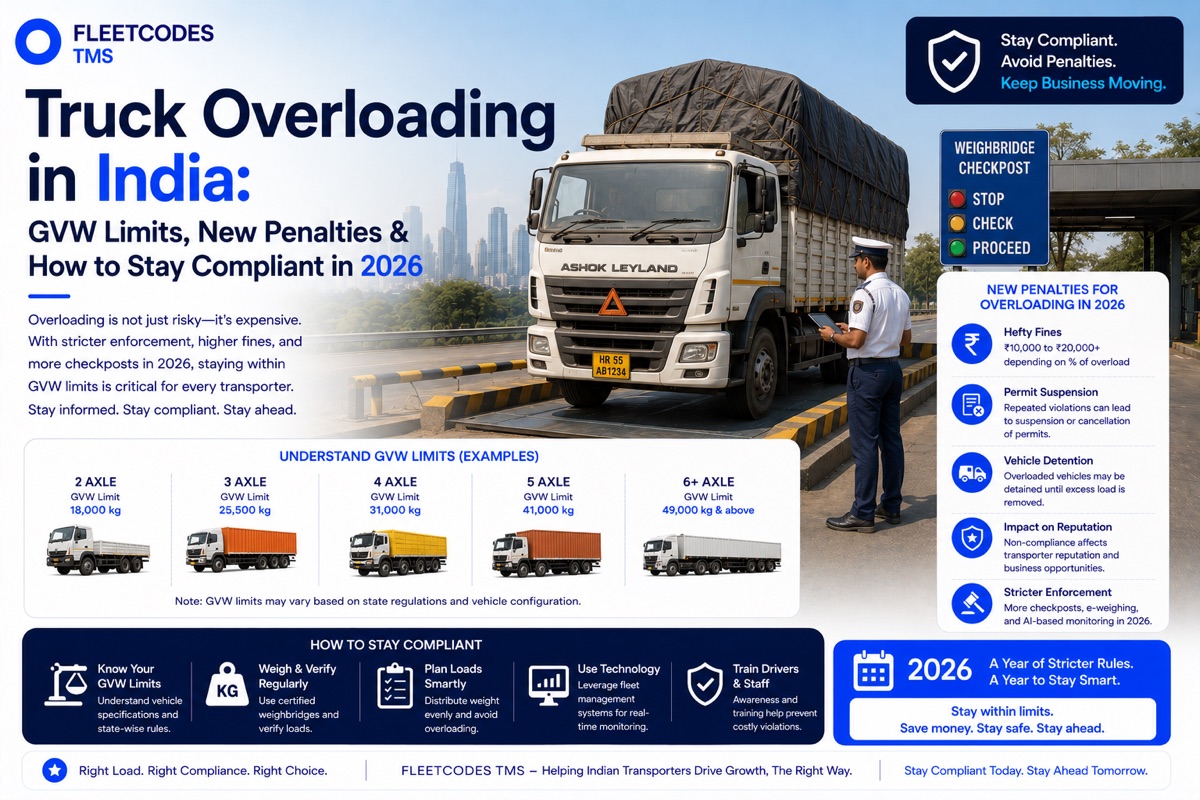
Effective April 2026, India's overloading enforcement framework changed fundamentally. Heavily overloaded trucks now face up to four times the base toll rate — collected automatically via FASTag and recorded permanently in the VAHAN database. The cost of one overloaded trip can now exceed the revenue it generates.
The New Enforcement Reality for Overloading in India
Truck overloading has been a persistent problem in Indian logistics — and a persistent blind spot for fleet operators who treated it as a manageable operational risk. The April 2026 regulatory changes make that calculus obsolete.
The new framework introduced three structural changes that transform overloading from a nuanced compliance issue into a hard financial stop:
Tiered toll penalties up to 4x base rate. Effective April 2026, overloaded vehicles face tiered penalties at toll plazas — with heavily overloaded vehicles paying up to four times the base toll rate. On a highway section where base toll is ₹320 per passage, a heavily overloaded truck now faces a ₹1,280 toll charge for that single passage.
Automatic VAHAN database recording. Overloading violations are now automatically recorded in the VAHAN database — the central government vehicle registry. This creates a permanent compliance history for every vehicle. Repeated violations can affect insurance renewals, permit applications, and fitness certificate issuance. The violation does not disappear when the fine is paid.
FASTag-linked digital enforcement. All overloading penalty payments must be made digitally via FASTag. This eliminates cash settlements at toll plazas and creates a clean digital audit trail of every violation. For fleet operators, this means overloading penalties are now visible in your FASTag transaction records — and therefore in any client compliance audit that reviews those records.
This shift — from manual, discretionary enforcement to standardised, technology-driven, and permanently recorded enforcement — is the most significant overloading compliance change in a decade.
Understanding GVW: What the Law Actually Says
A truck is considered overloaded under Indian law when its laden weight exceeds the Gross Vehicle Weight (GVW) specified in its Registration Certificate (RC).
GVW = Unladen vehicle weight + Fuel + Driver and passengers + All cargo
The GVW limit is printed on every vehicle's RC. It is determined at the time of manufacture and registration and cannot be legally exceeded regardless of road conditions, shipper pressure, or commercial necessity.
The governing legislation is Section 113 of the Motor Vehicles Act, 1988. A tolerance of 5% above GVW is permitted under Section 113(3) — meaning a vehicle with a 30,000 kg GVW can carry up to 31,500 kg without triggering the penalty.
Beyond 5% tolerance, penalties apply.
Current GVW and Axle Load Limits (MoRTH Revised)
MoRTH revised axle load limits upward by 20–25% in July 2018, providing additional legal payload capacity for multi-axle vehicles. The current enforceable limits for common commercial vehicle configurations:
| Vehicle Configuration | Maximum GVW | |---|---| | 2-axle rigid (medium goods vehicle) | 16,200 kg | | 3-axle rigid | 25,000 kg | | 2-axle tractor + semi-trailer (4-axle combination) | 40,000 kg | | 3-axle tractor + semi-trailer (5-axle combination) | 47,000 kg | | 3-axle tractor + 3-axle semi-trailer (6-axle combination) | 55,000 kg |
Critical point: Total GVW compliance is not sufficient. Axle group weight limits (GAWR) are enforced separately. A vehicle can be within total GVW while having an overloaded rear axle group due to uneven load distribution. Enforcement checks both — and an axle overload violation carries the same penalties as total GVW overloading.
The Full Penalty Framework for Overloading in India 2026
Understanding the financial exposure from a single overloading event:
Criminal Fine Under Motor Vehicles Act
| Overload Amount | Fine | |---|---| | First offence (any overload) | ₹20,000 for the first tonne over limit | | Each additional tonne | + ₹2,000 per tonne | | Repeat offence | Fine + potential permit cancellation |
For a 5-tonne overload: ₹20,000 + (4 × ₹2,000) = ₹28,000 fine for a single trip.
Toll Penalty (April 2026 Framework)
Under the new tiered penalty:
- Moderate overload (5–15% above GVW): 2x base toll rate
- Significant overload (15–30% above GVW): 3x base toll rate
- Heavy overload (30%+ above GVW): 4x base toll rate
On a long-haul route with ₹2,500 in total toll, a heavily overloaded truck now pays ₹10,000 in toll alone — in addition to the Motor Vehicles Act fine.
Detention at Weighbridge
The vehicle is detained at the checkpoint until excess load is removed or transferred. Detention costs: driver standby time, delayed delivery, potential customer penalty for late delivery, and the cost of arranging alternative transport for the excess load.
VAHAN Database Entry
Every violation is now permanently recorded. Over time, a repeated violation history affects insurance premiums, permit renewals, fitness certificate processing, and the vehicle's commercial viability.
Permit Suspension/Cancellation
Repeat offences can result in the vehicle's transport permit being suspended or cancelled — meaning the vehicle cannot legally carry commercial goods until the permit is reinstated, a process that takes time and costs significantly in lost operating days.
Why Fleet Operators Overload — and Why the Reasons No Longer Hold
Overloading in Indian trucking has historically been driven by commercial pressure: shippers want to move maximum cargo per trip to minimise per-unit freight costs, and transporters accept overloaded consignments to maintain customer relationships and win business.
The implicit calculation has been: the probability of being caught × the fine if caught = manageable expected cost. This calculation no longer holds for three reasons:
Enforcement is now automated and universal. Weigh-in-Motion (WIM) devices at toll plazas catch overloaded vehicles without any manual discretion. Every overloaded vehicle that passes a WIM-equipped plaza is automatically flagged. As WIM deployment expands, the "probability of being caught" approaches 1 on major corridors.
The VAHAN record is permanent. This is the enforcement change that most fleet operators have not yet fully internalised. A fine paid and forgotten used to close the violation. A VAHAN record does not close. It accumulates. And it now affects downstream regulatory interactions — insurance, permits, fitness — that are costly to have disrupted.
The financial exposure per event has multiplied. Under the new framework, a single heavily overloaded 5-tonne truck on a major highway corridor can incur: ₹28,000 in Motor Vehicles Act fine + ₹10,000 in toll penalty + ₹5,000–15,000 in detention costs = ₹43,000–53,000 for one trip. The freight revenue on that trip is unlikely to exceed this.
How Fleet Technology Prevents Overloading Before Dispatch
The most effective compliance strategy is prevention — stopping overloaded vehicles from leaving the yard, rather than managing the consequences of violations at weighbridges.
Fleetcodes integrates GVW compliance into the dispatch workflow:
Vehicle payload profiles: Every vehicle in the Fleetcodes fleet is configured with its GVW limit, unladen weight, and legal payload capacity. These are pulled from the RC and stored in the system.
Pre-dispatch load check: When a load is assigned to a vehicle, Fleetcodes calculates the total laden weight — cargo weight entered at booking, plus vehicle unladen weight, plus fuel and crew — and flags any assignment where the total exceeds the vehicle's GVW.
Dispatch blocking for overloaded assignments: Overloaded trip assignments can be configured to require manager override or to be automatically rejected — preventing a dispatcher from inadvertently sending an overloaded vehicle.
Vehicle-load matching: For consignments near GVW limits, Fleetcodes surfaces alternative vehicle options with higher payload capacity — enabling the dispatcher to assign the load to a legally compliant vehicle rather than overloading the initially selected one.
This is compliance as a system property — built into the dispatch decision rather than enforced as a retrospective audit.
Practical Pre-Trip Compliance Checklist
Before every loaded departure, verify:
- [ ] Cargo weight confirmed against booking record
- [ ] Total laden weight (cargo + unladen vehicle + fuel) calculated against GVW on RC
- [ ] Axle load distribution checked for multi-axle vehicles carrying dense or irregularly shaped cargo
- [ ] Driver briefed on the vehicle's legal payload limit for this trip
- [ ] E-way bill raised for GVW-compliant load (not an overloaded load that would later be discovered at checkpoint)
- [ ] FASTag account status confirmed active and funded before departure
FAQs
What is the GVW limit for trucks in India in 2026? GVW limits in India depend on vehicle configuration. Common limits range from 16,200 kg for 2-axle medium goods vehicles to 55,000 kg for 6-axle combinations under MoRTH revised standards. The specific limit for any vehicle is printed on its Registration Certificate. A 5% tolerance is permitted under the Motor Vehicles Act.
What are the new overloading penalties in India from April 2026? From April 2026, overloaded trucks face tiered toll penalties of up to 4x the base toll rate — collected automatically via FASTag and recorded in the VAHAN database. This is in addition to the existing Motor Vehicles Act criminal fine of ₹20,000 for the first tonne over the limit plus ₹2,000 per additional tonne.
What is the VAHAN database and why does overloading record matter? VAHAN is the Government of India's central vehicle registration database. From April 2026, overloading violations are automatically recorded in VAHAN — creating a permanent compliance history that affects insurance renewals, permit applications, and fitness certificate processing. Unlike cash fines, VAHAN records do not disappear when the penalty is paid.
How does Fleetcodes help prevent overloading violations? Fleetcodes integrates GVW compliance into the dispatch workflow — storing vehicle payload limits, calculating laden weight at trip assignment, and flagging or blocking overloaded assignments before the vehicle departs. Prevention at the yard eliminates the violation risk at the weighbridge.
Can a shipper force a transporter to carry an overloaded consignment? No. Under the Motor Vehicles Act, the transporter and driver are legally liable for an overloaded vehicle — regardless of shipper instruction. A shipper's request to carry excess weight does not constitute a legal defence at a weighbridge. Transporters who accept overloaded consignments under commercial pressure are accepting the legal and financial liability personally.
Overloading used to be a calculated risk. In 2026, the calculation has changed. The cost of one detected violation can exceed the revenue from an entire week of that vehicle's operation. See How Fleetcodes Builds Compliance Into Dispatch →