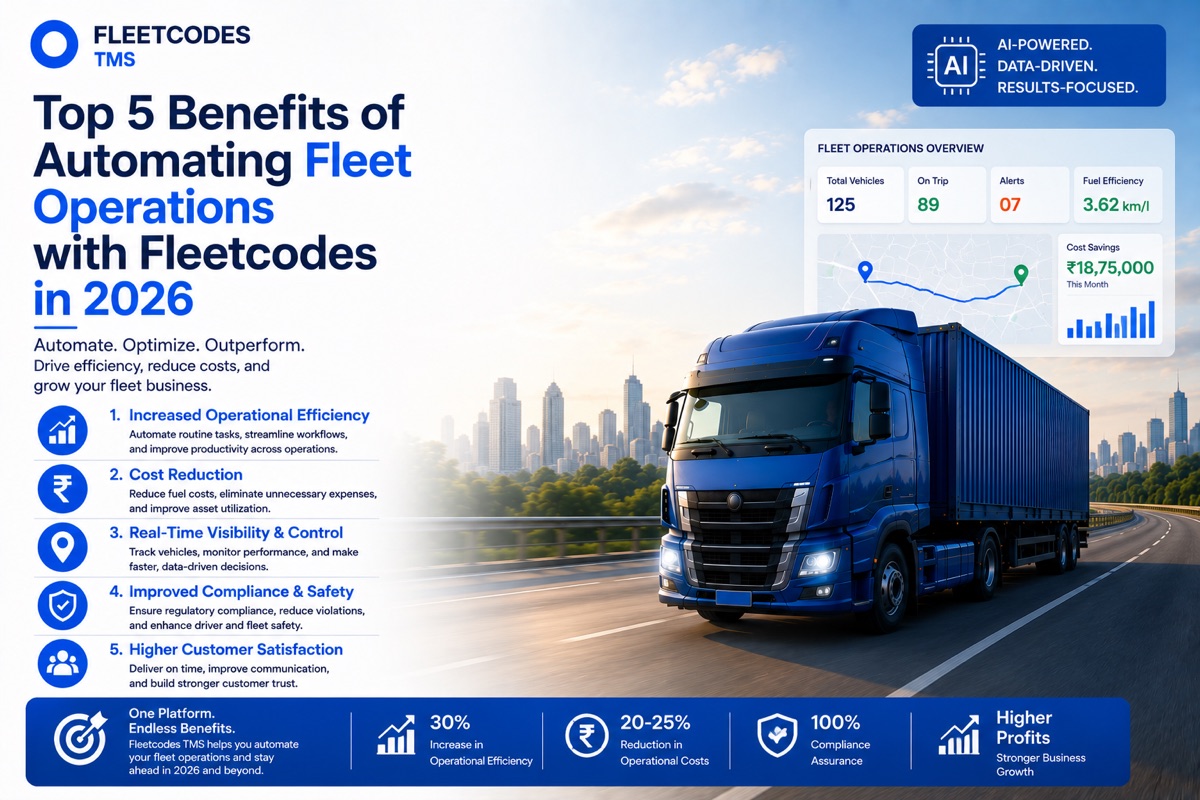
Fleet automation isn't about technology for its own sake. It's about what your operation can achieve when the routine work is handled by the system — and your team is focused on what actually requires human judgement.
Why Fleet Operations Automation Is the Defining Upgrade for Indian Logistics in 2026
The case for fleet automation in Indian logistics has moved decisively from "interesting concept" to "operational necessity" in 2026. The margin pressure is real. The customer service bar is rising. The shortage of skilled dispatch and operations talent is acute. And the sheer complexity of managing a growing fleet manually — across multiple states, customers, vehicle types, and compliance requirements — has outpaced what any team can handle without software.
Fleet operations automation doesn't change what your business does. It changes how well, how fast, and how consistently you do it — and it frees your team to spend their time on the decisions and relationships that software cannot replace.
Here are the five most impactful benefits that logistics businesses in India experience when they implement automated fleet management system capabilities through Fleetcodes.
See all five in action — Book a Free Fleetcodes Demo
Benefit 1: AI Dispatch Planning That Scales Without Adding Headcount
Manual dispatch has a fundamental scaling problem: every vehicle you add to your fleet increases the cognitive load on your dispatch team. At 20 vehicles, an experienced dispatcher can hold the full picture in their head. At 80 vehicles, that's impossible — and quality suffers.
AI fleet management in Fleetcodes solves this by making dispatch a data-driven, assisted process rather than a memory-driven, manual one.
Every incoming load is evaluated against the entire available fleet simultaneously — vehicle type, current location, driver hours, fuel efficiency, historical performance on the route. The AI surfaces the best match with supporting rationale. The dispatcher confirms, adjusts, or overrides. The decision is made in under 60 seconds.
The result: a single dispatcher operating with Fleetcodes' automated dispatch planning system can manage 2–3x more vehicles than a dispatcher working manually — without any reduction in decision quality. In fact, decision quality improves, because the AI incorporates more variables than any human can track simultaneously.
This is fleet management automation that pays for itself not just in efficiency, but in the headcount that doesn't need to be added as the fleet grows.
Benefit 2: Automated Maintenance Workflows That Prevent Breakdowns
Reactive maintenance is one of the most expensive patterns in fleet management. A truck that breaks down on a highway doesn't just incur a repair bill — it creates a delayed delivery, a stranded driver, the cost of an emergency recovery, and potential damage to a customer relationship.
Predictive maintenance for fleets in Fleetcodes turns the maintenance workflow from reactive to systematic:
- Every vehicle has a maintenance profile — service intervals, component history, and a baseline fuel consumption rate
- As trips accumulate, Fleetcodes tracks km since last service, flags scheduled services before they're overdue, and monitors for early signs of mechanical issues (fuel consumption anomalies, GPS-reported unusual stop patterns)
- When a service is due or an alert is triggered, the system automatically notifies the maintenance team and removes the vehicle from dispatch availability until the service is confirmed complete
Automated maintenance workflows ensure that:
- No vehicle goes out on a run with an overdue service
- Maintenance is scheduled in operational windows that minimise disruption
- Every maintenance action is logged and searchable — critical for insurance, resale value, and regulatory compliance
The financial impact is significant: preventive maintenance costs 3–4x less than reactive repairs on average, and every breakdown avoided preserves both vehicle availability and customer trust.
Benefit 3: Real-Time Fleet Alerts and Notifications — Managing by Exception
In a manually managed fleet, operations managers spend a large portion of their day checking on things: calling drivers for status updates, reviewing GPS platforms for vehicle positions, chasing the accounts team for invoice status, monitoring fuel logs for anomalies.
Real-time fleet alerts and notifications in Fleetcodes inverts this model. Instead of your team checking on everything, the system monitors everything and alerts your team only when something needs attention.
Fleet workflow automation in Fleetcodes generates real-time alerts for:
- Route deviations — vehicle has moved more than X km off the planned route
- Extended idle time — vehicle has been stationary with engine running for more than Y minutes
- Geofence events — vehicle has entered or exited a customer zone (triggering detention timer or delivery confirmation)
- Fuel consumption anomaly — vehicle's consumption is significantly above baseline for this trip type
- Driver behaviour flags — speeding, harsh braking, or aggressive acceleration events
- Maintenance due — vehicle approaching or past service interval
- Document alerts — e-way bill approaching expiry on an active trip
Each alert goes to the right person — the dispatcher, the operations manager, the maintenance team, the accounts team — via the Fleetcodes mobile app and dashboard. Nobody has to check. The system tells them what needs attention.
This is digital workflow automation for fleets that transforms operations management from constant monitoring to exception handling — dramatically reducing the cognitive load on your team and ensuring nothing is missed.
Benefit 4: Centralised Data and Paperless Fleet Operations
One of the most underestimated benefits of smart fleet management is the shift from distributed, paper-based records to centralised, digital data.
In a manually managed operation, the data your business needs lives in dozens of places: trip sheets in the cab, fuel receipts in a glove box, maintenance records in a filing cabinet, billing in an accounting spreadsheet, driver records in an HR folder. Assembling this data for a management report, a customer dispute, an insurance claim, or a regulatory audit takes days.
Logistics process automation in Fleetcodes means every operational event creates a digital record automatically:
- Trip data — created at dispatch, updated at every stage by the driver app
- Fuel records — captured at dispensing or validated against GPS consumption tracking
- POD records — digital signature and photo captured at delivery, timestamped and stored
- Maintenance records — every service action logged with date, km, parts, and cost
- Billing records — every invoice generated with a full audit trail from rate card to delivery confirmation
- Driver records — trip history, expense claims, advances, and settlement calculations per driver
Paperless fleet operations system capabilities in Fleetcodes mean that any data point from any trip in your history is searchable and retrievable in seconds — not a filing exercise.
For a customer dispute ("you delivered 3 days late"), you pull the trip record, the GPS timeline, the delivery confirmation timestamp, and the POD photo in under two minutes. For a regulatory audit, every trip record, every e-way bill, every maintenance log is available instantly.
Centralised data transforms compliance from a burden into a capability — and it makes the management reporting that drives better decisions possible without anyone assembling a spreadsheet.
Benefit 5: Reducing Fleet Operational Costs Using AI
The cumulative financial impact of fleet automation is significant — and it works across multiple cost lines simultaneously.
Reducing fleet operational costs using AI through Fleetcodes happens in five parallel ways:
Fuel Cost Reduction
AI dispatch optimization routes vehicles more efficiently, reduces empty miles, and monitors per-vehicle consumption against baselines. Combined with driver behaviour coaching, this typically delivers 8–12% fuel cost reduction.
Labour Cost Efficiency
Fleet management automation means the same team manages more vehicles, more loads, and more complexity — without proportional headcount increases. One dispatcher can manage 2–3x more vehicles. The billing team processes the same invoice volume with minimal manual work. Settlements that took days are calculated automatically.
Reduced Breakdown and Repair Costs
AI predictive maintenance for fleets prevents the expensive reactive repairs that come from undetected wear and overdue services. Preventive maintenance at the right time costs significantly less than emergency roadside breakdowns.
Revenue Recovery
Automated billing — applying correct rate cards, raising detention charges, capturing all surcharges — recovers 3–8% of revenue that was previously being lost to billing gaps in manual operations.
Better Asset Utilisation
AI telematics platform visibility means underperforming vehicles and routes are visible — enabling targeted decisions about fleet composition, route allocation, and asset retirement that improve return on every vehicle in the fleet.
| Cost Category | Typical Saving with Fleetcodes | |---|---| | Fuel costs | 8–12% reduction | | Billing leakage recovered | 3–8% of revenue | | Maintenance costs | 20–30% reduction (preventive vs reactive) | | Labour efficiency | 2–3x dispatcher capacity | | Empty mile reduction | 30–40% improvement |
These aren't projections from a single case study. They're the consistent operational improvements that transport automation software delivers when it replaces manual processes across an operation.
The Right Time to Automate Is Now
Every month of manual operations is a month where:
- Competitors who have automated are making faster, better dispatch decisions
- Revenue is leaking through billing gaps
- Vehicles are ageing without structured maintenance management
- Your team is spending time on data entry instead of operational improvement
Fleet automation tools for logistics companies have never been more accessible, more deployable, or more clearly ROI-positive than they are in 2026. And Fleetcodes is built to get your operation automated in days — not months.
FAQs
What is fleet automation and how does it work? Fleet automation is the use of software — including AI, real-time tracking, and workflow automation — to replace manual processes in dispatch, maintenance, billing, driver management, and reporting. In Fleetcodes, automation runs across the full operational cycle, with humans managing exceptions rather than routine tasks.
How does fleet operations automation improve logistics efficiency? Fleet operations automation eliminates manual handoffs between operational functions — dispatch to billing, delivery to invoicing, trip completion to driver settlement — reducing the errors, delays, and staff time that manual coordination requires.
What are the benefits of AI fleet management over manual operations? AI fleet management delivers faster dispatch decisions, predictive maintenance alerts, real-time anomaly detection, route optimisation, and data-driven driver performance management — capabilities that manual operations cannot replicate at scale.
How does Fleetcodes reduce fleet operational costs? Fleetcodes reduces costs through fuel optimisation, preventive maintenance management, billing leakage recovery, improved vehicle utilisation, and labour efficiency gains from automation — typically delivering 15–25% reduction in total operational cost per vehicle over the first year.
How quickly can a logistics business implement fleet automation with Fleetcodes? Most Fleetcodes customers complete core fleet automation implementation — dispatch, GPS integration, digital POD, and billing — within 7–10 days. Full automation including AI analytics and advanced reporting is typically active within 2–4 weeks.
Five benefits. One platform. Built for Indian fleet operations. Book Your Free Fleetcodes Demo →