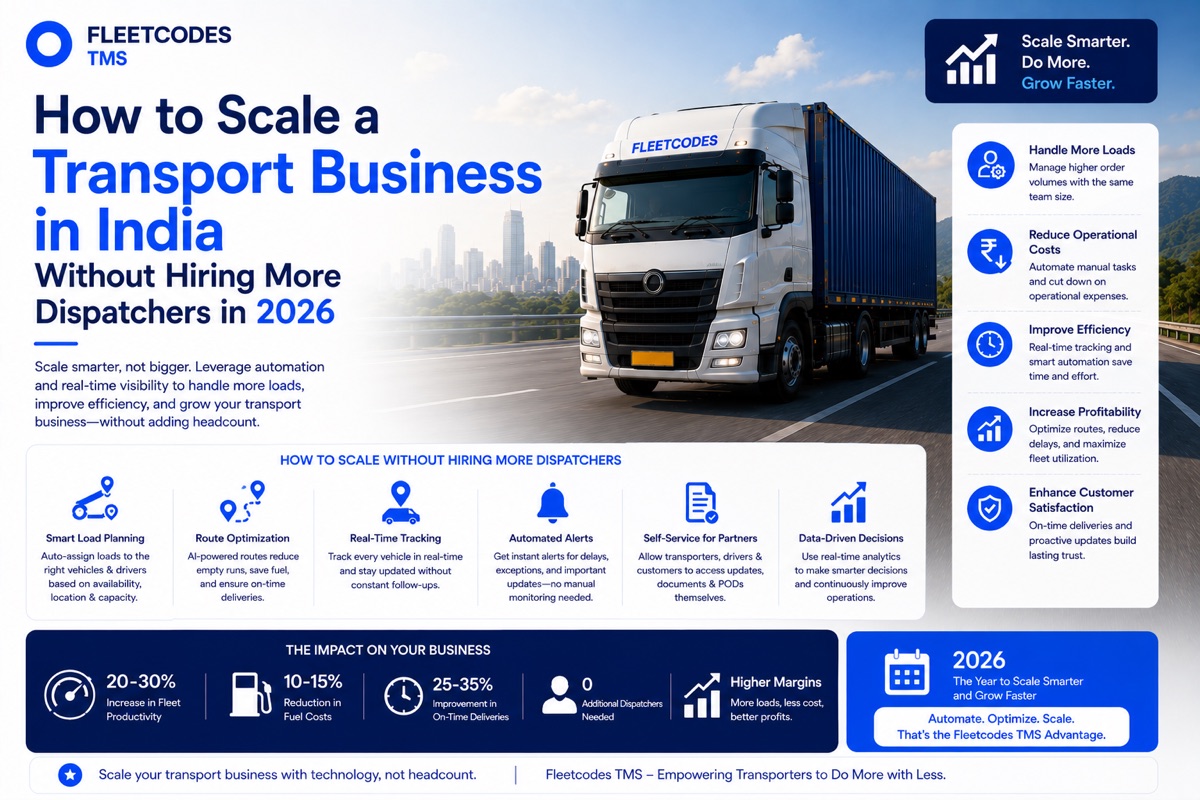
There is a ceiling that most Indian transport businesses hit somewhere between 60 and 80 vehicles. Revenue is growing. The fleet is expanding. But something is not keeping pace — and the answer is almost always the same. The dispatch and operations function has become the bottleneck.
The Dispatcher Bottleneck: Why Fleet Growth Stalls
When an Indian transport business runs 20–30 vehicles, a capable dispatcher can manage the operation effectively. They know the fleet. They know the customers. They know which driver is best on which route. They carry the operational logic of the business in their head — and they execute it reasonably well.
But at 60–80 vehicles, that model breaks down. The number of loads, routes, drivers, customers, compliance requirements, and real-time decisions has multiplied by a factor of 3–4. The cognitive load on each dispatcher has exceeded what a human working from memory and spreadsheets can reliably handle.
The natural response is to hire more dispatchers. And for a period, this works. Until the operation grows again, and the same ceiling is hit at 150 vehicles, at 250 vehicles, at 400 vehicles — each time requiring another round of headcount expansion just to maintain current operational quality, let alone improve it.
This is not a people problem. It is a systems problem. And in 2026, the Indian transport businesses that are growing logistics business India profitably without proportional headcount increases are the ones that have solved it with fleet automation — specifically with AI-powered transport management system platforms that multiply the operational capacity of every dispatcher they have.
Fleetcodes is built on a single core premise: you should be able to scale fleet without scaling headcount. Here is what that looks like in practice.
See how Fleetcodes enables fleet scaling → Book a Free Demo
The Dispatcher Capacity Problem: By the Numbers
To understand the scale of the problem, consider what a manual dispatcher actually does with their time in a typical day managing 40 vehicles:
| Task | Manual Time Per Day | |---|---| | Load-to-vehicle matching and assignment | 2.5–3.5 hours | | Driver communication (assignments, updates, issues) | 1.5–2.5 hours | | Status tracking and customer ETA updates | 1–2 hours | | Exception handling (delays, breakdowns, route issues) | 1–2 hours | | Documentation and record-keeping | 0.5–1 hour | | Total | 6.5–11 hours |
Of this, only a small fraction — exception handling and customer communication — genuinely requires human judgement. The majority — load matching, status tracking, record-keeping — is information processing work that software does faster, more accurately, and without fatigue.
When a dispatcher's day is consumed by information processing, three things happen:
- The quality of their judgement calls degrades under cognitive overload
- They become the bottleneck for every operational decision — nothing moves without going through them
- Scaling the fleet requires scaling them — more vehicles means more dispatcher capacity, indefinitely
Transport automation scale breaks this pattern by shifting the information processing load to the system and leaving the dispatcher free for the decisions that genuinely require human insight.
What AI Dispatch Actually Multiplies
AI dispatch India in Fleetcodes does not replace the dispatcher. It multiplies what each dispatcher can handle — by removing the cognitive load of information processing from every decision they make.
Here is what changes when AI dispatch is running:
Load-to-Vehicle Matching: From 10 Minutes to 60 Seconds
In a manual operation, every load assignment requires the dispatcher to mentally review available vehicles, check driver hours, consider vehicle type suitability, think about route efficiency, and decide. For a dispatcher managing 40+ vehicles across multiple simultaneous loads, this process consumes most of their morning.
Fleetcodes analyses every available vehicle against every incoming load simultaneously — type, location, driver hours, fuel efficiency, historical route performance — and surfaces the optimal recommendation with supporting data. The dispatcher reviews and confirms. What previously took 10–15 minutes per load takes under 60 seconds.
A dispatcher who previously managed 40 vehicles with 6+ hours of active load assignment now manages 120+ vehicles with 90 minutes of confirmation activity. Their cognitive capacity is available for the decisions that actually require judgement.
Real-Time Status: From Phone Calls to Dashboard
In a manual operation, knowing the current status of 60 vehicles requires 60 phone calls — or waiting for drivers to call in. This is not scalable. At 200 vehicles, nobody knows where anything is without active checking.
Fleetcodes integrates with GPS to show live vehicle positions, trip status, and ETA for every vehicle in the fleet on a single dashboard. Status updates from drivers flow through the app automatically — loaded, in transit, at customer, delivered. The dispatcher sees the full fleet picture at a glance, without asking anyone.
Fleet scaling without hiring is partly about multiplying individual capacity. It is equally about giving that individual the real-time information they need to manage a larger fleet effectively.
Exception Management: From Reactive to Proactive
The highest-value thing a dispatcher does is handle exceptions — a vehicle breaking down, a delivery delayed, a customer complaint, a route deviation that needs correction. In a manual operation, exceptions are discovered reactively — when the driver calls, when the customer calls, when someone notices the vehicle has stopped moving on the GPS.
Fleetcodes' alert system flags exceptions automatically and routes them to the dispatcher immediately: route deviation exceeding threshold, vehicle stationary beyond expected time, e-way bill approaching expiry on an active trip, driver app offline for extended period. The dispatcher receives the exception alert and acts — rather than discovering the problem after it has compounded.
This proactive exception management means a single dispatcher can effectively oversee a much larger fleet — not because they are working harder, but because the system is catching problems before the dispatcher needs to actively find them.
The Back-Office Multiplier
Scaling a transport business is not only a dispatch challenge. It is equally a back-office challenge — billing, settlement, compliance, and reporting all grow in complexity with fleet size, and all consume staff capacity in manual operations.
Billing: In a manual operation, every 100 trips requires the billing team to manually compile trip data, look up rate cards, calculate applicable surcharges, and generate invoices. At 500 trips per month — a 50-vehicle fleet — this is a multi-day monthly exercise. Automated billing in Fleetcodes generates invoices automatically from confirmed trip data, reducing a multi-day exercise to an exception-review process.
Driver settlement: 50 drivers with varying pay structures, advance records, expense claims, and performance metrics cannot be settled accurately in a short timeframe manually. Automated settlement calculates every driver's pay from trip data, flags exceptions for review, and generates settlement summaries — reducing the accounts team's settlement work from days to hours.
Compliance: E-way bill management for 200+ trips per day across multiple states is a full-time job in manual operations. Automated e-way bill generation from trip data, with validity monitoring and extension alerts, makes it a configuration task rather than a daily management burden.
Management reporting: Assembling a monthly fleet performance report manually from GPS data, billing records, fuel logs, and driver records takes 8–12 hours. Real-time dashboards in Fleetcodes make this continuous and automatic — the MD looks at a live dashboard, not a month-old assembled report.
Each of these back-office multipliers allows the business to handle more operational volume without proportionally increasing back-office headcount.
The Headcount Math: Before and After
A typical manually managed 50-vehicle Indian transport operation:
| Role | Headcount | Primary Burden | |---|---|---| | Dispatchers | 2 | Load matching, status tracking, driver coordination | | Billing/accounts | 2 | Invoice generation, POD chasing, settlement | | Operations manager | 1 | Exception handling, customer queries, reporting | | Total | 5 | |
The same 50-vehicle operation on Fleetcodes:
| Role | Headcount | Primary Focus | |---|---|---| | Dispatchers | 1 | Confirming AI recommendations, handling exceptions | | Billing/accounts | 1 | Exception review, customer queries, payment follow-up | | Operations manager | 1 | Strategic oversight, customer relationships, growth | | Total | 3 | |
This is not a projection. It is the operational headcount reality reported by growing fleet businesses that have made the transition from manual to automated operations. And at 100 or 200 vehicles, the multiplier effect is even more pronounced — because the platform scales linearly with fleet size while manual operations require near-proportional headcount increases.
What Scaling Actually Looks Like With Fleetcodes
A transport business that implements Fleetcodes at 50 vehicles and grows to 150 vehicles over two years does not need to triple its dispatch team. It needs to:
- Add additional driver accounts to the platform as drivers join the fleet
- Add new customer rate cards as accounts are won
- Configure dispatch rules for any new routes or specialised cargo types
- Potentially add one additional dispatcher when active daily loads justify it — not because the system cannot handle the volume, but because the human judgement layer benefits from additional capacity at significant scale
The operational discipline that Fleetcodes brings — structured dispatch, automated billing, digital POD, automated compliance — scales with fleet size. The manual administrative burden that would have grown proportionally with the fleet does not exist in an automated operation.
This is what logistics business growth India looks like when it is built on the right operational foundation.
FAQs
At what fleet size does dispatch automation have the most impact? Dispatch automation delivers value from 15 vehicles upward, but the impact is most pronounced in the 50–200 vehicle range — where manual operations are most likely to be creating bottlenecks that limit growth. Above 200 vehicles, the inability to scale without automation becomes an operational crisis rather than just an inefficiency.
How does AI dispatch differ from a regular TMS? A regular TMS records and tracks trips. AI dispatch in Fleetcodes actively analyses the full fleet state and recommends optimal load-to-vehicle assignments — incorporating vehicle type, location, driver hours, fuel efficiency, and route history. The difference is between a system that shows information and one that actively helps make decisions.
Does Fleetcodes work for fleets specialised in specific cargo types? Yes. Dispatch rules, vehicle type matching, and route configurations in Fleetcodes can be set up for specialised operations — temperature-controlled logistics, hazardous cargo, oversized load operations, or specific industry verticals like pharma, FMCG, or construction materials.
How does Fleetcodes support the dispatcher's role rather than replacing it? Fleetcodes handles the information processing — analysing vehicle availability, recommending assignments, tracking status, flagging exceptions. The dispatcher focuses on the decisions that require human insight — customer relationships, unusual operational situations, strategic load prioritisation. Their capacity increases; their role does not disappear.
What is the typical implementation timeline for a growing fleet? Core Fleetcodes implementation — dispatch, GPS integration, digital POD, and billing automation — is typically complete within 7–10 days. Advanced features including AI analytics, geofencing, and management dashboards are usually configured within 2–4 weeks. The platform scales as the fleet grows without requiring re-implementation.
The ceiling on your fleet's growth is not freight demand. It is operational capacity. Fleetcodes removes that ceiling — so your business can scale at the speed the market allows, not at the speed your dispatch team can manage manually. Book a Free Fleetcodes Demo — See How Many Vehicles One Dispatcher Can Manage →