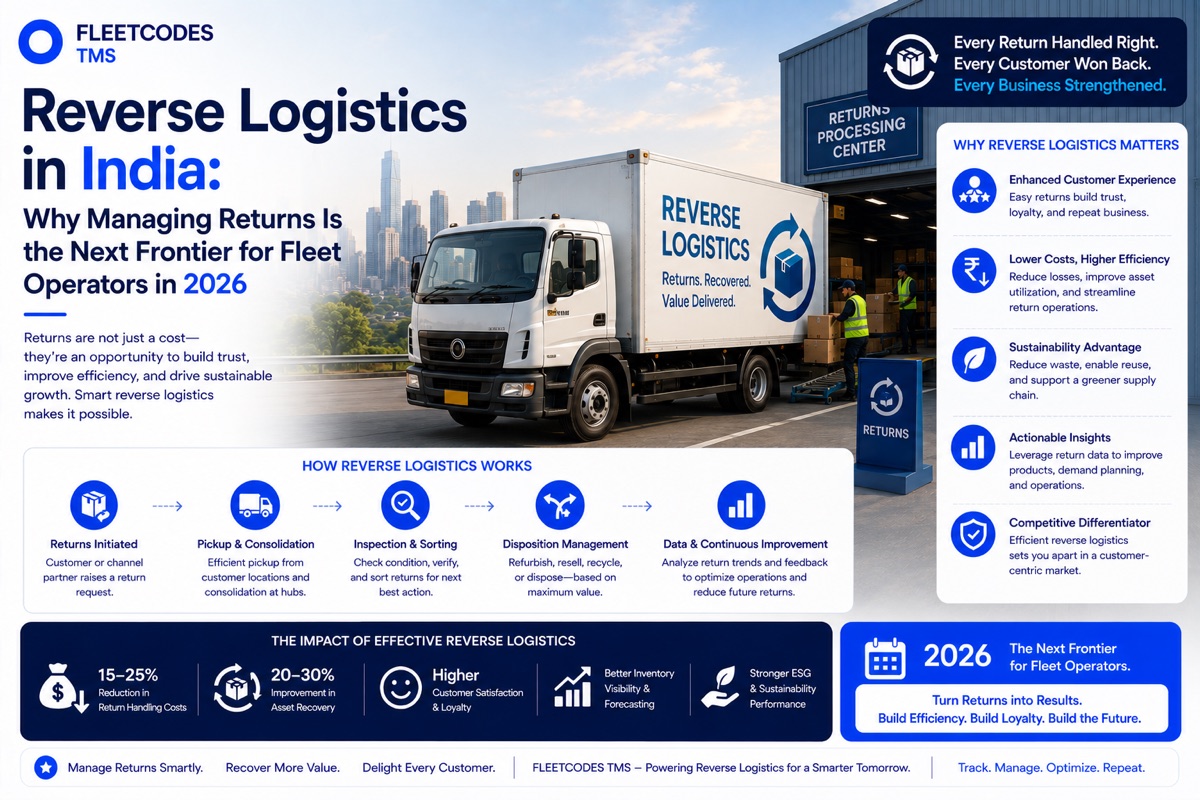
Delhivery processed 420 million returns in FY2024–25 — a 34% year-on-year increase. Returns now represent 20% of total parcel volume in India. And handling a return costs approximately 1.6 times the forward shipment. For fleet operators, this is either a growing cost burden or a growing revenue opportunity — depending entirely on whether it is managed as an afterthought or as a structured operational process.
What Is Reverse Logistics and Why Is It Exploding in India
Reverse logistics India refers to the process of moving goods back up the supply chain — from the end consumer or delivery point toward the origin, the manufacturer, or a processing facility. It encompasses product returns, refusals at delivery, defective goods recalls, packaging returns, and end-of-life product collection.
The explosion in returns management logistics in India is driven primarily by three forces:
E-commerce volume and consumer expectation: India's e-commerce sector has conditioned consumers to expect easy, free returns as a standard service. Return rates in Indian e-commerce range from 15–40% depending on category — fashion returns run highest, electronics lower. As e-commerce volumes grow, so does the absolute return volume, regardless of what percentage of orders are returned.
D2C (Direct-to-Consumer) brand growth: India's rapidly growing D2C sector — brands selling directly through their own digital channels rather than through aggregators — creates distributed, small-parcel forward and reverse logistics requirements that are structurally more complex than traditional B2B freight.
FMCG and pharma short-date returns: Fast-moving consumer goods and pharmaceutical products carry expiry dates. Short-date or near-expiry products that have not sold at retail are returned to the manufacturer for disposal, repurposing, or recycling — creating a structured reverse logistics requirement across FMCG and pharma supply chains.
The 1.6x cost multiplier for returns — relative to forward shipments — reflects the genuine operational complexity of reverse logistics: pickups are often unscheduled or loosely scheduled, addresses are consumer homes rather than commercial docks, goods may be damaged or partially packaged, and the routing and batching efficiency of forward distribution is absent.
The Four Operational Challenges of Reverse Logistics
Challenge 1: Unstructured Pickup Scheduling
Forward logistics is largely push-mode — the shipper books the freight, specifies the pickup time, and the transporter plans accordingly. Reverse logistics is largely pull-mode — the return is initiated by the consumer or recipient, often on their timeline.
This means pickups are harder to batch into efficient routes. A returns driver might have 12 pickups spread across a 30 km radius of a city, scheduled across a 4-hour window that customers requested at various times. Without structured routing and real-time sequencing, this is a high-cost, low-efficiency operation.
Return freight management platforms address this by treating return pickups as first-class trip assignments — with route optimisation, driver app assignment, and digital collection confirmation — rather than as informal reactive operations.
Challenge 2: Documentation and Quality Inspection
When goods are returned, their condition needs to be documented at the point of collection. Is the original packaging intact? Is the product undamaged? Is the seal broken? Does what is being returned match what was supposedly purchased?
Without a structured digital process for documenting return condition at pickup, this information either does not exist (creating disputes with customers about the condition of returned goods) or exists only as a paper note that may be lost or misread by the time it reaches the processing centre.
Reverse POD process India — digital return collection confirmation with photo, condition checklist, and recipient identity verification — creates an objective, timestamped record of the return's condition at the point of collection. This evidence is essential for consumer dispute resolution, insurance claims, and quality control upstream.
Challenge 3: Return Trip Routing and Consolidation
The core economics of reverse logistics software India depend on avoiding the same mistake that forward logistics makes when it deadheads: running vehicles with poor utilisation.
A dedicated returns vehicle that picks up 8 items across a day and then drives back to the depot is an expensive way to manage returns. The efficient model combines:
- Forward+return integration: Vehicles completing forward deliveries are assigned return pickups in the same area before heading back — turning deadhead kilometres into revenue or at minimum productive kilometres
- Return consolidation: Multiple returns from the same area or route are batched and assigned to the same vehicle run rather than dispatched individually
- Return depot routing: Returns that go to different processing destinations (manufacturer A vs brand B vs recycler C) are sorted at the vehicle level to minimise consolidation handling at the depot
This is fleet return trip optimisation in practice — treating the reverse logistics run with the same route planning discipline as the forward delivery.
Challenge 4: Credit and Financial Processing
In consumer-facing return scenarios, the return pickup triggers a financial process — a refund, a credit note, or a replacement order. When the documentation of the return pickup is manual, paper-based, or delayed, the financial process is delayed with it.
Consumers who have returned a product and are waiting for a refund that is delayed by documentation processing are among the most dissatisfied customers in any e-commerce operation. The returns experience significantly affects brand loyalty.
Digital return confirmation that triggers the refund or credit process automatically — the same way digital POD triggers invoice generation in forward logistics — is the operational model that separates e-commerce and D2C brands that retain customer trust from those that lose it on every return.
How Fleet Technology Transforms Returns Operations
The technology stack for efficient e-commerce returns logistics India at the fleet level involves the same operational tools as forward logistics — applied to the reverse flow:
Digital Return Assignment and Driver App
Return pickups are created as trip assignments in Fleetcodes and assigned to drivers via the app — just as forward deliveries are. The driver sees the pickup address, the return reference, the goods description, and any special handling instructions. The assignment is systematic, not informal.
Route Optimisation for Return Collections
Fleetcodes' route optimisation handles return pickup sequences as efficiently as delivery sequences — grouping nearby pickups into logical runs, minimising driving time between collection points, and integrating return pickups with forward delivery runs where geographically appropriate.
For a returns vehicle handling 15–20 pickups across a city in a day, the difference between an optimised route and an ad-hoc sequence can be 30–40% in total driving distance — directly affecting the profitability of the return operation.
Digital Return POD and Condition Documentation
The Fleetcodes driver app supports return-specific collection confirmation: photo of returned goods, condition checklist (packaging intact, seal intact, product visible damage), recipient identity confirmation, and timestamp. This creates an objective return condition record at the moment of collection.
For returns cost reduction fleet operations, this documentation closes the dispute loop that currently costs e-commerce businesses significant manual handling time — when a returned product arrives at the processing centre in worse condition than the collection record shows, liability is clear.
Forward+Return Trip Integration
The most significant efficiency gain in reverse logistics comes from integrating return collections with forward delivery runs. When a forward delivery driver completes their last delivery in an area, Fleetcodes can assign nearby scheduled return pickups to the same driver before the vehicle returns to depot — turning the return leg from deadhead into productive kilometres.
This forward+return integration is how the most efficient e-commerce logistics operators in India are addressing the 1.6x return cost multiplier — not by making returns cheaper in isolation, but by absorbing them into forward operational capacity that was already going in the right direction.
The Returns Opportunity for Indian Fleet Operators
For fleet operators reading this from a business development perspective, reverse supply chain India is a growing service revenue stream — not just an operational cost to manage.
E-commerce brands and FMCG companies with significant return volumes are increasingly looking for logistics partners who can manage reverse logistics as a structured, documented service — not as an ad-hoc favour attached to the forward contract.
Fleet operators who can demonstrate:
- Structured digital return scheduling and confirmation
- Condition-documented collection with photographic evidence
- Route-optimised collection to manage cost efficiency
- Integration with forward delivery runs to maximise vehicle utilisation
- Real-time visibility into return shipment status
...are positioned to win dedicated returns contracts — at rates that reflect the genuine operational complexity of reverse logistics, rather than treating returns as an extension of the forward rate.
FAQs
What is reverse logistics and why is it growing in India? Reverse logistics is the movement of goods back up the supply chain — from consumer to origin, processing centre, or recycler. In India, it is growing at 34% year-on-year, driven primarily by e-commerce return volumes, D2C brand growth, and FMCG short-date product returns. Returns now represent 20% of total parcel volume.
Why does reverse logistics cost more than forward logistics? Reverse logistics costs approximately 1.6x the forward shipment because: pickups are often unscheduled and harder to batch, consumer addresses are less accessible than commercial docks, goods may require condition assessment at collection, routing efficiency is lower than consolidated forward delivery, and documentation and credit processing add administrative overhead.
How can fleet operators reduce the cost of reverse logistics? The most effective cost reduction strategies are: route optimisation for return collection runs, integration of return pickups with forward delivery runs to avoid dedicated empty return legs, digital collection confirmation that eliminates documentation delays, and batching return collections by geography and destination to improve vehicle utilisation.
Does Fleetcodes support reverse logistics operations? Yes. Fleetcodes manages return pickups as structured trip assignments through the same dispatch, route optimisation, and driver app platform as forward deliveries. Digital return collection confirmation with condition documentation creates the evidence trail required for e-commerce returns processing.
What is the business opportunity for fleet operators in reverse logistics? E-commerce and FMCG brands with high return volumes are seeking logistics partners who can manage reverse logistics as a structured, documented service. Fleet operators with digital reverse logistics capability — condition-documented collection, route-optimised runs, real-time visibility — are positioned to win dedicated returns contracts at rates that reflect the genuine operational complexity of the service.
Reverse logistics is not a problem to be managed. For the fleet operators who get it right, it is a growing revenue stream that forward-only competitors cannot serve. See How Fleetcodes Manages Forward and Reverse Logistics Together →