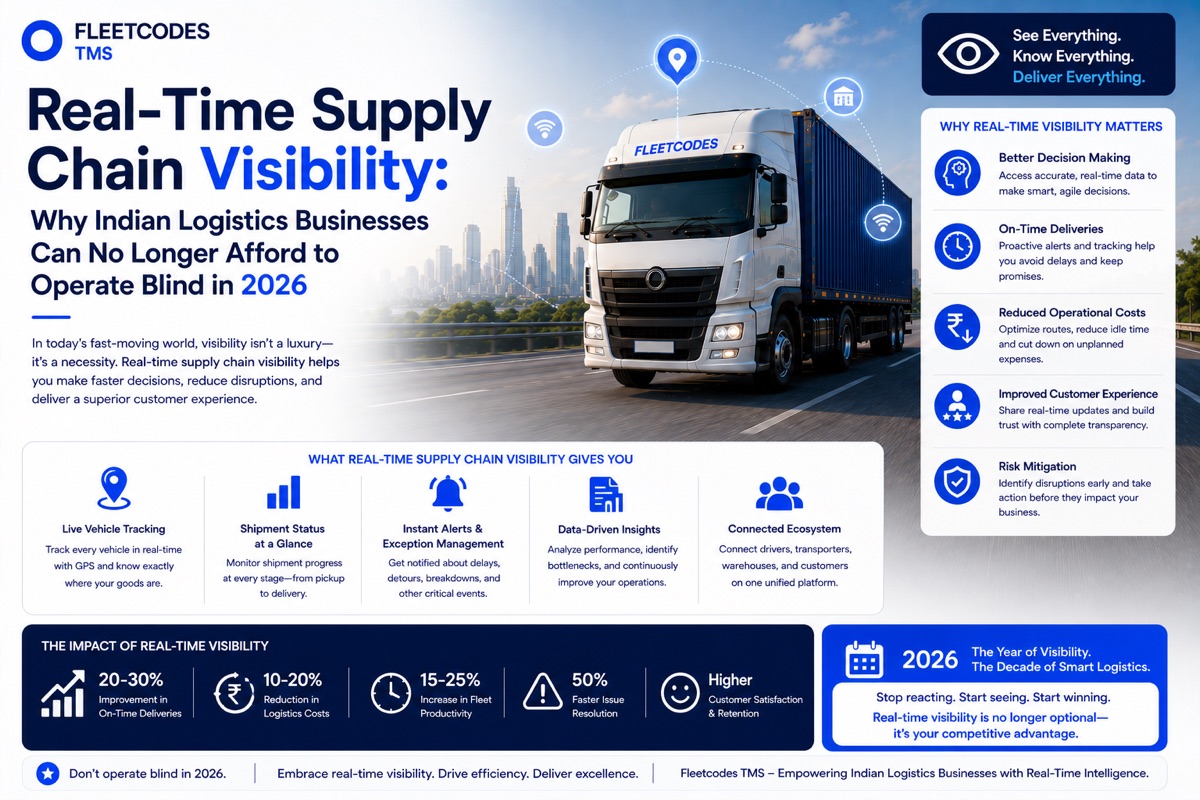
At Transport Logistic India 2026, attended by over 8,100 industry professionals, one theme was stated explicitly by leaders across sessions: real-time supply chain visibility is becoming a strategic priority — and the platforms that cannot deliver it are losing ground to those that can.
The Visibility Gap in Indian Logistics
Supply chain visibility India has a simple definition and a complicated implementation. The simple definition: knowing exactly where your goods are, what condition they are in, and when they will arrive — at any moment, from any device, without having to call anyone to find out.
The complicated implementation: most Indian logistics operations are still delivering visibility through phone calls. A shipper wants to know where their consignment is. They call the transporter. The transporter calls the driver. The driver gives an update that may or may not be accurate. The transporter calls the shipper back. By which time the answer is already several minutes old.
This is not visibility. It is a delayed version of uncertainty — and it fails on both sides. The shipper does not have the real-time information they need to plan their receiving operation, communicate with their customers, or make decisions about contingencies. The transporter's team spends a significant portion of its working day answering status enquiries that a properly implemented logistics visibility software system would make unnecessary.
In 2026, this gap is becoming a commercial problem for Indian logistics businesses. Shippers — particularly large-format FMCG, pharma, and e-commerce players — are increasingly selecting logistics partners based on the quality of real-time visibility they offer. The ability to provide a live tracking link, an accurate ETA, and proactive exception alerts has moved from differentiator to table stakes in the segment of the market that sets commercial standards.
What Real-Time Supply Chain Visibility Actually Requires
Real time freight tracking India at a meaningful level of quality requires four interconnected capabilities — not just a GPS dot on a map.
1. Live Vehicle Tracking Integrated with Operational Data
The foundation is GPS — live vehicle position, updated at a meaningful frequency (30–60 seconds for operational dispatch use). But location data alone is not visibility. It becomes visibility when it is connected to operational context:
- Which consignment is this vehicle carrying?
- What are the delivery stops on this trip?
- What is the expected arrival time at each stop, calculated dynamically from current position and historical route performance — not estimated at departure and never updated?
- Has the vehicle deviated from the planned route, and if so, what does that mean for ETA?
When GPS data is integrated with trip records, route plans, and delivery schedules in a platform like Fleetcodes, the live vehicle position becomes a meaningful operational signal rather than just a location coordinate.
2. Digital Trip Status Updates from Drivers
Live GPS tracking shows where a vehicle is. Driver app status updates show what is happening at each point:
- Loaded and departed from pickup — with a timestamp
- Arrived at delivery point — geofence triggered automatically
- Delivery completed — digital POD captured with recipient signature and photo
- Exception reported — delivery refused, goods damaged, recipient unavailable
These status events, transmitted digitally by the driver through the Fleetcodes app, create a real-time operational narrative for every trip — visible to the dispatcher, the operations manager, and through a customer portal, to the shipper themselves.
This is what separates shipment visibility platform capability from raw GPS tracking. The data tells a story, not just a location.
3. Customer-Facing Visibility Portal
The most commercially significant dimension of real-time visibility for transporters is what is visible to their customers. A dispatcher who can see every vehicle's live position is operationally better equipped. A shipper who can see their specific consignment's live status is commercially impressed — and retained.
Fleetcodes provides a customer-facing visibility portal where shippers can access live tracking, ETA updates, and delivery confirmation for their consignments without calling the transporter's operations team. This has two direct commercial effects:
Inbound call reduction: Transporters who implement customer-facing visibility consistently report 40–60% reductions in inbound status enquiry calls. This frees the operations team to focus on actual operational management rather than answering questions the system can answer automatically.
Customer retention: Shippers who can see their cargo in real time are more satisfied customers. In a sector where logistics relationships are often maintained by price and personal relationship alone, service quality differentiation through visibility is a powerful commercial tool.
4. Proactive Exception Alerting
The highest-value form of end to end logistics tracking is not passive visibility — it is active alerting. The difference is significant:
Passive visibility: the shipper or dispatcher checks the tracking portal and sees a delay.
Active alerting: the system detects the delay — vehicle stationary beyond expected time at customer location, route deviation suggesting a problem, ETA recalculated beyond delivery window — and proactively notifies the relevant parties before anyone has to check.
Proactive alerts change the customer service dynamic fundamentally. Instead of the shipper discovering a delay and calling to complain, the transporter reaches out proactively with a status update and a revised ETA. This is the difference between reactive damage control and professional supply chain management.
Why Shippers Are Now Demanding Visibility as Standard
The shift in shipper expectations around real-time freight tracking India has accelerated in 2026 for several interconnected reasons:
E-commerce growth driving consumer expectations upward: India's e-commerce sector has accustomed consumers to real-time parcel tracking as a baseline expectation. Those same consumers, in their business roles as supply chain managers and procurement leads, now expect the same visibility from their B2B logistics partners. The bar has been set by Amazon and Flipkart; B2B logistics is being held to it.
Inventory optimisation pressures: As shippers move toward leaner inventory models — reducing safety stock and relying on more reliable transit times — the accuracy of ETA information becomes critical. A shipper managing just-in-time production cannot afford to discover a logistics delay only when the goods fail to arrive. They need accurate, real-time ETA information to manage their own operations proactively.
Large shipper procurement practices: The largest FMCG, pharma, and industrial shippers in India now include visibility capability as a formal criterion in logistics tender evaluation. Transporters who cannot demonstrate real-time tracking, digital POD, and customer portal access are increasingly excluded from these tenders — regardless of their rate competitiveness.
Supply chain risk management: After the disruptions of 2020–2023, supply chain resilience has become a board-level priority for large Indian companies. Real-time visibility is central to resilience — you cannot manage what you cannot see.
The Operational Benefits for Transporters
Visibility is typically discussed from the shipper's perspective. The operational benefits for the transporter are equally significant.
Faster exception response: When the dispatcher can see every vehicle's status in real time — without making phone calls — exceptions are identified and resolved faster. A vehicle that should have departed but hasn't. A trip that is running 45 minutes behind schedule with no explanation. A vehicle showing unusual route deviation. All visible, all actionable, without active checking.
Better dispatch decisions: A dispatcher who knows exactly where every vehicle is — and when each will complete its current trip — makes better load assignment decisions. Real-time fleet state information is the input that turns dispatch from an estimation exercise into a data-driven decision.
Proof for customer disputes: When a shipper disputes a delivery time or claims goods were not delivered, the transporter with real-time tracking data has timestamped, GPS-verified evidence of exactly what happened and when. Digital POD with photo and geotag adds a further layer of irrefutable documentation. Disputes that previously took days to resolve — with both parties asserting conflicting accounts — are settled quickly and factually.
Fleet utilisation improvement: Knowing in real time when vehicles will complete their current trips allows dispatchers to pre-assign return loads before vehicles go empty. IoT logistics tracking India data, integrated with dispatch, turns vehicle completion into an automatic trigger for load assignment optimisation.
How Fleetcodes Delivers End-to-End Visibility
Fleetcodes is designed as a logistics visibility software platform where every stakeholder has the visibility they need:
The dispatcher sees live vehicle positions, trip status, driver app updates, and exception alerts on a single operational dashboard — with AI-assisted recommendations for load assignment based on real-time fleet state.
The operations manager sees fleet utilisation, delivery performance against SLA, fuel consumption trends, and exception rates across the full operation — in real time, without assembling a report.
The driver has clear trip assignments in the app, with all relevant consignment details, and captures status updates and digital POD simply — creating the data that drives visibility for everyone else.
The shipper accesses a customer portal with live tracking, ETA updates, and delivery confirmation for their consignments — without calling the transporter's team.
The MD sees the business performance picture — revenue, margins, on-time delivery rate, fleet utilisation — on a live dashboard that replaces the month-old assembled management report.
This is real time dispatch visibility as a system property, not as a specific feature — running across every role in the operation simultaneously.
The Competitive Implication: Visibility as a Commercial Differentiator
For Indian transporters serving mid-market and enterprise shippers in 2026, the commercial case for real-time visibility is straightforward:
Shippers who care about visibility — and the largest, most valuable shippers increasingly do — are building it into their logistics partner selection criteria. Transporters who can demonstrate live tracking, digital POD, and customer portal access are qualifying for this segment. Those who cannot are not.
The cost of implementing real-time visibility through a platform like Fleetcodes is modest. The cost of being excluded from the commercial conversations that require it is not.
FAQs
What is real-time supply chain visibility and why does it matter? Real-time supply chain visibility means being able to see exactly where goods are, what status they are in, and when they will arrive — at any moment, from any device. It matters because shippers increasingly require it for operational planning, inventory management, and customer service — and because transporters with visibility capabilities retain customers and win new ones more effectively than those without.
How is logistics visibility software different from basic GPS tracking? Basic GPS tracking shows vehicle location. Logistics visibility software connects that location data with consignment records, trip status, delivery confirmation, ETA calculations, and customer-facing portals — turning raw location data into a meaningful operational and commercial intelligence system.
What do Indian shippers specifically want from supply chain visibility? Indian shippers increasingly require: live consignment tracking (not vehicle tracking — they want to know where their specific goods are), accurate dynamic ETA updates, proactive exception alerts when delays occur, digital proof of delivery, and self-service access through a portal — without needing to call the transporter for status updates.
How does real-time visibility reduce operational costs for transporters? Real-time visibility reduces inbound status call volumes by 40–60%, enables proactive exception management that prevents delay compounding, supports faster dispute resolution with verified evidence, and improves fleet utilisation by allowing pre-assignment of return loads based on real-time vehicle completion status.
How quickly can a transporter implement real-time visibility with Fleetcodes? GPS integration, live tracking dashboard, driver app deployment, and customer portal activation are core features of Fleetcodes' standard implementation — typically live within 3–7 days of platform setup. The customer portal is available immediately, with shippers able to access live tracking as soon as their first digitally managed trip is underway.
The shippers who set the commercial standard in Indian logistics are already asking for real-time visibility. The transporters who provide it win the business. The ones who don't are competing only on price — and that is a race nobody wins. See Fleetcodes Real-Time Visibility in Action — Book a Demo →