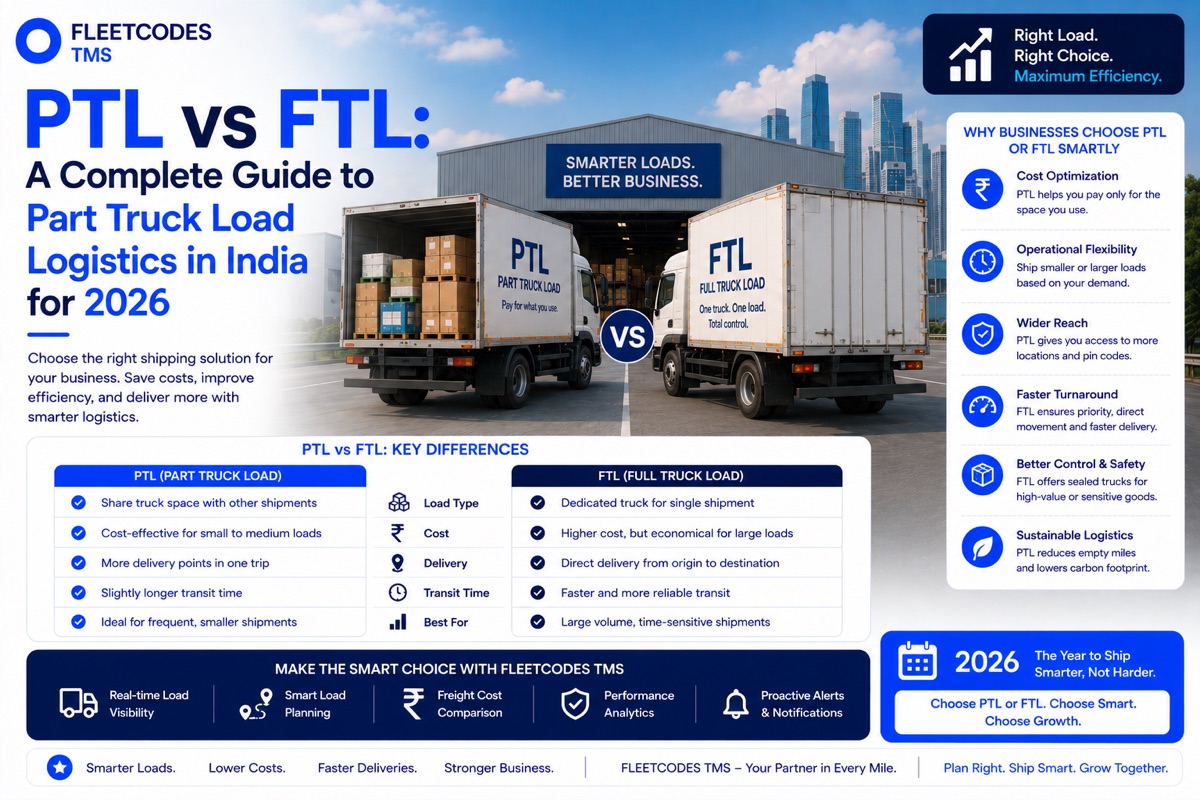
PTL — Part Truck Load logistics — is growing at 9.89% CAGR in India, outpacing FTL growth as D2C brands, organised retail, and FMCG distribution shift toward smaller, more frequent shipments. Understanding how PTL works, when it beats FTL, and how to manage it efficiently is now foundational knowledge for Indian logistics businesses.
What Is PTL Logistics?
PTL (Part Truck Load) — also called LTL (Less Than Truckload) in global terminology — is a freight model where a single vehicle carries consignments from multiple shippers simultaneously, with each shipper paying only for the space and weight their cargo occupies.
This is in contrast to FTL (Full Truck Load), where a single shipper reserves the entire vehicle for their consignment.
PTL is the backbone of India's secondary distribution network — the freight model that moves goods from regional depots to distributors, from distributors to retailers, and from manufacturers to trade channels across India's 13,850+ active pincodes. Almost every product on a kirana shelf has moved on a PTL vehicle at some stage of its journey.
The structural engine of PTL logistics is the hub-and-spoke model:
- Cargo is collected from the shipper's location and brought to the nearest consolidation hub
- At the hub, consignments are sorted and consolidated with cargo from other shippers going to the same destination region
- A line-haul vehicle (typically FTL on the trunk route) carries the consolidated load to the destination hub
- At the destination hub, cargo is sorted again and loaded onto last-mile vehicles for delivery to individual consignees
This multi-stage process creates complexity — more handling points, more documentation requirements, higher damage risk per consignment — but it enables cost efficiency for shippers who do not have enough freight to fill a truck.
PTL vs FTL: When Each Model Makes Sense
Choosing between PTL and FTL is one of the most frequent logistics decisions a shipper makes. The right answer depends on the specific situation — not on a blanket rule.
When FTL Makes More Sense
High volume, single destination: When a shipper has enough cargo to fill or near-fill a truck going to a single destination, FTL is almost always more economical — because the per-kg or per-tonne rate for a dedicated vehicle on a direct route beats PTL consolidation pricing at scale.
Time-sensitive cargo: FTL offers direct routing without intermediate handling stops. Transit time is predictable and typically faster than PTL, which moves through consolidation hubs. For time-definite shipments or urgent deliveries, FTL provides more reliable delivery windows.
High-value or fragile cargo: Every additional handling point in PTL — loading at origin, unloading and reloading at each hub — increases damage risk. High-value electronics, precision equipment, or fragile goods often justify FTL even at lower volumes to eliminate unnecessary handling.
Controlled environment requirements: Temperature-controlled cargo, pharmaceutical goods, or hazardous materials often require dedicated vehicles that maintain specific conditions throughout the journey — not shared vehicles with mixed cargo.
Confidential or sensitive cargo: Some shippers prefer FTL simply because they do not want their cargo visible to or accessible by handlers managing other shippers' goods in the same vehicle.
When PTL Makes More Sense
Small to medium volume shipments (typically below 5 tonnes): When freight volume is less than what fills a truck, PTL pricing — paying for space used rather than the full vehicle — is more economical than booking a dedicated FTL vehicle that will run partially empty.
Multiple destinations from one origin: A manufacturer distributing to 15 regional distributors from one factory has consignments that are individually too small for FTL. PTL consolidation handles this efficiently.
High shipping frequency with smaller order sizes: D2C brands, e-commerce sellers, and FMCG distributors shipping daily or multiple times per week in smaller quantities are natural PTL users — the economics of FTL at that frequency and volume do not work.
Cost optimisation over speed: When transit time of 2–5 days (vs FTL's 1–2 days) is acceptable, PTL's shared cost structure provides meaningful savings.
The Economics of PTL: How Pricing Works
PTL pricing India is calculated differently from FTL:
Weight-based pricing: Most PTL operators charge per kg or per tonne — either on actual weight or volumetric weight (length × breadth × height ÷ a volume factor), whichever is higher. This protects carriers against bulky low-density cargo that fills space without generating weight revenue.
Distance bands: PTL rates are typically structured in distance bands rather than per-km — reflecting the hub-spoke model where routing is not always a direct A-to-B distance.
Minimum charge: PTL shipments have minimum charges — a floor below which a consignment cannot be priced, regardless of weight. This accounts for the fixed handling cost of processing each consignment through the hub network.
Surcharges: PTL invoices commonly include: fuel surcharge (variable, linked to diesel price index), handling surcharge for difficult cargo, detention charge for delayed pickup or delivery, oversize surcharge for non-standard dimensions.
Understanding these pricing components is essential for PTL shippers benchmarking rates — and for fleet operators who operate PTL networks, for ensuring their pricing reflects their actual costs.
The Operational Complexity of Running PTL
For fleet operators running PTL services, the operational challenges are meaningfully greater than FTL:
Multi-consignment documentation: Every PTL vehicle carries multiple consignments, each with its own bilty, e-way bill, consignee details, and delivery instructions. Managing this documentation correctly — ensuring the right documents travel with each consignment and are correctly matched at each hub — requires systematic processes that manual operations cannot reliably deliver.
Hub consolidation and sorting: At each hub, incoming consignments must be sorted, stored briefly, and correctly matched to outgoing vehicles. Sorting errors — a consignment put on the wrong outgoing vehicle — cause delivery failures and customer disputes that are expensive to recover.
Multi-stop delivery sequencing: A PTL last-mile vehicle delivering 15–20 consignments in a city needs an optimised stop sequence to minimise total driving distance and complete all deliveries within promised windows. Without route optimisation, the same deliveries take significantly longer and cost more in fuel and driver time.
Per-consignment POD and billing: Because each consignment on a PTL vehicle belongs to a different shipper, billing must be done per consignment — each with its own rate, its own invoice, and its own delivery confirmation requirement. In manual operations, this billing complexity multiplies error risk proportionally.
Transit damage and liability clarity: When a consignment is damaged during PTL transit — at a handling point, in a vehicle, or during sorting — establishing exactly where and how the damage occurred is much harder than in FTL. Documented chain of custody at each handling point is essential for resolving these disputes fairly.
How Fleet Technology Makes PTL Operationally Viable
Running a PTL operation efficiently at scale requires the same technology foundation as any fleet operation — with additional layers specific to multi-consignment management.
Fleetcodes manages PTL operations through:
Multi-consignment trip management: A single trip in Fleetcodes can carry multiple consignment records — each with its own bilty, e-way bill reference, consignee details, and delivery sequence. All consignment records are linked to the vehicle and driver, creating a complete manifest for the trip.
Digital per-consignment POD: The Fleetcodes driver app captures individual delivery confirmation — signature, photo, and timestamp — for each consignment at each stop. When a delivery is refused or only partially completed, the exception is documented at that point rather than discovered later.
Per-consignment billing triggers: When each consignment's POD is confirmed, the billing trigger for that specific consignment fires automatically — applying the correct rate for that shipper and generating their invoice without the billing team needing to manually process each delivery confirmation.
Route optimisation for multi-stop delivery: Fleetcodes optimises the stop sequence for PTL last-mile vehicles — minimising total distance while respecting delivery time windows for each consignment. This is particularly impactful for city distribution vehicles with 15–25 stops per run.
Consolidated e-way bill management: For PTL vehicles carrying multiple consignments, Fleetcodes manages the consolidated e-way bill — tracking validity across the vehicle's full journey and flagging extensions needed before expiry.
The GST Impact on PTL: What Fleet Operators Must Know
The implementation of GST transformed India's inter-state freight movement — and PTL operations were among the most significantly affected, because each consignment on a PTL vehicle may belong to a different GST-registered shipper with different tax implications.
Key GST requirements for PTL operations:
E-way bill per consignment: Each consignment on a PTL vehicle above the applicable threshold requires its own e-way bill. The consolidated e-way bill for the vehicle covers the entire load, but individual consignment e-way bills must also be present for each qualifying shipment.
GSTIN of transporter on bilty: The transporter's GSTIN must appear on every bilty issued — and the bilty serves as the tax invoice for freight services rendered, with GST charged at 5% on freight (without input tax credit) or 12% (with ITC).
RCM (Reverse Charge Mechanism): When an unregistered transporter provides GTA (Goods Transport Agency) services to a registered recipient, GST is payable by the recipient under RCM. Understanding whether your operation qualifies as GTA — and the RCM implications — is essential for compliance.
FAQs
What is PTL logistics in India? PTL (Part Truck Load) — also called LTL — is a freight model where multiple shippers share a single vehicle, each paying for the space and weight their cargo occupies. It operates on a hub-and-spoke model, with cargo consolidated at hubs for line-haul movement and deconsolidated for last-mile delivery.
When should I use PTL vs FTL for my shipment? Use FTL when your cargo fills or nearly fills a truck, when delivery speed and direct routing are critical, when cargo is high-value or fragile, or when controlled environment requirements apply. Use PTL when your shipment volume is below 5 tonnes, when shipping to multiple destinations, when shipping frequency is high with smaller order sizes, or when cost is more important than transit speed.
How is PTL pricing calculated in India? PTL pricing is based on per-kg or per-tonne rates (actual or volumetric weight, whichever is higher), applied across distance bands, with minimum charges per consignment and variable surcharges for fuel, handling, detention, and oversize cargo.
How does fleet technology improve PTL operations? Fleet technology improves PTL through: multi-consignment trip management with per-consignment documentation, digital POD capture for each delivery stop, automated per-consignment billing triggers, route optimisation for multi-stop delivery sequences, and consolidated e-way bill management — all of which are operationally difficult to manage reliably in manual systems.
What are the GST requirements for PTL transporters in India? PTL transporters must issue GTA-compliant bilties with their GSTIN, manage e-way bills per consignment for qualifying shipments, and understand the RCM implications of their service structure. GST compliance in PTL is more complex than FTL because each consignment belongs to a different taxpayer with potentially different compliance requirements.
PTL logistics is growing faster than FTL in India. The fleet operators who handle it efficiently — with the right technology — are capturing the growth. Those managing it manually are absorbing its complexity without capturing its margin. See How Fleetcodes Manages Multi-Consignment PTL Operations →