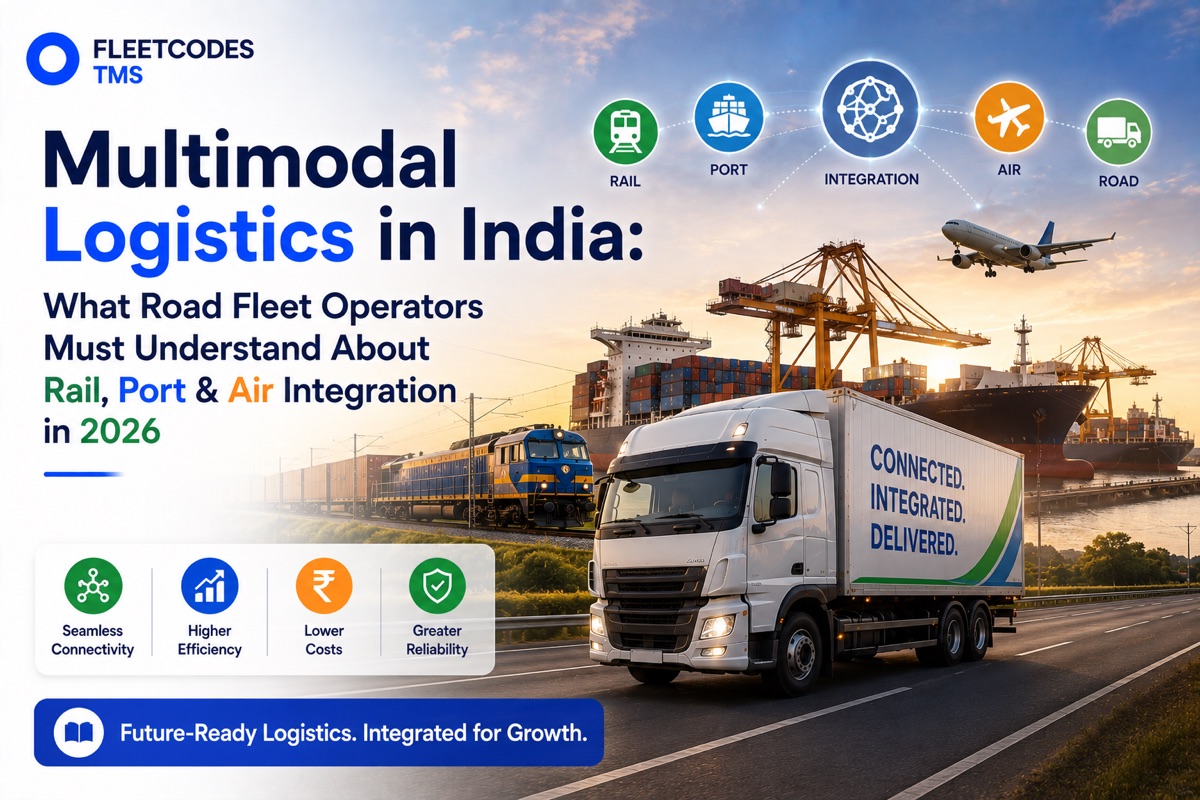
CONCOR is accelerating India's logistics transformation with 16 Multimodal Logistics Parks and 7 Goods Consolidation Terminals. The Eastern and Western Dedicated Freight Corridors are substantially operational. Freight trains are running at 70 km/h on DFC tracks. India's multimodal logistics infrastructure has arrived — and for road fleet operators, the implications are significant.
What Multimodal Logistics Actually Means in the Indian Context
Multimodal logistics India refers to the movement of goods using more than one mode of transport — typically a combination of road, rail, sea, or air — under a single contract, with coordinated handoffs between modes managed as a seamless chain rather than a sequence of disconnected transactions.
In India's context in 2026, the most practically significant multimodal corridors are:
Road-Rail (DFC-linked): Factory or origin → road to DFC terminal → rail on the Dedicated Freight Corridor → road from destination DFC terminal to final delivery
Road-Port (container movement): Factory → road to inland container depot (ICD) or container freight station (CFS) → rail or road to port → sea
Road-Air (express cargo): Warehouse → road to air cargo terminal → air freight → road from destination airport → delivery
For road fleet operators, the question is not whether multimodal is happening — it clearly is. The question is how it affects your business and where the opportunities lie.
The Dedicated Freight Corridor: Competition and Opportunity
The DFC is the single most significant infrastructure development for road freight in India — and it cuts both ways for truck operators.
The Competition Reality
The Eastern DFC (Ludhiana to Dankuni) and Western DFC (Dadri to JNPT) are now substantially operational. Freight trains on DFC tracks run at 60–70 km/h versus 25 km/h on the conventional rail network — transforming rail's time competitiveness on these corridors.
For road operators who primarily run long-haul freight on the DFC corridor routes — Gujarat-Mumbai, Delhi-Mumbai, Punjab-Kolkata — the competitive dynamics have changed. Rail is no longer a slow alternative; on DFC routes, it is a genuinely fast alternative for bulk and container freight that can tolerate the terminal handling time at each end.
The freight segments most exposed to DFC competition:
- Bulk commodities (steel, cement, fertiliser) on DFC corridors where rail efficiency is highest
- Container freight (both domestic and export/import) where container train services have expanded significantly
- Any shipper with predictable volumes and schedule flexibility who previously defaulted to road on these corridors
The Opportunity Reality
DFC competition for road freight on trunk corridors creates first-and-last-mile opportunity that is potentially larger than the trunk haul lost.
Every DFC terminal or multimodal logistics park requires:
- Inbound road freight: Goods must move from origin (factory, warehouse) to the DFC terminal. This is road freight — and it is growing as DFC terminal volumes grow.
- Outbound road freight: Goods must move from the DFC terminal to the final consignee. This is also road freight — and in markets where rail volumes are high, the outbound distribution requirement is substantial.
- Freight consolidation and deconsolidation: Goods arriving at a terminal need sorting, consolidation into rail units, deconsolidation from incoming trains, and staging for outbound distribution. Road vehicles are integral to this process.
Fleet operators who position themselves as preferred first-and-last-mile partners for DFC terminals are accessing a growing market — not competing with DFC, but integrating with it.
The 16 Multimodal Logistics Parks: What They Mean for Fleet Operators
CONCOR's 16 Multimodal Logistics Parks (MMLPs) — announced under PM Gati Shakti and being developed across major freight corridors — are purpose-built intermodal hubs integrating rail sidings, road access, warehousing, customs facilities, and value-added service zones.
Why MMLPs matter for road fleet operators:
MMLPs are becoming freight concentration nodes — points where large volumes of goods aggregate for onward movement by road, rail, or further multimodal distribution. The road freight requirement around an MMLP is significant:
- Collection from factories and farms in the surrounding catchment area
- Linehaul from the MMLP to regional distribution centres
- Last-mile distribution from the MMLP to end recipients in the surrounding geography
- Specialised movements — temperature-controlled, oversized, hazardous — that rail cannot handle and must move by road regardless of DFC capacity
Fleet operators who establish operations near or serving major MMLPs are positioning for the freight concentration that these hubs will create over the next 5 years.
Road-Port Integration: The Container Movement Opportunity
India's 13 major ports and the ICDs and CFSs that serve them create a significant and growing road freight requirement. Container drayage — the movement of containers between ports, ICDs, and shipper locations — is a road freight function that multimodal infrastructure growth is expanding, not contracting.
Key operational characteristics of container drayage for road fleet operators:
Specialised vehicles: Container movement requires flatbed trailers or skeletal trailers capable of carrying 20-foot or 40-foot ISO containers, with twist locks and appropriate chassis ratings.
Port access requirements: Port entry for vehicles carrying containers requires advance pre-gate appointments, vehicle and driver registration in port systems, and compliance with port terminal operating procedures.
Customs status awareness: A container in customs hold cannot be moved; one that has received customs out-of-charge can. The driver and dispatcher need to know the customs status of the container before a pickup attempt.
Detention tracking: Container depots and ports apply detention charges for containers held beyond the free time window (typically 3–5 days for imports). Fleet operators who track container detention via their TMS can alert shippers to approaching detention exposure.
Fleetcodes manages container trip records with container number tracking, detention time monitoring, and customs status fields — giving fleet operators the operational data needed to manage container drayage professionally.
Air Cargo Ground Transport: A Growing Niche
India's air freight market grew 14% in FY2024–25 to 4.1 million tonnes — driven by pharma exports, electronics, and perishables. This growth directly expands the ground transport requirement around airports.
Air cargo ground transport involves:
Pre-flight collection: Picking up cargo from exporter warehouses and delivering to air cargo terminals before flight departure — with strict cut-off times that make punctuality critical.
Post-flight delivery: Collecting import air cargo from customs-cleared air cargo terminals and delivering to the consignee within the rapid delivery window that air cargo shippers expect.
Specialised pharma and perishable handling: GDP-compliant temperature management for pharmaceutical imports and exports; perishable handling with rapid transit times.
For fleet operators near India's major air cargo hubs — Delhi, Mumbai, Bengaluru, Hyderabad, Chennai — air cargo ground transport is a niche with premium rates, high service quality requirements, and growing volume.
How Fleet Technology Supports Multimodal Operations
Managing road fleet operations as part of a multimodal chain creates documentation and coordination requirements beyond standard freight:
Container number tracking: Every container movement requires the container number and seal number in the trip record — linked to port documentation, customs records, and the shipper's logistics system.
Multi-leg trip management: A multimodal journey has multiple legs with multiple modes. The road legs must be managed as part of this chain — with ETAs that factor in terminal handling time, rail transit time, and road leg transit time.
Terminal coordination: Port, ICD, and MMLP terminals have their own appointment systems and operational windows. Fleet management platforms that integrate these requirements into dispatch planning reduce the idle time and detention costs that come from poor terminal coordination.
Documentation chain: Multimodal movements require coordinated documentation — lorry receipt for the road leg, rail consignment note for the rail leg, bill of lading for the sea leg. Each must be correctly referenced against the others for a clean chain of custody.
Real-time visibility for multimodal chains: Shippers and freight forwarders managing multimodal movements need visibility not just on the road leg, but on the full chain status. Fleetcodes provides the road leg visibility that integrates with multimodal tracking systems to create end-to-end cargo status visibility.
FAQs
What is multimodal logistics and how does it affect Indian road transporters? Multimodal logistics involves moving goods using two or more transport modes — road, rail, sea, or air — in a coordinated chain. For Indian road transporters, multimodal growth creates competition on DFC corridor trunk hauls but significant opportunity in first-and-last-mile connectivity to DFC terminals, MMLPs, ports, and air cargo hubs.
How does the Dedicated Freight Corridor affect road freight in India? The DFC makes rail freight meaningfully faster on key corridors — competitive with road for bulk and container freight on those routes. For road operators, this means potential loss of trunk haul volume on DFC corridors, balanced by growing first-and-last-mile demand as DFC terminal volumes increase.
What are India's Multimodal Logistics Parks and why do they matter? India's 16 Multimodal Logistics Parks are purpose-built intermodal freight hubs integrating rail, road, warehousing, and customs facilities. They create freight concentration nodes where substantial road freight — both inbound collection and outbound distribution — is required around each hub.
How can road fleet operators benefit from multimodal logistics growth? The primary opportunities are: first-and-last-mile connectivity to DFC terminals and MMLPs, container drayage between ports and ICDs, air cargo ground transport near major airports, and specialised road movements (temperature-controlled, oversized, hazardous) that rail cannot handle regardless of DFC capacity.
What operational capabilities does multimodal road freight require? Container drayage requires specialised flatbed or skeletal trailers and knowledge of port terminal procedures. MMLP-connected operations require structured terminal appointment management and multi-leg trip documentation. Air cargo ground transport requires time-critical dispatch and temperature management capability for pharma and perishables.
India's multimodal infrastructure is not competing with road freight — it is creating new road freight requirements at every terminal, hub, and port it serves. The fleet operators who understand this are positioning for growth, not retreat. See How Fleetcodes Supports Multimodal Road Fleet Operations →