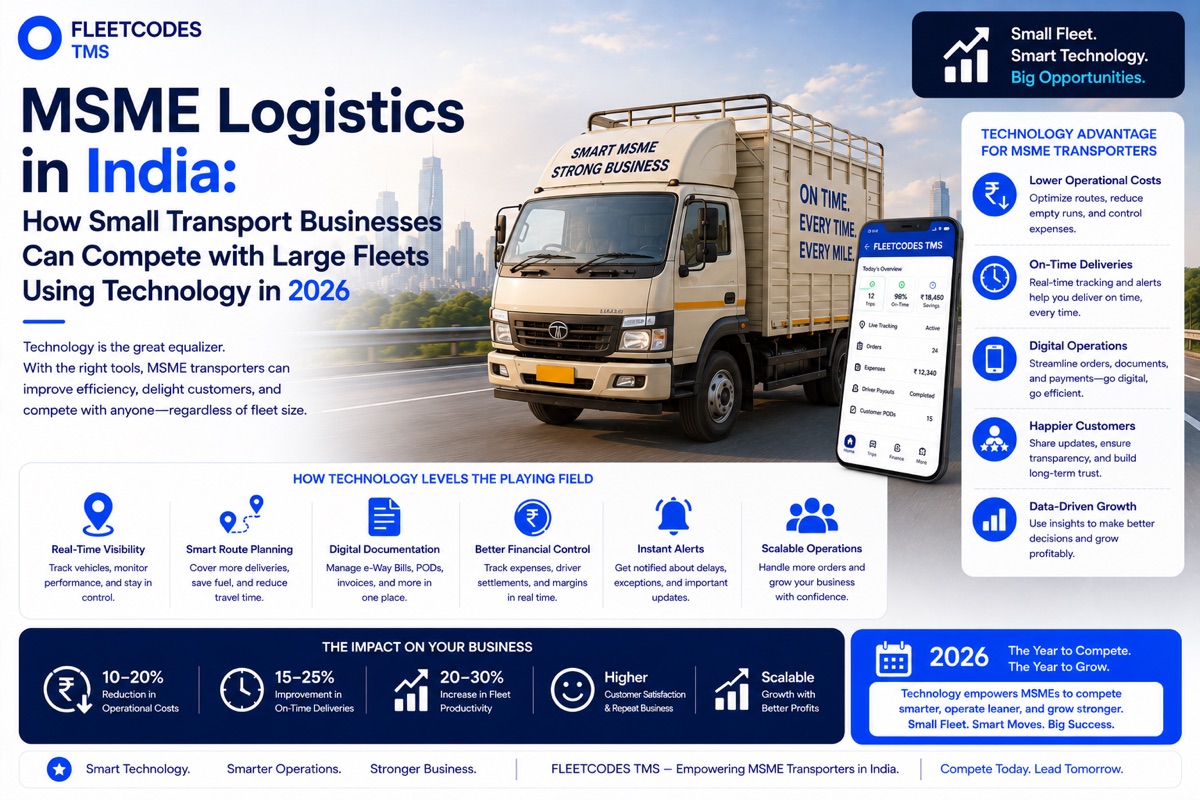
India has over 63 million MSMEs. A significant proportion of them are small transport and logistics businesses — running 5 to 30 vehicles, serving regional customers, and operating mostly on manual processes inherited from when the business started. In 2026, this is no longer a sustainable competitive position. The gap between what technology-enabled fleets can offer and what manual operations can deliver is widening — and the market is noticing.
The Reality of Running a Small Transport Business in India
Small transport business India owners are some of the most operationally resourceful people in the country. Running a 10-vehicle fleet across 3 states, managing driver relationships, negotiating with customers, staying on top of compliance, and keeping vehicles roadworthy — all while handling the financial management of a thin-margin business — requires genuine skill and daily problem-solving.
But resourcefulness has limits. When every bill is manually calculated, every driver settlement is done by hand, every POD is a piece of paper that may or may not make it back to the office, and every dispatch decision is made through phone calls and memory — the business is structurally capped.
It cannot scale beyond what one capable owner-operator can personally manage.
It cannot win contracts that require digital documentation and compliance evidence.
It cannot respond to customer service expectations that assume real-time tracking.
And it cannot compete on service quality with larger fleets who have invested in technology — because all the owner's management time is consumed by the daily administrative work that technology would automate.
MSME logistics India technology has historically not addressed this gap well. Enterprise TMS platforms were priced for large fleets. GPS hardware required IT infrastructure. Implementation projects took months. The small fleet operator was left choosing between expensive enterprise tools designed for a different scale — or continuing to run manually.
In 2026, that has changed. Cloud-based, per-vehicle SaaS platforms designed specifically for growing fleets make enterprise-grade logistics automation available at a cost and complexity level that works for a 10-vehicle MSME.
The Five Technology Gaps That Small Fleets Must Close
Gap 1: Billing and Invoicing
This is where most small fleet management India businesses lose the most money. Manual billing in a small fleet means:
- Invoices raised 3–7 days after delivery — because someone needs to compile the billing information from trip sheets, PODs, and rate cards
- Rate card errors — because the person raising the invoice is working from memory or a rate sheet that may be outdated
- Missed surcharges — detention, overweight, fuel adjustment — that should be charged but aren't
- Lost PODs that mean invoices are never raised at all
For a small fleet doing ₹8–15 lakh per month in freight, even 5% billing leakage is ₹40,000–75,000 per month. That is almost certainly more than the monthly cost of billing automation software.
What technology closes this gap: Automated invoice generation triggered by digital POD confirmation. Rate cards stored in the system and applied automatically. Surcharge rules configured once and applied every time. The billing cycle shrinks from days to hours.
Gap 2: Driver Settlement and Retention
Driver attrition is proportionally more damaging for small fleets than large ones. When a 10-vehicle fleet loses one of its experienced drivers, it loses 10% of its operational capacity — and the replacement process is expensive and disruptive.
Most MSME freight management driver attrition is driven by settlement disputes. When settlements are calculated manually, they are slow, they are opaque, and they are frequently wrong. Drivers who do not trust the settlement process look for employers who have a more transparent one.
What technology closes this gap: Automated settlement calculation visible to the driver via a mobile app. Every component of the pay — trip base rate, per-km, advances, expenses — is visible and verifiable in real time. Disputes fall. Drivers stay.
Gap 3: Real-Time Visibility for Customers
The customers who pay the best rates — organised retail, FMCG manufacturers, e-commerce brands — increasingly require real-time shipment tracking as a baseline service requirement. They have been using it from their large logistics partners for years. When they engage a smaller transporter, they expect the same visibility.
A small fleet operator who cannot provide a live tracking link is competing only on rate — the most commoditised dimension of the business. One who can provide live tracking, digital POD, and automated delivery confirmation is competing on service quality — a dimension where size matters less.
What technology closes this gap: GPS integration with a customer-facing portal. When the shipper can track their consignment directly — without calling the transport office — the small operator delivers a service experience that was previously only available from large logistics companies.
Gap 4: Compliance Documentation
E-way bill management, vehicle document tracking, driver licence validity, fitness certificate currency — compliance in a small fleet is a daily operational task. When it is managed manually, gaps happen. Vehicles go out with expired documents. E-way bills are generated late or not at all. The resulting checkpoint fines and detentions are a significant cost for small operators who cannot afford professional compliance staff.
What technology closes this gap: Automated e-way bill generation from trip data. Vehicle and driver document expiry tracking with advance alerts. Compliance runs in the background — not as a task someone remembers to do.
Gap 5: Management Visibility
When a small transport business owner does not have real-time visibility into their own operations — which routes are profitable, which drivers are efficient, which customers are generating positive margins — every business decision is made on incomplete information.
Affordable TMS India platforms give MSME operators the same management dashboard available to enterprise fleets: per-trip P&L, fleet utilisation rate, fuel consumption per vehicle, on-time delivery performance. The owner can see the business in real time — not through a month-end report assembled from memory and spreadsheets.
What Affordable Technology Actually Costs — and What It Returns
The objection most transport business technology MSME owners raise is cost. And it is a fair concern — cash flow in a small logistics business is tight, and any new expense is evaluated carefully.
The relevant comparison is not "what does the software cost" versus "what does it save." It is "what does the software cost" versus "what does staying manual cost."
For a 10-vehicle small fleet doing ₹10 lakh per month in freight:
| Manual Operations Cost | Monthly Amount | |---|---| | Billing leakage (5% of revenue) | ₹50,000 | | Driver attrition (2 replacements/year at ₹50K each) | ₹8,333 | | Admin staff time on invoicing/settlement (20hrs/month at ₹200/hr) | ₹4,000 | | Compliance fines (1 event/month average) | ₹5,000–10,000 | | Total monthly cost of manual operations | ₹67,000–72,000 |
A per-vehicle cloud TMS subscription for 10 vehicles at typical Indian SaaS pricing: significantly less than this figure every month.
The ROI closes in the first month of correct billing alone.
How Fleetcodes Is Designed for MSME Fleet Operators
Fleetcodes was built with the Indian MSME fleet operator as a core design consideration — not as a scaled-down version of an enterprise product, but as a platform whose deployment model, pricing structure, and interface design reflect the realities of running a 10–50 vehicle business.
Fast deployment: Core functionality — dispatch, GPS integration, digital POD, billing, and driver app — is live within 3–7 days. No IT project. No implementation consultant. No six-month rollout.
Driver app designed for real-world use: The Fleetcodes driver app works on basic Android smartphones with limited data plans. Offline functionality ensures trip updates and POD capture work even in areas with poor network coverage. Training for a driver with basic smartphone literacy takes under an hour.
Scalable pricing: Per-vehicle subscription pricing means a 10-vehicle fleet pays for 10 vehicles. As the fleet grows to 20, 30, or 50 vehicles, the cost scales with actual fleet size — no large upfront licensing commitment.
India-first compliance: E-way bill integration, GST-compliant invoicing, FASTag toll tracking, and AIS 140 GPS connectivity are built in — because these are the compliance requirements that MSME operators in India face every day.
No IT department required: The system is cloud-hosted and managed by Fleetcodes. Updates happen automatically. Data is backed up continuously. The MSME operator accesses everything through a browser or mobile app — no servers, no IT infrastructure, no maintenance overhead.
The Competitive Opportunity: What Technology Enables for Small Fleets
When a small transport business closes the five technology gaps above, something important changes. They are no longer competing only on rate. They are competing on:
- Billing accuracy — invoices that are correct, complete, and issued the same day as delivery
- Compliance reliability — documentation that holds up at checkpoints and in customer audits
- Visibility — live tracking and digital POD that large shippers require
- Driver quality — lower attrition means more experienced, more consistent drivers on customer routes
- Profitability data — the ability to quote lanes accurately because you know what they actually cost
This is the service quality platform of a much larger fleet — delivered by a 15-vehicle MSME that happens to run efficiently. And in a market where most small transport businesses are still operating manually, this is a genuine competitive differentiator.
FAQs
What is MSME logistics in India? MSME logistics refers to the transport and logistics operations of India's micro, small, and medium enterprises — including small fleet operators running 5–50 vehicles, regional trucking companies, and owner-operators providing road freight services. MSMEs collectively move a significant proportion of India's domestic freight.
How can small transport businesses compete with large fleets in India? Small fleets compete most effectively by closing the service quality gaps that technology enables: accurate digital billing, real-time customer visibility, digital compliance documentation, and professional driver management. These capabilities are now accessible through affordable cloud TMS platforms without the enterprise price tag.
What features does a small fleet most need in a TMS? For most 10–30 vehicle MSME fleets, the highest-priority features are: digital POD with automated billing trigger, customer rate card management, GPS integration for real-time tracking, driver settlement automation, e-way bill integration, and vehicle document expiry alerts. These five capabilities address the majority of MSME fleet operational pain.
Is fleet management software affordable for small businesses in India? Yes. Cloud-based per-vehicle SaaS platforms like Fleetcodes are priced to be accessible for fleets from 10 vehicles upward — with subscription costs that are typically recovered within the first month through billing leakage recovery alone. The days of fleet management software requiring a large upfront licensing investment are over.
How quickly can a small fleet implement a TMS without IT support? With Fleetcodes, most small fleets are operationally live — dispatch, GPS tracking, digital POD, and billing — within 3–7 days of signing up. The platform requires no IT infrastructure, no implementation consultant, and minimal technical training for drivers and office staff.
The technology that large logistics companies have been using for years is now accessible to any Indian transport business willing to adopt it. The gap between small and large is no longer about resources — it is about the decision to modernise. Book a Free Fleetcodes Demo for Your Small Fleet →