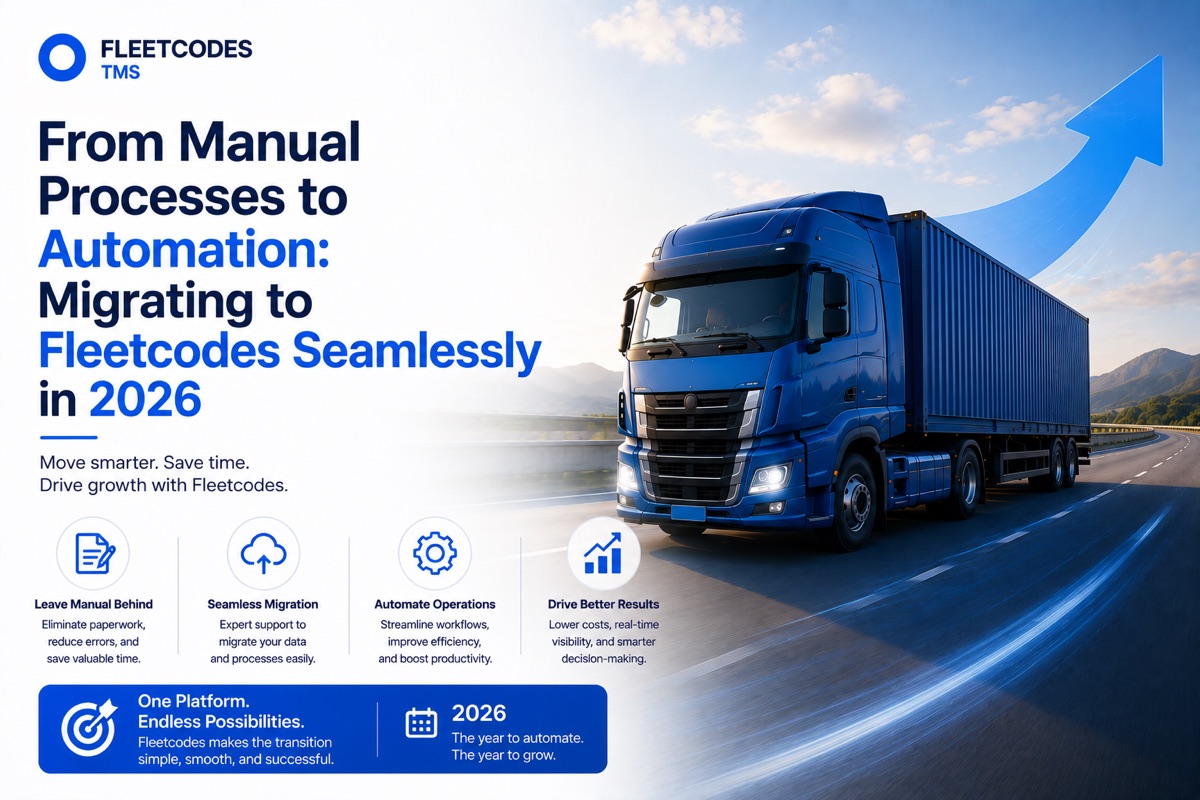
The biggest blocker to logistics automation isn't the technology — it's the fear of disruption during migration. Here's how Fleetcodes makes the move from manual operations smooth, fast, and risk-free.
Why Most Transport Businesses Stay Stuck on Manual Processes
Ask any transport business owner why they haven't digitised their operations yet, and the answers follow a familiar pattern:
"We've been doing it this way for 10 years and it works." "I don't want to disrupt operations while we switch." "My team isn't tech-savvy enough." "What if something goes wrong during the transition?"
These are legitimate concerns. A transport business can't afford downtime — loads are moving every day, drivers are on the road, customers are expecting deliveries. The risk of a botched technology migration feels very real.
But here's the counterargument: staying manual is also a risk. Every month of manual operations is a month of billing delays, route inefficiencies, driver settlement disputes, and management decisions based on incomplete data. The cost of not migrating compounds quietly — and eventually becomes larger than any migration risk.
The question isn't whether to automate. It's how to do it without breaking what's already working.
Fleetcodes is designed for exactly this transition — a migration path from manual operations to full workflow automation that keeps your business running while the change happens around it.
See how Fleetcodes migrates your operation smoothly → Book a Free Demo
What "Migration" Actually Means in a Logistics Context
Moving to a transport management system isn't a single event — it's a transition across several operational areas. Understanding the components helps reduce the anxiety around the process:
Data migration — moving your existing master data (vehicles, drivers, customers, rate cards) into the new system. Fleetcodes provides structured templates and data import tools that make this straightforward.
Workflow migration — redesigning your operational processes (dispatch, POD, billing, settlement) from manual to automated. Fleetcodes maps your existing SOPs and configures the platform to mirror them — then progressively automates the manual steps.
Team migration — training dispatchers, accounts staff, drivers, and managers to use the new system. Fleetcodes is built for users at every technical literacy level, with role-specific interfaces that show each person only what's relevant to their function.
Integration migration — connecting Fleetcodes to your existing GPS hardware, accounting tools, and customer systems. Fleetcodes' open API architecture handles this without requiring a full technology overhaul.
None of these steps require you to pause your business. The migration happens in parallel with live operations.
The Role of AI Agents in Modern Logistics Automation
One of the most significant shifts in enterprise operations software in 2026 is the emergence of AI agents — autonomous software processes that can handle defined tasks independently, without requiring human instruction for each action.
In the context of logistics workflow automation, AI agents in Fleetcodes operate across several areas:
Dispatch assistance agents — monitor incoming load requests, match them against available vehicles, and surface recommendations to dispatchers automatically. Rather than a dispatcher scanning a spreadsheet to find the best vehicle, the AI agent presents the optimal match with supporting rationale.
Billing agents — monitor trip completion events and automatically initiate invoice generation based on confirmed PODs and customer rate cards. The billing agent handles routine invoices without human intervention, flagging exceptions for human review.
Compliance agents — track e-way bill validity against active trips and automatically flag extensions needed before expiry. The compliance agent monitors every multi-state trip continuously — something no human dispatcher can do manually at scale.
Cost monitoring agents — watch for anomalies in fuel consumption, route deviation, and idle time across the fleet, surfacing exceptions that warrant operations manager attention.
These AI agents don't replace human judgement — they eliminate the routine monitoring and decision-making that consumes dispatcher and management capacity, freeing people to focus on the decisions that genuinely require human insight.
Human-in-the-Loop AI: How Fleetcodes Keeps People in Control
A common concern about workflow automation and AI agents is the loss of human oversight — the worry that automation will make decisions that a human would have caught and corrected.
Fleetcodes is designed around a human-in-the-loop AI architecture — meaning that AI handles the data processing, pattern recognition, and routine recommendations, but humans retain decision authority at every point where judgement matters.
In practice, this means:
- An AI dispatch recommendation is just that — a recommendation. The dispatcher confirms, modifies, or overrides it
- Automated billing handles standard invoices; exceptions (disputed rates, unusual charges, new customers) are flagged for human review
- AI-generated driver settlement calculations are visible to both the driver and the accounts team before finalisation
- Cost anomaly alerts surface to managers — but the manager decides whether to act and how
This human-in-the-loop AI approach gives your team the productivity benefits of automation without removing the human accountability that's essential in a business where every decision has real financial and operational consequences.
Migration Phases: How Fleetcodes Transitions Your Operation
Fleetcodes uses a structured three-phase approach to migration that keeps risk low and adoption high:
Phase 1: Foundation (Days 1–3)
- Master data loaded — vehicles, drivers, customers, rate cards
- GPS integration connected — live tracking feeds into Fleetcodes dashboard
- Team accounts created — dispatcher, manager, driver, and accounts roles configured
- Pilot trips run — a small subset of daily operations on Fleetcodes while the rest continues as normal
What this achieves: Your team sees the system working with real data before full cutover. Confidence builds. Issues are identified and resolved on a small scale.
Phase 2: Core Workflow Migration (Days 4–10)
- Dispatch moves to Fleetcodes — all trip assignments created and managed in the platform
- Driver app live — drivers receive assignments, update status, and capture PODs digitally
- Billing migrates — invoices generated from Fleetcodes trip data (run parallel to existing billing system briefly for validation)
- Workflows for settlements, expense management, and customer notifications configured
What this achieves: The core operational loop — dispatch, delivery, billing — is fully on Fleetcodes. The old system is no longer the source of truth.
Phase 3: Full Automation and Optimisation (Days 11–30)
- AI agents fully active — automated billing triggers, compliance monitoring, dispatch assistance
- Management dashboards configured — P&L per trip, fleet utilisation, cost trends
- Advanced features activated — geofencing, route optimisation, profit-per-load reporting
- Production operations running entirely on Fleetcodes
What this achieves: The business is fully automated. Manual processes that used to consume hours are handled by the system. The team is managing by exception rather than by routine tasks.
What Changes for Each Role in Your Business
Dispatchers Before: Spreadsheet + phone calls + whiteboard. Reactive, manual, capacity-limited. After: AI-assisted dispatch recommendations, live fleet visibility, automated route optimisation. The same dispatcher manages 2–3x more vehicles effectively.
Accounts / Billing Team Before: Waiting for paper PODs, manual invoicing, settlement calculations by tally. After: Automated invoice generation on POD confirmation, digital settlement summaries, exception-only review. Billing cycle from days to hours.
Drivers Before: Paper trip sheets, cash expense claims, uncertainty about settlement. After: App-based trip updates, digital POD capture, transparent real-time settlement visibility. Less friction, faster payment.
Operations Manager / MD Before: End-of-month reports assembled manually, always looking backward. After: Live enterprise operations dashboard — profit per trip, fleet utilisation, cost anomalies, delivery performance — in real time.
The Real Risk Is Waiting
Every quarter without workflow automation is a quarter where:
- Competitors who have automated are getting faster, cheaper, and more accurate
- Your manual processes are a ceiling on how much you can scale without adding headcount
- Data that could be informing better decisions is being lost in paper records and spreadsheets
- Production capacity is being consumed by administrative tasks rather than operational growth
Fleetcodes' migration approach is designed to eliminate the legitimate fear of disruption — so that the only reason left not to automate is inertia. And inertia has a cost too.
FAQs
How long does migrating to Fleetcodes take? Most Fleetcodes customers complete the core migration — dispatch, GPS integration, digital POD, and billing — within 7–10 days. Full automation including AI agent activation and advanced reporting typically takes 2–4 weeks from initial setup.
Does the team need technical expertise to use Fleetcodes? No. Fleetcodes is designed for users across all technical literacy levels. Dispatchers, drivers, and accounts staff work within role-specific interfaces that show only what's relevant to their function. Driver training typically takes under an hour.
What are AI agents in the context of logistics automation? AI agents in Fleetcodes are automated software processes that handle defined tasks — billing triggers, compliance monitoring, cost anomaly alerts, dispatch recommendations — without requiring manual instruction for each action. They work within a human-in-the-loop AI framework where humans retain decision authority.
How does Fleetcodes support human-in-the-loop AI? Fleetcodes' automation is designed so that AI handles data processing and routine recommendations, while humans confirm, modify, or override decisions at every point where judgement matters. Automation increases speed and consistency; humans maintain accountability and control.
What happens to existing data during migration to Fleetcodes? Fleetcodes provides structured data import tools for vehicles, drivers, customers, and rate cards. Historical trip data can be archived digitally. The migration team at Fleetcodes supports data preparation and import — ensuring your master data is accurate in the new system from day one.
The migration to automation doesn't have to be disruptive. With Fleetcodes, it's designed not to be. Book Your Free Fleetcodes Demo →