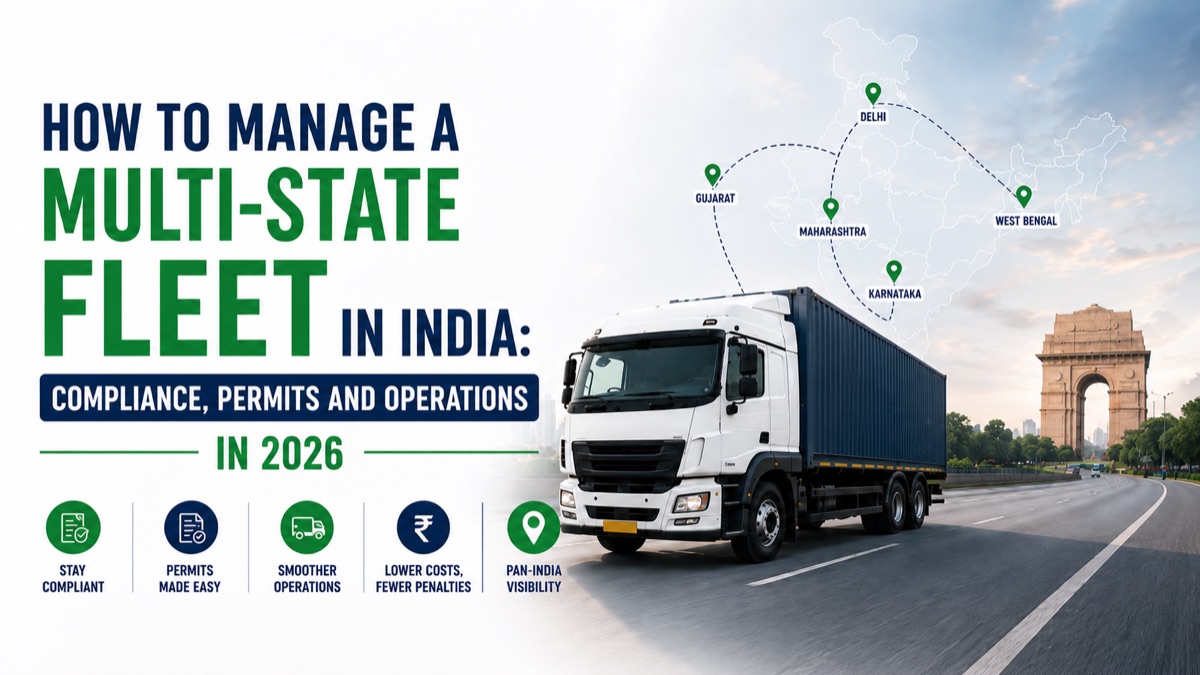
India has 28 states and 8 union territories — each with its own transport department, its own road tax structure, and its own enforcement priorities. A fleet that operates only within one state navigates a relatively manageable compliance environment. A fleet operating across multiple states navigates all of them simultaneously. The difference in compliance complexity is significant — and the cost of getting it wrong is measurable.
The Multi-State Compliance Framework: What Changes When You Cross a Border
National Permit vs State Permit
The most fundamental compliance requirement for multi-state operations is the National Permit — the authorisation that allows a commercial vehicle to carry goods anywhere in India.
A vehicle with only a State Permit (or a specific route permit issued by its home state) is legally restricted to operating within that state. Crossing a state border without a National Permit is a Motor Vehicles Act violation — subject to fine and vehicle detention.
National Permit acquisition:
- Applied through the home state's Regional Transport Authority (RTA) via the Parivahan portal
- For most commercial vehicle categories, validity is 5 years
- Counter-signature permits are required from each state the vehicle will operate in, in addition to the national permit
Counter-signature permits: A National Permit must be counter-signed by the transport authority of each state the vehicle will operate in. This is a separate application per state, with its own fee and processing time.
For a vehicle operating in 5 states, that means: 1 National Permit + 4 counter-signature permits, each with its own validity period and renewal requirement.
Fleetcodes stores permit details per vehicle — including which states are covered, counter-signature permit numbers, and expiry dates — generating advance alerts before any permit expires and flagging vehicles for renewal before they are assigned to routes in states where their permits are approaching expiry.
State-Specific Road Tax
Most Indian states require payment of road tax for commercial vehicles operating within their territory — either as a one-time payment at permit issuance or as an annual fee. Road tax rates, applicable vehicle categories, and collection mechanisms vary by state.
For multi-state operators, tracking road tax payment status across multiple states adds administrative overhead that is easy to miss in a manual compliance management system — and has compliance consequences when missed.
E-Way Bill Validity Across State Borders
Multi-state freight movements face the greatest e-way bill validity risk — because longer journeys consume more validity time, and delays at state border checkpoints, loading docks, and urban traffic can push actual transit time beyond the estimated duration the e-way bill was generated for.
E-way bill validity is calculated at 1 day per 200 km (standard cargo). A Delhi-to-Chennai run of approximately 2,200 km has a validity of 11 days — which sounds comfortable. But a vehicle encountering 3 days of delay at intermediate points has only 8 days of validity remaining for a journey that may need 10.
Fleetcodes tracks e-way bill validity against estimated trip progress — alerting dispatchers when a vehicle is at risk of validity expiry before reaching its destination. Extension can then be applied before the bill expires, preventing the checkpoint violation that would result from an expired bill on a vehicle still in transit.
Operational Considerations for Multi-State Fleet Management
State-Specific Toll Structures
Toll rates on national highways are centralised through NHAI, but state highways and expressways have their own toll structures — and FASTag integration varies. A route that crosses 3 states may encounter different FASTag acceptance rates, different toll plaza layouts, and different queue management systems at state border crossing points.
For fleet operators managing toll costs across multi-state operations, the challenge is allocating toll expenditure accurately to the correct trip and customer — particularly when a single trip crosses multiple toll authorities.
Fleetcodes integrates FASTag transaction data per vehicle — automatically allocating toll costs to the trip in progress at the time of each transaction, regardless of which state's toll infrastructure it passes through.
State-Level Intra-State E-Way Bill Requirements
The inter-state e-way bill requirement (above Rs 50,000 value) is uniform across India. But several states have their own intra-state e-way bill requirements — different value thresholds and different commodity exemptions.
For a vehicle that completes a long-haul inter-state delivery and then picks up a return load within the destination state, the intra-state e-way bill rules of the destination state apply to the return movement — not the origin state's rules.
Multi-state operators must know the intra-state e-way bill rules for every state they regularly operate in — and ensure drivers are aware of what documentation is required for within-state movements in each state they operate.
Checkpoint Navigation and Documentation Readiness
State border checkpoints and mobile enforcement units vary significantly in their documentation requirements and enforcement intensity across India. Some states have highly systematic enforcement with automated vehicle scanning. Others rely on officer discretion.
The consistent protection against checkpoint delays is complete documentation, immediately producible:
- National Permit (hard copy or DigiLocker digital)
- All applicable counter-signature permits
- Current fitness certificate
- Valid insurance certificate
- Current PUC certificate
- Driver licence with appropriate endorsements
- E-way bill for each consignment on the vehicle
- Bilty for each consignment
Fleetcodes driver app stores vehicle and driver document references — with expiry dates visible. The driver knows exactly which documents should be current before departure.
How Fleetcodes Manages Multi-State Compliance
Permit Coverage Tracking per Vehicle
Each vehicle in Fleetcodes has a permit profile — National Permit number and expiry, plus each state counter-signature permit with its individual expiry date. The system:
- Alerts the compliance team 30 days before any permit expires
- Flags vehicles in the dispatch dashboard when they are approaching assignment on routes in states where permits are near expiry
- Prevents accidental assignment of a vehicle to a state for which it lacks a current counter-signature permit
E-Way Bill Validity Monitoring on Active Trips
For long-haul multi-state trips, Fleetcodes tracks e-way bill validity against estimated trip duration. When a trip is running behind schedule due to delays — visible from GPS progress data — and the e-way bill validity is approaching expiry, a proactive alert reaches the dispatcher to initiate extension before the bill expires.
Multi-State Toll Cost Allocation
FASTag transactions are captured per vehicle and automatically allocated to the trip in progress — regardless of which state's toll infrastructure they occurred on. Multi-state route toll costs are visible per trip, per route, and per customer account — providing the data for accurate toll pass-through billing.
State-Specific Compliance Alerts
Fleetcodes can be configured with state-specific compliance rules — intra-state e-way bill thresholds, state-specific permit requirements, and any seasonal or category-specific restrictions for the states your fleet regularly operates in. The system flags the appropriate compliance requirements based on the origin, destination, and route of each trip.
FAQs
What permits does a commercial vehicle need to operate across multiple Indian states? A National Permit (valid for 5 years, issued by the home state RTA) plus counter-signature permits for each additional state the vehicle will operate in. Without a National Permit, a vehicle is legally restricted to its home state.
How does e-way bill management become more complex in multi-state operations? Longer journeys consume more validity time. Multi-state routes are more susceptible to delays at border crosspoints, loading docks, and urban traffic that push actual transit time beyond estimated duration. Fleetcodes tracks e-way bill validity against actual trip progress and alerts dispatchers before expiry — enabling extension before a checkpoint violation occurs.
How does Fleetcodes track permit compliance for multi-state fleets? Fleetcodes stores National Permit and counter-signature permit details per vehicle, with expiry dates and covered states. Advance alerts fire before expiry. The dispatch dashboard flags vehicles approaching permit expiry for states they are assigned to operate in.
Multi-state operations create multi-state compliance requirements. Fleetcodes manages them systematically — so your vehicles keep moving and your compliance record stays clean. Manage Your Multi-State Fleet with Fleetcodes — Book a Demo →