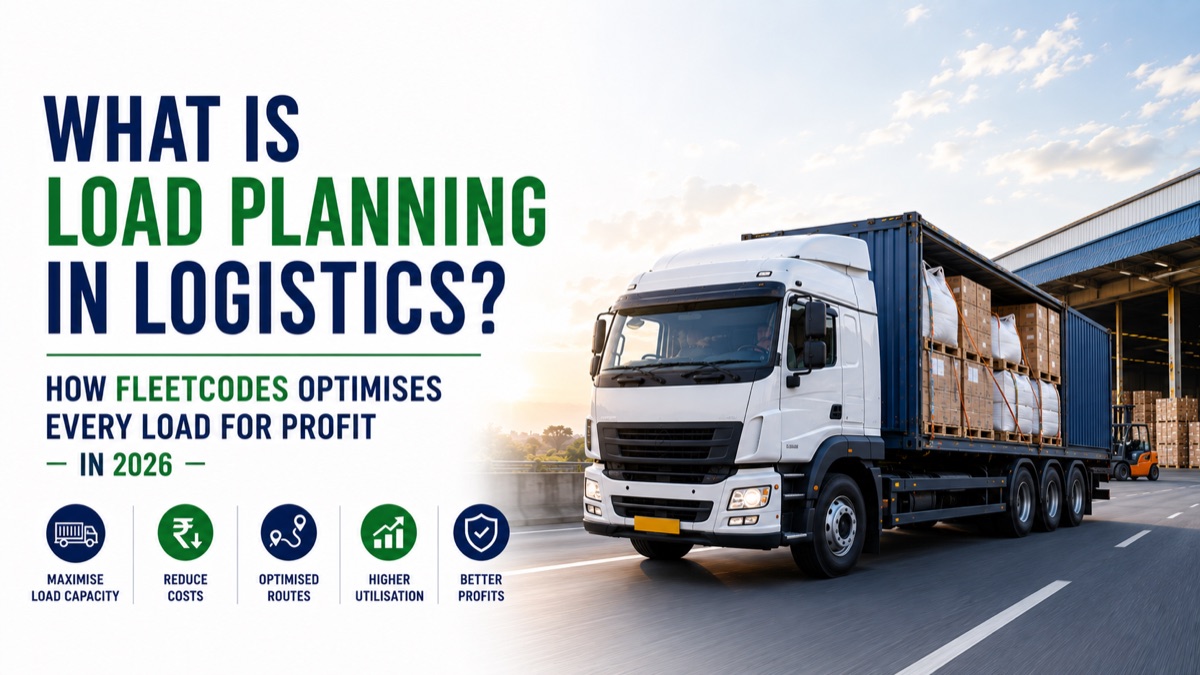
Load planning is the decision of which goods go on which vehicle, in what sequence, at what fill rate. Done well, it maximises vehicle utilisation, minimises fuel cost, ensures GVW compliance, and generates the best available margin on every trip. Done poorly — or not done at all — it is one of the largest sources of avoidable cost in any fleet operation.
What Load Planning Encompasses in Indian Fleet Operations
Load planning is broader than simply deciding which truck picks up which consignment. Done properly, it integrates several decisions simultaneously:
Vehicle-to-load matching: Which vehicle type is appropriate for this load's weight, volume, cargo type, and delivery requirements? Sending a 20-tonne HGV on a 2-tonne delivery is an expensive mismatch. Sending a 5-tonne LCV on a 12-tonne load is both operationally impossible and potentially a GVW violation.
Load sequencing for multi-stop trips: In PTL and last-mile operations, the sequence in which stops are loaded onto the vehicle determines the sequence in which they can be delivered — because goods loaded last are typically unloaded first. A poorly sequenced load means rehandling cargo at intermediate stops, adding time and risk of damage.
Load consolidation: Can multiple small consignments from different shippers be consolidated onto a single vehicle for a PTL run — improving vehicle fill rate and reducing cost per consignment?
Fill rate optimisation: What combination of loads maximises the vehicle's payload utilisation (kg and volume) for a given journey? A vehicle running at 60% of its legal payload capacity on every trip is generating 60% of its potential revenue on the same fixed costs.
GVW compliance at load planning stage: Does the planned load combination keep the vehicle within its legal Gross Vehicle Weight limit? GVW compliance verified at load planning prevents the checkpoint exposure and penalty risk of discovering an overload at a weighbridge.
Return load integration: Can a return load be incorporated into the trip planning from the start — so the vehicle returns with a paying load rather than running empty?
Why Load Planning Goes Wrong in Manual Operations
In manually managed fleet operations, load planning is effectively a dispatcher's judgment call — made quickly, under time pressure, with incomplete information.
The typical manual load planning process:
The dispatcher receives load bookings — by phone, by WhatsApp, by email. They mentally assess which vehicles are available, which are roughly in the right location, and which seem appropriate for the load. They assign based on experience and availability. The vehicle departs.
What this process consistently misses:
Actual vehicle availability vs assumed availability: A vehicle the dispatcher thought was available is running late on its previous delivery. The GPS data would have shown this — but the dispatcher did not check, or the GPS platform is separate from the dispatch tool.
GVW calculation: The dispatcher estimates the vehicle can carry the load based on experience — without calculating the actual loaded weight against the vehicle's specific GVW limit. Loads that seem reasonable by volume may exceed the legal payload for that vehicle by weight.
Fuel cost optimisation: The dispatcher assigns the nearest available vehicle — but the nearest vehicle is not necessarily the most fuel-efficient vehicle for that route type. A dispatcher without per-vehicle fuel efficiency data cannot make this optimisation.
Consolidation opportunities: Multiple small loads going to the same area could be consolidated on one vehicle — but the dispatcher managing 30+ loads simultaneously does not have the cognitive bandwidth to identify every consolidation opportunity.
Return load integration: The dispatcher assigns a vehicle to a long-haul load without checking whether a return load is available in the destination area — because they are focused on the outbound assignment, not the full round-trip picture.
Each of these misses has a direct cost. Collectively, they represent 15-25% of addressable operating cost in unoptimised fleet operations.
How Fleetcodes Optimises Load Planning
Fleetcodes transforms load planning from a dispatcher's judgment call into a data-driven optimisation — processing all relevant variables simultaneously and surfacing the best available decision.
Vehicle-Load Matching with GVW Compliance Check
When a load is created in Fleetcodes, the system evaluates every available vehicle against the load requirements:
- Vehicle type suitability: Does the vehicle category match the load's cargo type and requirements?
- Payload availability: Is the vehicle's available payload (GVW minus unladen weight and any current load) sufficient for this consignment's weight?
- Volume availability: Does the vehicle have sufficient cargo volume for the consignment's dimensions?
- GVW compliance: Will the addition of this load keep the vehicle within its legal GVW? If not, the vehicle is excluded from the recommendation — preventing the overloading decision before it happens.
The output is a ranked list of suitable vehicles — not all available vehicles, but the ones that match the load's requirements with GVW compliance confirmed.
Load Consolidation Intelligence
For PTL operations, Fleetcodes identifies consolidation opportunities automatically — surfacing loads going to the same destination area that can be combined on a single vehicle to improve fill rate and reduce per-consignment cost.
The consolidation recommendation shows the dispatcher: combined weight (GVW compliant), combined volume (within vehicle capacity), delivery sequence (optimised for the stop order), and estimated fuel cost saving versus running separate vehicles.
Fuel Efficiency-Based Vehicle Selection
Each vehicle in Fleetcodes has a fuel efficiency profile — actual km per litre on comparable route types, built from GPS and fuel data over time. When multiple vehicles are suitable for a load, Fleetcodes ranks them in part by fuel cost — so the most economical vehicle for the specific route type is surfaced first.
For a fleet with 10 HGVs of similar specification, fuel efficiency variation between vehicles can be 8-15%. Consistently assigning the most fuel-efficient vehicles to the highest-mileage loads reduces fleet-wide fuel cost without changing anything else about operations.
Return Load Integration in Trip Planning
When a one-way load is being planned, Fleetcodes checks whether any loads are available for pickup at or near the delivery destination — and surfaces potential return loads alongside the outbound assignment.
The dispatcher sees both legs simultaneously: "Vehicle MH-12-AB-3456 is recommended for this load. A return load is available 18 km from the delivery point — accepting it reduces the return leg to 12% deadhead vs 100% empty return."
This integration of return load consideration into the initial trip planning decision — rather than as an afterthought after departure — is one of the most direct load planning levers for reducing empty miles.
Load Sequence Optimisation for Multi-Stop Trips
For PTL and last-mile vehicles loading multiple consignments, Fleetcodes calculates the optimal loading sequence — ensuring goods are loaded in reverse delivery order (last stop loaded first, first stop accessible last) so that deliveries can be made without cargo rehandling.
This seemingly operational detail has real cost implications: vehicles that need to rehandle cargo at each stop take longer per delivery, consume more driver time, and create higher cargo damage risk from unnecessary handling.
The Profit Impact of Systematic Load Planning
When load planning is optimised across a 50-vehicle fleet:
| Metric | Unoptimised | Fleetcodes Optimised | |---|---|---| | Average vehicle fill rate | 58-65% | 75-85% | | Empty mile percentage | 28-35% | 14-20% | | GVW violation rate | 8-15% of trips | Near zero | | Fuel cost per trip | Baseline | 8-12% lower | | Revenue per vehicle per day | Baseline | 15-20% higher |
The financial compounding of these improvements across every vehicle, every day, is substantial. Fill rate improvement from 62% to 80% on a 50-vehicle fleet generating Rs 1 crore monthly revenue represents Rs 29 lakh in additional monthly revenue potential on the same fixed costs.
FAQs
What is load planning in logistics? Load planning is the decision-making process that determines which goods go on which vehicle, in what sequence, at what fill rate — optimising for GVW compliance, fuel efficiency, vehicle utilisation, and trip profitability simultaneously.
How does Fleetcodes improve load planning decisions? Fleetcodes evaluates vehicle-load matching against GVW compliance, cargo type suitability, fuel efficiency profiles, and return load availability — surfacing optimised recommendations that account for all variables simultaneously rather than requiring dispatchers to assess each factor manually.
Why is GVW compliance important at the load planning stage? A GVW violation discovered at a weighbridge creates immediate financial penalties (Rs 20,000+ fine plus 4x toll penalty from April 2026) and VAHAN database recording. Catching overloading at the load planning stage — before the vehicle departs — prevents the violation entirely at zero cost.
Every load your fleet carries is a profit opportunity or a profit leak — depending on whether it was planned with data or by gut feel. Fleetcodes makes every load a data-driven decision. See How Fleetcodes Optimises Load Planning — Book a Demo →