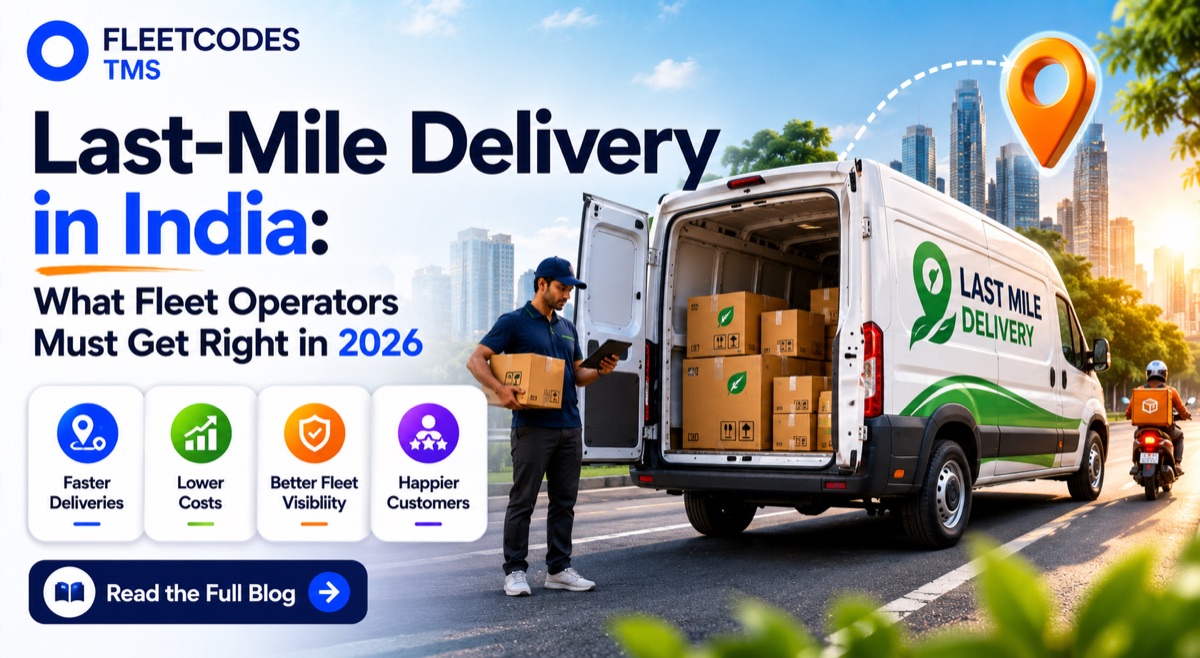
Last-mile delivery accounts for 41–53% of total shipping costs — and India's last-mile market is growing at its fastest rate in tier-2 and tier-3 cities, where e-commerce penetration has expanded 22% CAGR since 2025. For fleet operators, last-mile logistics is the highest-cost, highest-complexity, and highest-growth segment of Indian road freight.
What Makes Last-Mile Different — and Why It Matters for Fleet Operators
Last mile delivery India refers to the final leg of a freight journey — from the distribution hub or warehouse to the end recipient's address. It sounds simple. It is not.
The last mile is where freight encounters its greatest complexity:
- Urban traffic congestion that makes planned route times unreliable
- Consumer recipients who are not home, refuse delivery, or require rescheduling
- Multiple stops per vehicle per day — each with its own documentation, signature requirement, and delivery window
- Cash-on-delivery (COD) transactions that require cash handling and reconciliation alongside physical delivery
- The expectation — set by e-commerce platforms — of real-time tracking, ETA notifications, and instant delivery confirmation
These factors combine to make last-mile the most expensive part of any supply chain on a per-kilometre basis — and simultaneously the segment where customer experience is most directly shaped by fleet operations.
For fleet operators, last-mile logistics in 2026 represents both the highest-cost challenge and the highest-growth opportunity in Indian road freight.
The Tier-2 and Tier-3 City Opportunity
The structural growth story in Indian last mile fleet management is not in metros. It is in the geographic expansion of e-commerce into smaller cities and towns.
India's e-commerce sector is forecast at a 22% CAGR from 2025 to 2030 — driven substantially by rural smartphone penetration and UPI payment adoption in smaller markets. New micro-fulfilment hubs are being established to meet fast delivery demands in tier-2 and tier-3 cities, creating structured last-mile freight requirements across India's secondary geography.
For regional fleet operators in these markets, this represents a significant opportunity:
- E-commerce platforms and D2C brands need reliable last-mile partners in markets they are entering for the first time
- The established logistics players (Delhivery, XpressBees) have pin code coverage in these markets but may lack the local operational depth and relationship quality that a regional specialist can provide
- Regional carriers who can navigate local road conditions, regulatory frameworks, and delivery address complexity have an inherent advantage over national networks managing the same geography remotely
The fleet operators winning in tier-2 and tier-3 last-mile are those combining local knowledge with the technology infrastructure that e-commerce customers require — digital POD, real-time tracking, automated billing — capabilities that used to require large-enterprise scale and are now accessible through cloud TMS platforms.
The Five Operational Requirements of Effective Last-Mile Delivery
1. Multi-Stop Route Optimisation
A last-mile delivery vehicle making 15–25 stops per day in an urban area is fundamentally different from a long-haul truck on a point-to-point route. The sequence of stops, the order in which deliveries are attempted, and the time allocated at each address all determine whether all deliveries are completed within the operating window.
Without route optimisation, drivers sequence stops based on memory or the order shipments were loaded — inefficient by definition. With urban delivery optimisation in Fleetcodes, stop sequences are calculated to minimise total driving distance while respecting any delivery time windows committed to customers.
For a 20-stop urban delivery run, route optimisation typically reduces total driving distance by 25–35% compared to unoptimised sequencing. At ₹8/km operating cost across 200 operating days per year, the per-vehicle annual fuel saving is meaningful.
2. Digital POD with Real-Time Confirmation
In last-mile logistics, delivery performance is measured in real time — by e-commerce platforms, by shippers, and increasingly by the end consumers themselves. Every delivery must generate an immediate digital confirmation: who received it, when, what condition the goods were in, and a photo record.
Paper POD in last-mile operations is operationally untenable at scale. A driver completing 20 deliveries per day cannot manage 20 sets of paper forms reliably. Lost forms, illegible signatures, and delayed return of physical PODs to the billing team create exactly the billing gaps and dispute risks that eliminate margin.
Fleetcodes' driver app captures digital POD at every stop — recipient signature, photo, geotag, and timestamp — in under 60 seconds per delivery. The confirmation is immediately visible to the operations team, the shipper, and (through the customer portal) the end shipper's own customer. The billing trigger fires automatically on confirmation.
3. Real-Time Tracking and Customer Notifications
The consumer expectation set by Amazon and Flipkart — live tracking with "your delivery is arriving" notifications — is now a baseline requirement for any shipper contracting last-mile services.
Fleet operators who can offer a customer portal with live vehicle tracking and automated delivery notifications are commercially positioned to win contracts from e-commerce brands that require this capability from their logistics partners. Those who cannot are competing only on rate — and in last-mile, that is a race against national aggregators with enormous scale advantages.
Fleetcodes provides real-time tracking feeds and customer portal access as standard features. When the driver is 2 stops away from a delivery address, the system can trigger an automated notification to the recipient — reducing failed delivery attempts and improving first-attempt delivery rates, which is the single most important operational efficiency metric in last-mile.
4. Failed Delivery and Re-Attempt Management
Last-mile delivery failure rates in India run at 15–25% for consumer e-commerce — driven by recipients not being home, incorrect addresses, and COD refusals. How these failures are managed directly determines the total cost of the delivery operation.
An unmanaged failed delivery creates: a second delivery attempt (another vehicle trip), customer service handling time, potential return-to-origin processing, and in COD situations, reconciliation of the un-collected payment.
Structured failed delivery management in Fleetcodes:
- Driver documents the failure reason at the stop (recipient absent, refused, incorrect address) via the app
- Automatic notification to the shipper immediately on failure — not at end of day
- Re-attempt scheduled in the system with updated instructions
- Failed delivery analytics by reason, area, and driver — enabling targeted improvement
Reducing failed delivery rate from 20% to 12% across a 200-delivery/day operation saves approximately 16 additional vehicle trips per day — a significant fuel and capacity saving.
5. COD Reconciliation
Cash-on-delivery remains 30–40% of e-commerce transactions in India's tier-2 and tier-3 markets. For last-mile fleet operators handling COD, cash reconciliation is an end-of-day operational requirement — every driver must account for the cash collected against the deliveries confirmed.
Manual COD reconciliation is time-consuming, prone to discrepancy, and creates trust issues with drivers when figures don't match. Fleetcodes tracks COD amounts against confirmed delivery records — giving the operations manager a pre-calculated expected cash figure for each driver at end of shift, and flagging discrepancies for investigation before a driver leaves the depot.
Fleet Technology Requirements Specific to Last-Mile
Last-mile operations require a different technology configuration than long-haul fleet management:
High-frequency GPS updates: Urban last-mile vehicles make many short trips between stops. A GPS refresh rate of 15–30 seconds (vs 60 seconds for highway fleet monitoring) provides meaningful real-time visibility in urban traffic conditions.
Offline-capable driver app: Urban last-mile delivery areas in tier-2 and tier-3 cities may have intermittent data connectivity. The Fleetcodes driver app works offline — capturing POD, status updates, and COD records locally — and syncs automatically when connectivity is restored.
Per-stop billing: Unlike long-haul freight where one trip generates one invoice, last-mile operations may involve per-stop billing for different shippers on the same vehicle. Fleetcodes manages per-consignment billing within a multi-stop trip — generating individual invoices for each shipper whose goods were delivered on that run.
Integration with shipper platforms: Large e-commerce shippers typically have their own order management platforms that must receive delivery confirmation data automatically. Fleetcodes' API connectivity enables outbound delivery confirmation data to feed into shipper platforms in real time — without manual data transfer.
Building a Last-Mile Operation That Wins in 2026
The fleet operators successfully building last-mile businesses in India share three characteristics:
They treat technology as a service quality enabler, not just an operational tool. The digital POD, real-time tracking, and automated customer notifications are not internal efficiency tools — they are the service quality that e-commerce and D2C customers are buying when they contract a last-mile carrier.
They measure first-attempt delivery rate obsessively. This single metric drives last-mile economics more than any other. Every percentage point of improvement in first-attempt delivery rate reduces cost, improves customer satisfaction, and increases vehicle capacity for additional deliveries.
They build density before geography. The temptation in last-mile is to cover the most pin codes. The profitable approach is to build delivery density in a defined geography before expanding — because vehicle utilisation and route efficiency both improve with density.
FAQs
What is last-mile delivery and why is it so expensive? Last-mile delivery is the final leg of freight movement from a distribution hub to the end recipient. It accounts for 41–53% of total shipping costs because it involves many individual stops, urban traffic delays, failed delivery attempts, COD handling, and high labour intensity relative to distance covered.
How is last-mile delivery growing in India's tier-2 and tier-3 cities? India's e-commerce sector is growing at 22% CAGR from 2025 to 2030, driven substantially by tier-2 and tier-3 city adoption. New micro-fulfilment hubs are being established in secondary cities, creating structured last-mile demand that regional fleet operators are well-positioned to serve.
What technology does a last-mile fleet operation need? Core requirements: multi-stop route optimisation, digital POD with real-time confirmation, customer-facing tracking portal, failed delivery management with automatic shipper notification, COD reconciliation, and offline-capable driver app. Fleetcodes provides all of these as integrated features.
How does Fleetcodes support last-mile delivery operations? Fleetcodes manages multi-stop delivery sequences with route optimisation, captures digital POD at each stop via the driver app, provides real-time tracking visibility for customers and dispatchers, triggers automatic billing on delivery confirmation, tracks COD against confirmed deliveries, and generates per-consignment invoices for multi-shipper vehicle runs.
What is a good first-attempt delivery rate for Indian last-mile operations? Industry benchmarks suggest 80–85% first-attempt delivery rate for consumer e-commerce last-mile. Operations achieving 88–92% are considered high-performing. The most common lever for improvement is advance recipient notification before arrival — which Fleetcodes enables through automated delivery alerts.
Last-mile delivery is where customer relationships are won and lost. The fleet operators who invest in the right operational and technology foundation are capturing the growth that India's geographic e-commerce expansion is creating. See How Fleetcodes Powers Last-Mile Fleet Operations →