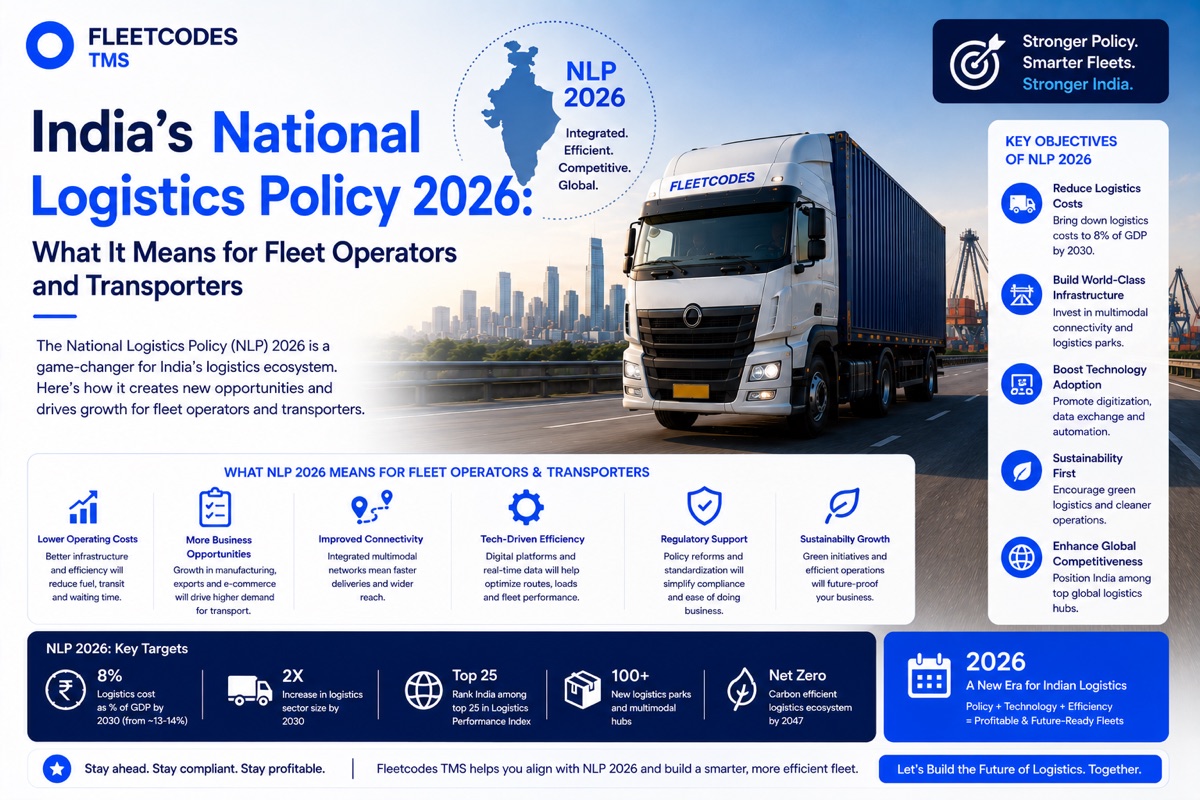
India's logistics cost as a percentage of GDP has fallen from 13–14% in 2016 to approximately 7.9% in 2026 — a structural improvement driven by infrastructure investment, policy reform, and technology adoption. For fleet operators, this transformation creates both opportunity and new competitive pressure.
Why the National Logistics Policy Matters to Your Fleet Business
The National Logistics Policy India was announced in September 2022 with one headline target: bring India's logistics cost down to 8% of GDP — from the 13–14% it had been running at for decades, and closer to global benchmarks of 8–10%.
In 2026, that target is largely achieved. India's logistics expenditure has fallen from nearly 13–14 per cent of GDP in 2016 to around 7.9 per cent today, reflecting sustained reforms and efforts to improve ease of doing business. But the policy framework that drove this improvement is not a completed project — it is an ongoing structural transformation that will continue to reshape the competitive landscape for road freight operators through the rest of the decade.
Understanding logistics policy India 2026 is not an academic exercise for fleet operators. It is a practical necessity — because the policy determines where infrastructure investment flows, which compliance requirements are tightening, what digital mandates are coming, and where the commercial opportunities will be.
The Three Pillars of India's Logistics Policy Framework
1. PM Gati Shakti — Infrastructure as Foundation
PM Gati Shakti logistics is the infrastructure backbone of the policy — a national master plan for multi-modal connectivity launched in 2021, integrating roads, railways, ports, airports, inland waterways, and logistics parks on a unified digital planning platform.
For road freight operators, the most practically significant Gati Shakti outcomes are:
National Highway expansion: India's national highway network has expanded significantly, with the NHDP and Bharatmala programmes adding thousands of kilometres of four-lane and six-lane highway capacity. Better highways mean faster transit times, lower fuel costs from better road surfaces, and reduced vehicle wear — directly improving per-trip margins for transporters on key corridors.
Dedicated Freight Corridors (DFCs): The Eastern and Western Dedicated Freight Corridors are now substantially operational. Freight trains on DFCs are running at 60–70 km/h compared to 25 km/h on the traditional network. For road transporters, the DFCs represent both competition on certain corridors and opportunity — as first-and-last-mile road connectivity to DFC terminals becomes a growing market.
Multimodal Logistics Parks: With 35 parks approved and key locations under development, these integrated hubs combining rail-road-port connectivity and warehousing are creating new operational nodes for road freight businesses. Transporters positioned near these parks — as feeders to rail or as last-mile distributors from park to recipient — have a growing commercial opportunity.
2. Digital India Logistics — The Compliance and Efficiency Mandate
The National Logistics Policy explicitly prioritises digital transformation of India's logistics sector. This has several practical implications for fleet operators:
Unified Logistics Interface Platform (ULIP): ULIP is the government's logistics data exchange platform — connecting systems across ports, railways, highways, customs, and commercial entities. For road freight operators, ULIP integration means your operational data (vehicle positions, consignment details, e-way bill records) can increasingly be accessed and shared across government and commercial systems.
E-way bill evolution: The e-way bill system — now in its second generation with the 2.0 portal — is the most direct digital compliance tool affecting day-to-day transport operations. Regulatory expectations around e-way bill compliance are tightening, not easing. Automated generation and validity tracking are moving from competitive advantage to operational baseline.
AIS 140 and vehicle tracking mandates: The AIS 140 GPS tracking requirement for commercial vehicles is an existing mandate that is progressively enforced. The data from AIS 140 devices feeds into government monitoring systems and will increasingly intersect with compliance reporting requirements.
National Logistics Policy rating framework: The NLP introduced a Logistics Ease Across Different States (LEADS) framework — rating states on their logistics environment. High-rated states attract more freight investment, creating competitive pressure on transporters to operate in states where the regulatory and infrastructure environment is improving.
3. Multimodal Integration — The Shift in Freight Movement
Multimodal integration is accelerating, digital freight and visibility are moving from pilot projects to operations, and infrastructure investments are finally delivering cost and time gains.
For road transporters, multimodal integration means several things in practice:
Rail competition on long-haul corridors: As DFCs improve rail freight speed and reliability, road's traditional time advantage on 500+ km routes is narrowing. Transporters who compete primarily on long-haul national highway routes need to understand which corridors are most exposed to rail competition and position accordingly.
First-and-last-mile opportunity: The expansion of rail and multimodal capacity creates demand for efficient short-haul road connectivity — from production facilities to rail terminals, and from logistics parks to final delivery points. This is a growing market for smaller and mid-size road freight operators.
Coastal and inland waterway freight: India's push to utilise the country's extensive coastline and inland waterways to encourage a shift towards more efficient transport modes creates additional competition for some cargo types — and additional opportunity for transporters willing to build multimodal capability.
What the National Logistics Policy Means Practically for Fleet Operators
Translating transport policy fleet India headlines into operational decisions requires understanding which elements of the policy create direct pressure or opportunity for your specific business.
Areas of Competitive Pressure
Digitalisation compliance: The NLP's digital agenda means compliance requirements will continue to rise. Businesses still operating on paper bilties, manual e-way bill generation, and disconnected systems face increasing regulatory friction and commercial disadvantage relative to digitised competitors.
Price pressure from infrastructure improvement: Better roads and lower logistics costs are good for India's economy — but they also put pressure on freight rates. As shippers benefit from infrastructure improvement, many will expect rates to adjust downward. Transporters who have reduced their own costs through operational efficiency are better positioned to maintain margins as market rates shift.
Rail and multimodal competition on key lanes: On the Western and Eastern DFC corridors specifically, rail freight is becoming more competitive for certain cargo types and distance ranges. Road transporters who understand which of their lanes are most exposed can make proactive commercial decisions — develop multimodal offerings, focus on first-and-last-mile, or differentiate on speed and flexibility where rail cannot compete.
Areas of Direct Opportunity
Multimodal logistics parks as customer hubs: The 35+ multimodal logistics parks approved under Gati Shakti represent concentrated demand nodes for road freight services — both inbound (collecting goods arriving by rail or vessel) and outbound (distributing to final recipients). Transporters who establish relationships with these parks early have a structural advantage.
Tier-2 and tier-3 city growth: India's growth is shifting beyond metros, with tier-2 and tier-3 cities emerging as new engines of infrastructure, manufacturing, and digital expansion. Manufacturing and e-commerce growth in smaller cities creates new freight demand that established metro-focused operators are not yet efficiently serving. For regional transporters, this is a significant organic growth opportunity.
Green freight premiums: As sustainability requirements tighten — driven by both government policy and corporate ESG commitments from large shippers — transporters who can demonstrate lower emissions, EV integration, or verified fuel efficiency data will access preferential commercial terms from the growing segment of environmentally committed customers.
Technology-enabled service differentiation: Real-time supply chain visibility is becoming a strategic priority — industry leaders emphasised the need for platforms that provide real-time insights into fleet operations, cargo movement, and logistics performance. Transporters who can offer customers real-time shipment visibility, digital documentation, and automated reporting are differentiating on service quality — not just rate.
How Digital Tools Align with Policy Direction
The technology investments that the NLP and Gati Shakti framework are driving — ULIP, e-way bill 2.0, AIS 140, digital freight platforms — all point in the same direction: an Indian logistics sector where data flows digitally across the supply chain, compliance is automated, and visibility is real-time.
For fleet operators, aligning with this direction is both a compliance strategy and a competitive strategy. Businesses that adopt transport logistics infrastructure India digital tools now are building capabilities that will be increasingly required — not optional — as the policy framework matures.
This does not require large capital investment. Cloud-based TMS platforms like Fleetcodes are designed to align with India's digital logistics direction — with e-way bill integration, AIS 140 GPS connectivity, digital documentation, and real-time visibility — at a scale and cost point that works for mid-size fleet operators, not just large enterprises.
The transporters who will benefit most from India's logistics transformation are not those who wait for it to settle — but those who position themselves ahead of it.
FAQs
What is India's National Logistics Policy and when was it launched? India's National Logistics Policy was launched in September 2022 with the goal of reducing logistics costs as a percentage of GDP, improving the country's logistics performance index ranking, and creating a data-driven, integrated logistics ecosystem. It operates alongside PM Gati Shakti, the national multimodal infrastructure master plan.
What is PM Gati Shakti and how does it affect road transporters? PM Gati Shakti is the government's integrated infrastructure planning platform, coordinating investment across roads, railways, ports, airports, and logistics parks. For road transporters, its most significant outcomes are the National Highway expansion, the Dedicated Freight Corridors, and the development of multimodal logistics parks — each of which creates both competitive pressure and commercial opportunity.
How have India's logistics costs changed since 2016? India's logistics cost as a percentage of GDP has fallen from approximately 13–14% in 2016 to around 7.9% in 2026 — driven by infrastructure improvement, policy reform, and technology adoption. The target is to sustain this improvement and move toward global benchmarks.
What does the National Logistics Policy mean for small and mid-size transporters? For mid-size fleet operators, the most practical implications are: rising digital compliance requirements (e-way bill, AIS 140, digital documentation), competitive pressure from improved infrastructure lowering freight rates on key corridors, and opportunity from multimodal logistics park development and tier-2/3 city freight growth.
How can fleet operators prepare for India's logistics policy direction? The most actionable preparation steps are: adopt digital documentation and e-way bill automation, ensure AIS 140 GPS compliance across the fleet, explore first-and-last-mile positioning relative to nearby multimodal logistics parks, and use fleet management technology to demonstrate the service quality (visibility, reliability, digital reporting) that policy-aligned shippers increasingly demand.
India's logistics transformation is creating winners and losers. The difference is preparation — and the businesses that understand the policy environment they are operating in are better positioned to be on the right side of that divide.