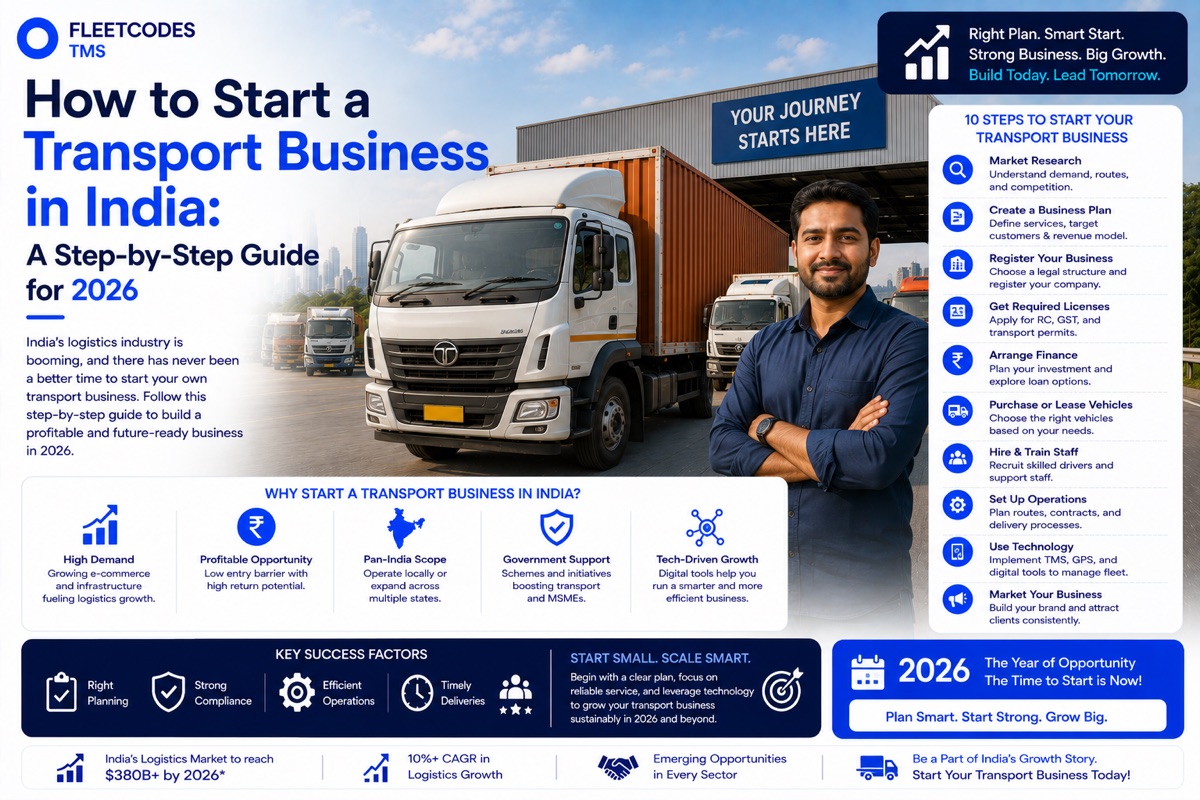
India's road freight market carries 69% of the country's total freight tonnage, generating over ₹14 lakh crore in annual revenue. The sector is growing, consolidating, and digitising simultaneously — creating genuine opportunity for new entrants who build on the right foundation from the start.
Why 2026 Is a Strong Time to Start a Transport Business in India
The structural conditions for starting a transport business in India have not been better in years:
Infrastructure investment is delivering returns. National highway expansion, the Dedicated Freight Corridors, and multimodal logistics park development are reducing transit times and lowering per-km operating costs on major corridors — improving unit economics for all road freight operators.
Digital compliance has standardised the playing field. E-way bills, FASTag tolling, and the National Logistics Policy's digitisation push mean that new, technology-enabled entrants can compete on compliance quality rather than being disadvantaged by legacy manual processes.
Technology is accessible at startup scale. Cloud-based TMS platforms, affordable GPS hardware, and digital documentation tools that were previously available only to large enterprises are now accessible to a 5-vehicle startup — enabling a new entrant to operate with the operational discipline of a much larger fleet.
Freight demand is structurally growing. E-commerce, organised retail, D2C brands, cold chain, and industrial supply chains are all creating new freight demand across India's expanding tier-2 and tier-3 geography. The volume opportunity is real and growing.
Step 1: Choose Your Business Structure and Register
The first formal step in starting a transport business is choosing how the business will be legally structured. The main options in India:
Proprietorship: Simplest and fastest to set up. No formal registration required beyond PAN and local trade licence. Full personal liability. Suitable for starting with 1–3 vehicles while testing viability before formal incorporation.
Partnership Firm: For two or more founders. Registered under the Indian Partnership Act. Shared liability between partners. Suitable for small multi-founder operations.
Private Limited Company: Separate legal entity with limited liability. Requires registration with MCA (Ministry of Corporate Affairs), a minimum of two directors and shareholders, and ongoing compliance filings. Recommended from the start if you plan to grow, seek external financing, or win contracts with large corporates who require vendor registration from incorporated entities.
LLP (Limited Liability Partnership): Combines partnership flexibility with limited liability. Lower compliance burden than Pvt Ltd. A good middle ground for 2–5 founders.
Registration steps:
- Obtain PAN for the entity
- Register with MCA (for Pvt Ltd or LLP) at mca.gov.in
- Open a current bank account in the entity name
- Obtain Udyam registration (MSME registration) for access to MSME credit schemes and government procurement preferences
Step 2: GST Registration
Any transport business carrying goods for payment is a Goods Transport Agency (GTA) under GST — and GTA registration has specific requirements.
GST registration is mandatory if:
- Annual turnover exceeds ₹20 lakh (₹10 lakh in special category states)
- You are making inter-state supplies regardless of turnover
Key GTA GST points:
- GTAs can opt to pay GST at 5% (without ITC) or 12% (with ITC) on freight charges
- Alternatively, GST on GTA services is payable by the recipient under Reverse Charge Mechanism (RCM) in many cases
- Your bilty (lorry receipt) must carry your GSTIN and comply with GST invoice requirements
Register at gstin.gov.in. Processing typically takes 3–7 working days.
Step 3: Obtain Transport Permits for Your Vehicles
Each commercial vehicle you operate requires a permit authorising its use for goods transport.
National Permit: Allows the vehicle to operate anywhere in India. Required for inter-state operations. Issued by the home state RTO; counter-signatures from other states are required for continuous multi-state operations.
State Permit / Contract Carriage Permit: For operations within a single state or specific routes. Lower cost than national permit but operationally limiting.
Permit process:
- Apply to your state's Regional Transport Authority (RTA) through the Parivahan portal (parivahan.gov.in) or in person at the RTO
- Submit vehicle RC, insurance certificate, fitness certificate, and driver licence documents
- Pay the prescribed permit fee
- Receive the permit — valid for 5 years (national) or varying periods (state)
Practical note for new fleet operators: Apply for national permits from the start, even if you initially plan to operate in one state. The incremental cost of a national permit over a state permit is modest, and having national coverage prevents having to re-permit when your first inter-state customer opportunity arises.
Step 4: Ensure Full Vehicle Compliance
Every commercial vehicle you operate must carry valid documentation before it carries a single load, but the essentials for a new vehicle entering commercial service:
- Registration Certificate (issued at purchase)
- Certificate of Fitness (from authorised testing station)
- Third-party insurance (mandatory; comprehensive cover strongly recommended)
- PUC Certificate (from any authorised PUC testing centre)
- National/State Permit (Step 3 above)
Set up a compliance calendar from day one — or use a fleet management platform that tracks document expiry automatically. A compliance gap on a new business's first few vehicles is a particularly damaging way to start.
Step 5: Hire and Onboard Drivers
Drivers are the most important operational asset in any transport business. How you hire, onboard, and manage them from day one determines the operational quality — and the attrition rate — of your fleet for years.
Licence verification: Every driver must hold a valid commercial vehicle licence (LMV, MGV, or HGV as appropriate) with the correct endorsement for the vehicle category they will operate. Verify the licence directly through the Sarathi portal (sarathi.parivahan.gov.in) before the driver's first trip.
Background verification: For new hires, a basic background check — previous employer reference, no-objection certificate from previous GVW, verification of address — reduces risk and demonstrates operational seriousness to the clients who will ask about your driver screening process.
Onboarding for compliance: Brief every driver on the e-way bill process, vehicle document requirements, and what to do if stopped at a checkpoint. A driver who knows the compliance basics is less likely to create an avoidable violation.
Driver app deployment: From day one, deploy drivers on a driver app (Fleetcodes provides this as part of the platform) for digital trip assignment, status updates, and POD capture. Building digital workflow habits early — before manual habits are entrenched — is significantly easier than changing established behaviour later.
Step 6: Build Your Customer Base
Getting your first freight customers is the most commercially critical early challenge. Strategies that work for new transport businesses in India:
Start with your network: The first 3–5 customers of most successful new transport businesses come from personal networks — former employers, business contacts, regional traders known to the founders. These relationships provide the working capital tolerance and initial load volume that a new business needs to establish operations.
Target underserved lanes: Look for freight lanes where existing operators provide poor service — delayed deliveries, poor billing, no digital documentation. A new operator with technology-enabled service quality can win these accounts by demonstrating what better looks like.
Register on freight exchanges: Digital freight platforms (Porter, BlackBuck, Rivigo's platform, TrucksMile) connect shippers with available carriers. Registering provides access to spot freight to fill otherwise empty vehicles while your contracted customer base grows.
Build GST-compliant billing from day one: Corporate shippers require tax-compliant invoices, digital POD, and on-time payment processing. A new transporter who delivers this from the first consignment differentiates immediately from the majority of small operators who do not.
Consider specialisation: A niche in cold chain, pharma, oversized cargo, or a specific corridor where you have deep familiarity provides a competitive position that pure price competition cannot easily erode.
Step 7: Set Up Your Technology Stack
The technology decisions made at the start of a transport business are harder to change later than almost any other operational decision. Getting this right from day one prevents the costly migration project that most growing fleets eventually face.
The minimum viable technology stack for a new transport business in 2026:
Fleet management TMS: A platform that handles dispatch, trip management, driver app, digital POD, e-way bill integration, and billing. Fleetcodes is designed specifically for this — deployable in days, scalable from 5 to 500+ vehicles, with the India-specific compliance features (e-way bill, GST billing, FASTag integration) built in from the start.
GPS hardware: AIS 140-compliant GPS devices for every vehicle — both for your own operational visibility and for legal compliance. Integration between your GPS hardware and Fleetcodes means live vehicle positions feed directly into your dispatch and customer visibility workflows.
Accounting software: For financial management — Tally, Zoho Books, or similar. If your TMS integrates with your accounting tool, invoices and payments sync without manual re-entry.
DigiLocker access: For digital storage and access to RC, DL, insurance, and other government-issued vehicle documents — reducing paperwork at checkpoints and enabling faster document retrieval for audits.
The Financial Model: What to Expect in Year 1
A realistic financial picture for a new transport business starting with 5 vehicles:
| Item | Approximate Range | |---|---| | Vehicle acquisition (5 x 10-tonne truck, used) | ₹60–90 lakh | | Initial compliance costs (permits, insurance, FC, PUC) | ₹2–4 lakh | | Driver recruitment and onboarding | ₹50,000–1 lakh | | Technology setup (TMS + GPS) | ₹15,000–30,000/year | | Working capital (fuel, driver wages for first 2–3 months) | ₹8–15 lakh | | Total initial capital requirement | ₹72–1.10 crore |
Revenue potential at 80% utilisation with 5 trucks on regional routes: ₹8–15 lakh per month depending on route and cargo type.
Working capital is the most common early-stage constraint. Payment terms from first customers are often 30–45 days, while fuel and driver costs are daily. A TMS that accelerates billing cycle time — getting invoices out the same day as delivery confirmation — directly improves working capital position from the first month.
FAQs
What licences are needed to start a transport business in India? Core requirements: business registration (proprietorship, partnership, Pvt Ltd, or LLP), GST registration, goods vehicle permits for each vehicle (National or State), valid insurance and fitness certificates for every vehicle, and commercial driving licences for all drivers.
How much does it cost to start a small transport business in India? Starting a 5-vehicle transport business requires approximately ₹72 lakh to ₹1.10 crore in initial capital — covering used vehicle acquisition, compliance costs, driver recruitment, and working capital for the first 2–3 months of operations.
What is GTA registration under GST for transport businesses? A Goods Transport Agency (GTA) is a transport business that issues consignment notes (bilties) for goods transport. GTAs are subject to specific GST rules — including the option to pay GST at 5% or 12%, and the Reverse Charge Mechanism where GST is paid by the recipient in many cases.
How long does it take to get a National Permit for a commercial vehicle in India? The National Permit application process through the Parivahan portal typically takes 7–21 working days, depending on state and document completeness. Counter-signature in each additional state takes a further 7–14 days per state.
What technology does a new transport business need from day one? The essential technology stack is: a cloud TMS with dispatch, driver app, digital POD, e-way bill integration, and billing; AIS 140-compliant GPS hardware on every vehicle; and accounting software. Fleetcodes covers the TMS layer and is deployable in 3–7 days for a new fleet.
Starting right is easier than fixing what was built wrong. The business decisions made in the first 90 days — legal structure, compliance foundation, technology choices, customer strategy — compound for years. Book a Fleetcodes Demo for Your New Fleet →