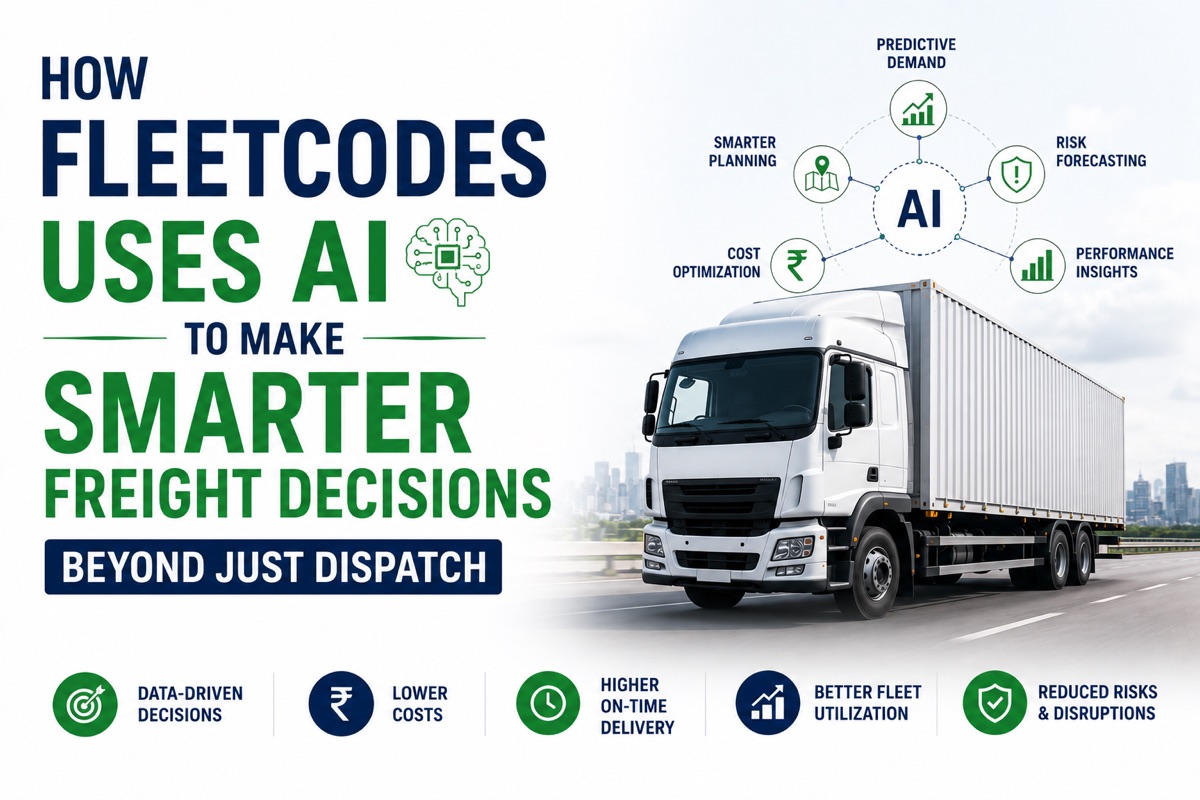
Dispatch automation is the entry point. The most valuable AI in a transport management system is what watches every corner of your operation — and tells you what is going wrong before you notice it yourself.
What Most TMS Platforms Mean by "AI"
When logistics vendors say AI-powered, they usually mean route optimization algorithms or basic load-matching rules.
Fleetcodes is different. AI is not a feature layer added to a traditional TMS. It is the operational intelligence that runs across every workflow. Here is where it actually operates.
1. Dispatch: Multi-Variable Optimization
Fleetcodes dispatch AI does not just match available vehicles to loads. It evaluates the full decision context simultaneously:
- Which vehicle has the lowest historical fuel cost on this specific route?
- Which driver has the best delivery record with this customer?
- Which assignment creates the best return load opportunity after delivery?
- Which combination maximises overall fleet utilisation — not just this one trip?
No human dispatcher can run this analysis across 50 vehicles and 30 loads at once. Fleetcodes does it in seconds and surfaces the best answer for confirmation.
2. Revenue Intelligence: Catching Billing Gaps Automatically
Billing leakage — uninvoiced detention, stale rate cards, missed surcharges — costs Indian fleets 3–8% of monthly revenue. Most is invisible until month-end.
Fleetcodes AI monitors every completed trip against the customer's rate card and flags anomalies before the invoice is raised:
- Detention time exceeding contracted free-time — auto-flagged for billing
- Load weight triggering an overweight surcharge — applied automatically
- Rate applied not matching the current contracted rate — flagged before dispatch
This is the difference between recovering revenue and losing it silently.
3. Predictive Maintenance: The Early Warning System
Fleetcodes tracks per-vehicle fuel consumption against a rolling baseline. When a vehicle's consumption rises 8%+ above its baseline for similar routes and loads, the AI correlates the deviation with maintenance history.
A vehicle at 115,000 km with a fuel spike and a last injector service at 75,000 km receives a different alert context than a newer vehicle showing the same spike. The system interprets data in context — not as a raw number.
Problems caught in weeks cost a fraction of what they cost as breakdowns.
4. Cost Anomaly Detection: Watching What Manual Systems Miss
Every fleet has costs that drift upward invisibly. Fleetcodes AI monitors continuously and surfaces anomalies to management as real-time alerts — not monthly P&L line items:
- A driver whose fuel consumption has been 12% above average for three weeks
- A route whose toll costs have increased from a new plaza
- A vehicle whose maintenance cost per km has been climbing for a month
Problems that previously compounded for months before showing up in the P&L are caught in weeks when they are still manageable.
5. Freight Profitability Intelligence: Knowing Which Business to Keep
Fleetcodes aggregates revenue, fuel, toll, driver, and vehicle cost per trip — generating a margin figure for every journey. Over time, this builds a profitability picture by customer, route, and lane.
When a shipper pushes back on a rate increase, the Fleetcodes profitability dashboard shows exactly what margin that customer's business currently generates — and what rate is needed to make it viable. Rate negotiation becomes a data conversation, not a guessing game.
FAQs
How is Fleetcodes AI different from standard TMS automation? Standard automation applies fixed rules. Fleetcodes AI uses pattern recognition across your specific operational data — your routes, vehicles, customers, and drivers — and improves as your operation accumulates history.
Does the AI require configuration to work? Most features activate automatically as data accumulates. Fuel baseline profiles build within 2–3 weeks. Revenue anomaly detection is active from the first invoiced trip.
Can small fleets benefit from Fleetcodes AI? Yes. A 15-vehicle fleet with one underperforming driver and one margin-negative lane benefits as much as a 500-vehicle operation — the data is proportionally just as actionable.
Dispatch automation is table stakes. Revenue intelligence, cost anomaly detection, predictive maintenance, and freight profitability analytics — that is what AI-first fleet management actually delivers. See Fleetcodes AI in Action — Book a Demo →