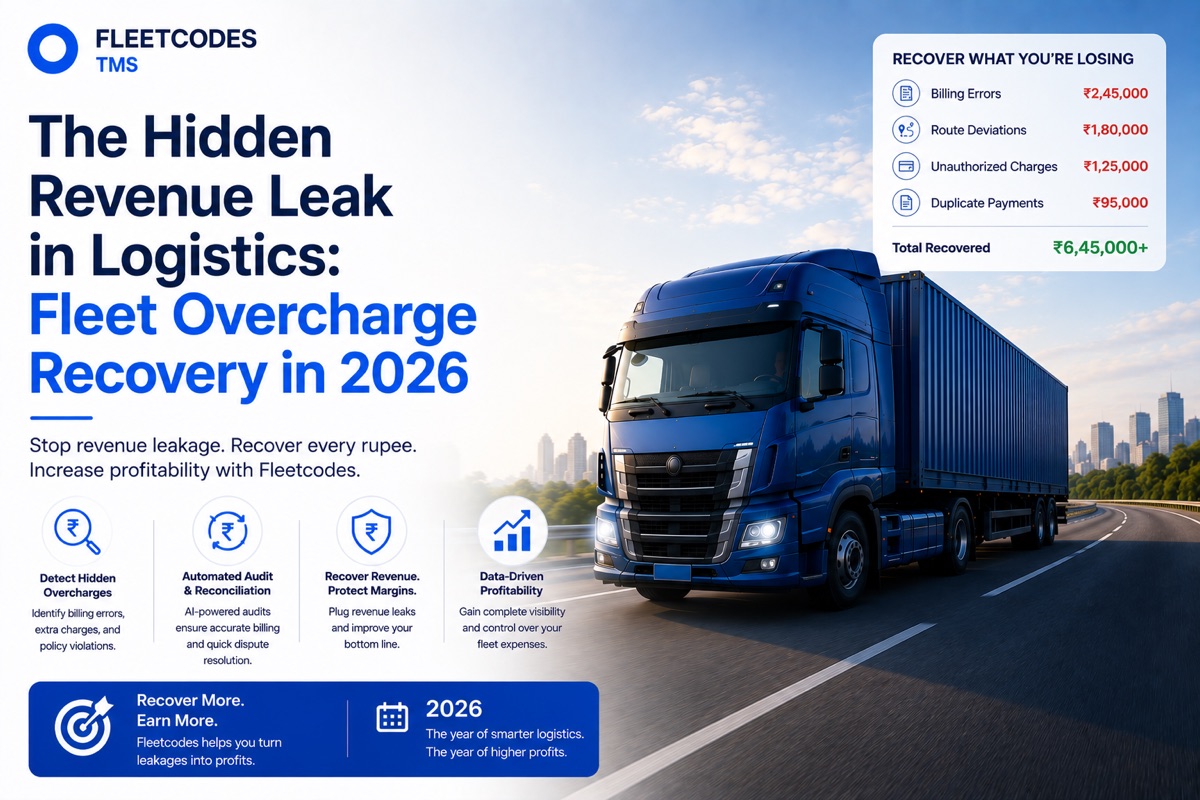
Most logistics businesses focus on cutting costs. But there's another number that's just as important — and most operators never look at it. It's the revenue you've already earned but failed to collect.
The Revenue Leakage Problem Nobody Audits
Ask a fleet operator about their biggest financial challenges and you'll hear the same answers: fuel costs, driver wages, toll expenses, maintenance. These are the visible costs — the ones that appear in every monthly P&L.
What doesn't appear on the P&L is logistics revenue leakage — the money you were entitled to charge but didn't. The detention billing that was never raised because no one tracked the waiting time. The fuel surcharge that applied to the load but wasn't added to the invoice. The customer who was billed at a rate that was negotiated upward six months ago, but whose rate card was never updated in the system.
Industry data on fleet cost optimization in logistics consistently shows that billing errors, under-billing, and unclaimed surcharges account for 3–8% of total freight revenue in manually managed operations. For a business turning over ₹5 crore per month in freight, that's ₹15–40 lakhs per month of revenue that was earned and not collected.
This is not a cost problem. It's a revenue capture problem. And unlike fuel costs or driver wages, it's fully recoverable — if you have the right transport management system in place.
See how Fleetcodes recovers your billing leakage → Book a Free Demo
The Six Sources of Logistics Revenue Leakage
Understanding where logistics revenue leakage occurs is the first step to closing it. Here are the six most common sources in Indian logistics operations:
1. Unbilled Detention Time
When a truck waits at a customer's loading dock beyond the agreed free-time window, you're entitled to bill detention charges. But in manual operations, nobody is tracking arrival and departure times accurately enough to raise these charges reliably.
The result: most detention goes unbilled. Fleetcodes' geofencing automatically records time-at-location for every delivery — giving the billing team an accurate, timestamped record to raise detention charges without dispute.
2. Rate Card Errors and Stale Pricing
In a fleet serving multiple customers, rate cards change. Customers negotiate new terms. Fuel surcharge thresholds shift. Special handling charges are agreed for new cargo types. In manual systems, these updates often don't make it into the billing template in time — or at all.
Freight billing automation in Fleetcodes stores each customer's current rate card centrally and applies it automatically to every invoice. Rate changes are updated once and applied immediately to all subsequent billing — eliminating the stale-rate error entirely.
3. Missing Surcharges
Fuel adjustment factors, overweight charges, hazardous cargo premiums, night delivery surcharges — these are legitimate, contractual additions to the base freight rate. But when billing is done manually from memory or a basic template, surcharges are frequently missed.
Logistics automation software in Fleetcodes applies all applicable surcharges automatically based on the trip's actual characteristics — weight, cargo type, time of delivery, route-specific conditions — ensuring no billable surcharge is left off an invoice.
4. Carrier Invoice Overcharges (Inbound)
For logistics businesses that subcontract movement to third-party carriers, the reverse problem exists: carrier invoice auditing — verifying that what the carrier charges matches what was actually agreed and delivered.
Without systematic carrier invoice auditing, overcharges — for distances not travelled, services not rendered, or rates above the agreed contract — go undetected and get paid. Fleetcodes logs the agreed terms at the time of carrier assignment and flags discrepancies automatically when the carrier's invoice arrives.
5. Under-Billed Multi-Stop Trips
Trips with multiple delivery stops have more complex billing — each stop may have different rates, and the sequence may trigger additional charges. Manual billing of multi-stop trips is especially prone to errors of omission, where stops are missed or charged at the wrong rate.
Fleetcodes' transport management system tracks every stop, every delivery confirmation, and every applicable charge for multi-stop trips — generating an itemised invoice that captures the full billable value of the journey.
6. Lost or Late PODs Causing Invoice Delays
When paper PODs are lost or arrive late, invoices are delayed — and in some cases, never raised. Every unbilled delivery is 100% revenue leakage. Digital POD capture in Fleetcodes eliminates this entirely: the invoice is raised automatically the moment the driver confirms delivery, regardless of any paper document.
Freight Billing Automation: How Fleetcodes Closes the Gaps
Fleetcodes addresses every source of logistics revenue leakage through connected freight billing automation that runs from trip creation to invoice dispatch without manual intervention.
Here's the billing chain in a Fleetcodes-powered operation:
Step 1 — Rate Card Loaded at Booking When a trip is created, the customer's current rate card is pulled automatically — base rate, fuel surcharge formula, detention terms, and any special charges for this cargo type. No manual lookup. No risk of applying yesterday's rate.
Step 2 — Trip Characteristics Captured Throughout As the trip progresses, Fleetcodes captures every billable event: actual weight at loading, departure and arrival times, stops completed, any deviations, waiting time at each location. These feed into the billing calculation automatically.
Step 3 — Surcharges Applied by Rules Engine Fleetcodes' billing rules engine evaluates the completed trip against the customer's contractual surcharge triggers and applies all applicable charges — fuel adjustment, detention (if applicable), overweight, special handling — without any billing team action required.
Step 4 — Invoice Generated on POD Confirmation The moment the driver confirms delivery via the app, the complete invoice is generated and dispatched to the customer. No waiting. No manual assembly. No missed items.
Step 5 — Carrier Invoice Matching (if applicable) For subcontracted movements, Fleetcodes matches the received carrier invoice against the agreed terms and actual trip data, flagging discrepancies before payment is made.
The Numbers: Revenue Recovery at Scale
To put the fleet profitability impact in concrete terms:
| Revenue Leak Source | Typical Leakage Rate | On ₹5Cr/Month Revenue | |---|---|---| | Unbilled detention | 0.5–1.5% | ₹25,000–75,000/month | | Rate card errors | 0.5–1% | ₹25,000–50,000/month | | Missing surcharges | 0.5–2% | ₹25,000–1,00,000/month | | Carrier overcharges | 0.5–1% | ₹25,000–50,000/month | | Multi-stop billing errors | 0.3–0.8% | ₹15,000–40,000/month | | Lost POD / late billing | 0.5–1% | ₹25,000–50,000/month | | Total | 3–8% | ₹1.4L–3.65L/month |
At the midpoint — 5% leakage — a business turning ₹5 crore/month in freight is losing approximately ₹30 lakhs per month in uncollected revenue. That's ₹3.6 crore per year.
Logistics analytics that make this visible are not a nice-to-have. They are directly connected to the profitability of the business.
Dispatch Automation and Its Role in Revenue Capture
Dispatch automation contributes to revenue recovery in a less obvious but important way. When trips are created and managed in a structured system rather than informally, every billable event is captured from the start — there is no gap between what happened operationally and what gets billed.
In contrast, informal dispatch (WhatsApp, phone calls, verbal agreements) creates a trail of operationally real events that never make it into a billing record. The load was moved. The detention was incurred. The surcharge applied. But without a system that captured these events as they happened, billing misses them.
AI logistics management in Fleetcodes closes this gap by treating every dispatch event as a structured data entry — ensuring that what happens on the road becomes a billing-ready record automatically.
FAQs
What is logistics revenue leakage? Logistics revenue leakage is the difference between the revenue a business is contractually entitled to charge and the revenue it actually invoices and collects. Common sources include unbilled detention, stale rate cards, missing surcharges, and lost PODs that delay or prevent invoicing.
How does freight billing automation reduce revenue leakage? Freight billing automation applies current rate cards, surcharge rules, and detention charges automatically to every trip — generating invoices from actual trip data rather than manual memory. This closes the most common billing omission gaps and eliminates rate card errors.
What is carrier invoice auditing and why does it matter? Carrier invoice auditing is the systematic verification of subcontractor invoices against agreed rates and actual service delivery. Without automated auditing, overcharges by carriers — incorrect distances, wrong rates, charges for services not rendered — are regularly paid without detection.
How does Fleetcodes' transport management system reduce under-billing? Fleetcodes captures all billable events automatically throughout the trip lifecycle — including departure and arrival timestamps for detention tracking, actual weight for overweight charges, stop confirmations for multi-drop billing, and surcharge trigger conditions. These feed directly into invoice generation without manual input.
What role does logistics analytics play in revenue recovery? Logistics analytics in Fleetcodes surface billing performance data — invoices raised vs. loads completed, average invoice value vs. expected rate, detention billed vs. detention incurred — giving management visibility into where revenue leakage is occurring and quantifying the opportunity to recover it.
Revenue you've earned deserves to be collected. Fleetcodes ensures it is. Book Your Free Fleetcodes Demo →