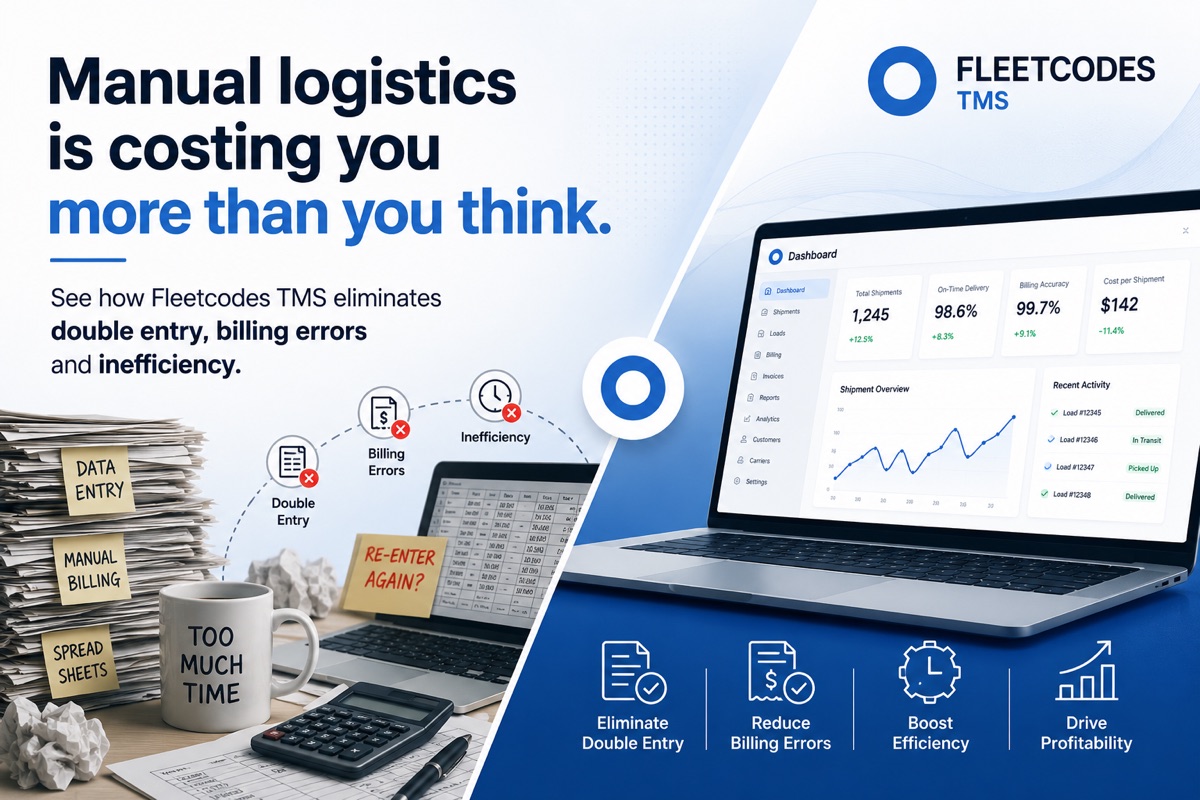
Stop keying the same data twice. In 2026, fleet management software that can't talk to your other systems is costing you more than just time.
The Hidden Cost Nobody Talks About
Your dispatcher enters a load into the system. Your accounts team re-enters it into the billing tool. Your operations manager pulls it into a spreadsheet to track performance.
The same data. Entered three times. By three different people.
This is double entry — and for most logistics businesses in India running manual or disconnected systems, it's the single biggest source of billing errors, payment delays, and operational inefficiency.
According to industry benchmarks, data entry errors in transport operations cause up to 12% revenue leakage through billing discrepancies, duplicate invoices, and unverified PODs. For a fleet running 500 loads a month, that's not a rounding error — that's a serious profit problem.
The fix isn't hiring more people to check each other's work. The fix is transport management system software that integrates across your entire operation — eliminating double entry at the source.
See how Fleetcodes eliminates double entry → Book a Free Demo
What Is TMS Integration, and Why Does It Matter in 2026?
A transport management system (TMS) integration connects your TMS directly to the other tools your logistics business depends on — your ERP, your accounting software, your GPS and real-time tracking platform, your billing system, and your customer portals.
When these systems share data automatically:
- A load created in the TMS instantly appears in billing
- A POD confirmed by a driver auto-triggers the invoice
- A completed trip feeds directly into driver settlement calculations
- Customer rate cards apply automatically — no manual lookup required
This is what fleet management software built for 2026 looks like. Not isolated modules that need manual syncing. One connected system where data flows without human intervention.
The 5 Places Double Entry Destroys Operational Efficiency
1. Order Entry vs. Dispatch
Sales or customer service logs an order. The dispatcher re-enters it to create a trip. One field entered differently — a weight, a pickup time, a destination — and the entire delivery chain is off.
2. Trip Completion vs. Billing
The driver marks a delivery complete. The billing team waits for a physical POD before raising an invoice. Days pass. Cash flow suffers. With integrated fleet management shipping workflows, digital POD confirmation triggers the invoice automatically.
3. Driver Logs vs. Payroll
Drivers submit trip sheets. HR or accounts manually tallies hours, kilometers, and allowances. Errors are common. Disputes are frequent. Integrated fleet mgmt systems pull trip data directly into settlement calculations — zero re-entry.
4. GPS Data vs. Operations Reports
Your real-time tracking system knows exactly where every vehicle is and how long each trip took. But if that data doesn't feed into your TMS, your operations team is still building reports manually from multiple sources.
5. Customer Rate Cards vs. Invoices
Different customers have different rate agreements. Applying the right rate manually on every invoice is slow and error-prone. Integrated transport management system software applies rates automatically based on route, load type, and customer contract.
How Fleetcodes Solves This with Native Integrations
Fleetcodes is built as an automation-first transport management system software — meaning integration isn't an add-on, it's the foundation.
Here's what the Fleetcodes integration architecture delivers:
| Integration Point | What It Automates | |---|---| | ERP / Accounting | Auto-sync of trip data, invoices, and payments | | GPS & Real-Time Tracking | Live vehicle data feeds directly into dispatch and reports | | Digital POD | Driver app confirmation triggers billing and settlement | | Customer Portal | Rate cards, booking confirmations, and tracking in one place | | Driver Settlement Engine | Trip completion auto-calculates pay, deductions, and advances |
This is how logistics automation replaces the copy-paste workflows that slow down your team every single day.
Real Impact: What Integration Actually Changes
When a fleet management india private limited company running 200 vehicles moved from disconnected spreadsheets to Fleetcodes' integrated TMS, the results were measurable:
- Invoice generation time dropped from 3 days to same-day
- Billing disputes fell by 68% — because data was consistent across all systems
- Driver settlements were processed in hours, not a week
- Operational efficiency improved as managers stopped chasing data and started acting on it
This isn't theory. It's what happens when your fleet management software is actually connected.
What to Look for in a TMS with Strong Integration Capabilities
If you're evaluating transport management system software in 2026, here's a practical checklist:
- Open API architecture — can it connect to your existing ERP or accounting tool?
- Native GPS integration — does real-time tracking data flow into reports automatically?
- Digital POD to billing trigger — is the invoice raised automatically on delivery confirmation?
- Driver app connectivity — can drivers log trip data that feeds directly into settlement?
- Customer portal — can clients book, track, and receive invoices in one interface?
- No-code configuration — can your operations team set up workflows without IT support?
Fleetcodes checks every item on this list. And it's built specifically for fleet management operations in India — with the compliance, language, and operational requirements that generic global TMS platforms miss.
The Cost of Doing Nothing
Every month you operate with disconnected systems, you're paying for it — in staff time spent on re-entry, in billing errors that delay payment, in driver disputes that erode morale, and in the operational inefficiency that prevents you from scaling.
Transport management system software should make your business faster, more accurate, and more profitable — not add another tool your team has to manually feed.
In 2026, integration isn't a premium feature. It's the baseline. And Fleetcodes delivers it out of the box.
FAQs
What is double entry in logistics operations? Double entry refers to entering the same data — order details, trip information, billing figures — into multiple systems manually. It creates errors, wastes time, and leads to billing discrepancies.
How does TMS integration eliminate double entry? An integrated transport management system software automatically shares data between dispatch, billing, GPS tracking, and payroll systems. When a driver completes a trip, that single event updates all connected systems without manual re-entry.
Does Fleetcodes integrate with existing ERP systems? Yes. Fleetcodes is built with open APIs that connect to common ERP, accounting, and GPS platforms used by logistics businesses in India.
How long does it take to implement Fleetcodes integrations? Most Fleetcodes customers are fully integrated and operational within days, not months. The platform is designed for fast deployment without heavy IT involvement.
Is Fleetcodes suitable for small and mid-size fleets? Yes. Fleetcodes is designed to deliver enterprise-grade fleet management software capabilities at a scale and price point that works for growing logistics businesses across India.
Ready to stop entering data twice and start running a connected operation? Book a Free Fleetcodes Demo Today →