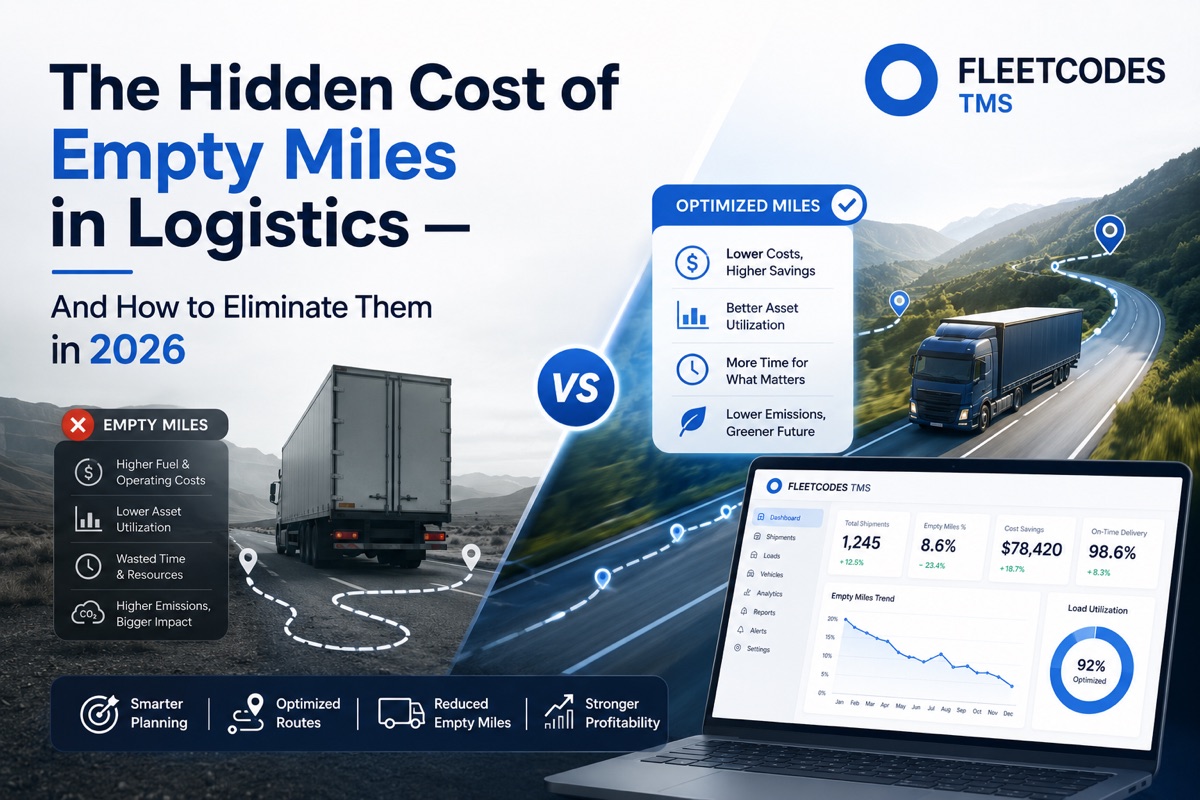
Every kilometre your truck runs empty is a kilometre you're paying for and earning nothing from. In Indian logistics, deadhead miles are the silent profit killer most fleet operators never fully measure.
What Are Deadhead Miles — and Why Should You Care?
Deadhead miles (also called empty miles) are the kilometres a truck travels without a paying load — typically on the return leg after a delivery, or when repositioning a vehicle to the next pickup.
For most fleet operators, deadhead is accepted as an unavoidable cost of doing business. But here's the uncomfortable truth:
The average Indian logistics fleet runs 25–35% of total kilometres empty.
On a fleet of 50 trucks averaging 10,000 km/month each, that's up to 1,75,000 km per month of completely unmonetised movement — burning fuel, wearing down vehicles, and paying driver wages for zero revenue.
If your fleet management software isn't actively tracking and reducing deadhead, you're bleeding profit and you may not even know exactly how much.
See how Fleetcodes calculates and cuts your empty miles → Book a Demo
Why Deadhead Is an Especially Serious Problem in Indian Logistics
India's logistics network presents unique challenges that make deadhead miles worse than in many other markets:
- Hub-and-spoke imbalance — freight flows heavily from manufacturing hubs (Pune, Surat, Ludhiana) to distribution cities, but return loads are scarce on the same lanes
- Fragmented load booking — without integrated transport management system software, dispatchers book loads in isolation without visibility into nearby return opportunities
- Poor real-time tracking integration — if your GPS data and your load management system don't talk to each other, dispatchers can't see which trucks are finishing nearby
- Last-minute booking culture — many shippers in India confirm loads late, leaving fleet operators unable to plan return trips effectively
The result: trucks that could be earning on the return leg are deadheading back to base. Every trip. Every day.
The True Cost of Empty Miles: A Calculation Most Fleets Avoid
Let's put real numbers to this for a mid-size fleet management india private limited operation:
| Metric | Example Fleet | |---|---| | Fleet size | 50 trucks | | Average monthly km per truck | 10,000 km | | Deadhead percentage | 30% | | Monthly empty km | 1,50,000 km | | Average fuel cost per km | ₹8 | | Monthly fuel burn on empty km | ₹12,00,000 | | Annual empty-mile fuel cost | ₹1.44 Crore |
And fuel is only part of it. Add driver wages for empty hours, tyre wear, vehicle depreciation, and the opportunity cost of a truck that could have been earning — and the real figure climbs significantly higher.
This is why cost saving through deadhead reduction is one of the highest-ROI improvements any logistics business can make.
How Transport Management System Software Reduces Deadhead
The reason most fleets struggle to reduce empty miles isn't lack of effort — it's lack of data and tools. Here's how a modern transport management system software like Fleetcodes attacks deadhead at every stage:
1. Real-Time Vehicle Positioning
Fleetcodes integrates with your GPS and real-time tracking system to show dispatchers exactly where every truck is, what it's carrying, and when it will be free. This makes it possible to identify return load opportunities before a truck finishes its current delivery.
2. Load Matching and Route Optimisation
When a truck completes a delivery in a city, Fleetcodes flags available loads in that region that match the truck's specs and timing. Dispatchers can assign a return load in minutes rather than sending the truck back empty.
3. Trip Planning Visibility
Instead of planning trips in isolation, Fleetcodes gives dispatchers a full picture of the week's movement — allowing round-trip planning that minimises repositioning runs.
4. Deadhead Reporting by Route, Driver, and Vehicle
You can't fix what you can't measure. Fleetcodes' fleet mgmt dashboard tracks empty mile percentage by route, by driver, and by vehicle — giving operations managers the data to identify where deadhead is highest and act on it.
5. Operational Efficiency Benchmarks
Fleetcodes allows you to set target deadhead percentages and track performance over time — turning empty mile reduction from a vague goal into a measured KPI.
The Dispatch Behaviour That Makes Deadhead Worse
Beyond the software, there are operational habits that compound the deadhead problem — and that integrated fleet management shipping tools help correct:
Siloed dispatching: When each dispatcher manages their own set of trucks without visibility into the wider fleet, opportunities to match trucks with nearby return loads are missed constantly.
Manual status updates: If drivers call in their status rather than updating a connected app, dispatchers are always working with incomplete, delayed information — making proactive load matching impossible.
No cost visibility per load: When dispatchers don't see the cost of empty return legs, there's no urgency to fill them. Fleetcodes surfaces the cost of each empty trip in real time, creating accountability.
What Reducing Deadhead by 10% Actually Means
Going back to our example fleet: reducing deadhead from 30% to 20% on 50 trucks saves approximately ₹48 lakhs per year in fuel alone — before accounting for increased revenue from additional loads carried on previously empty legs.
For a fleet management business competing on thin margins, that improvement is the difference between a profitable year and a difficult one.
Logistics automation that actively works to fill empty miles doesn't just cut costs — it increases delivery capacity and revenue without adding a single truck to your fleet.
Fleetcodes: Built to Maximise Every Kilometre
Fleetcodes is an automation-first transport management system software designed specifically for logistics businesses that need to operate profitably at scale.
The Fleetcodes platform gives you:
- Live vehicle tracking integrated with dispatch — so you always know where your trucks are and when they're available
- Load optimisation tools that surface return load opportunities before a truck goes empty
- Profit-per-load visibility that makes the cost of deadhead impossible to ignore
- Route and trip planning dashboards built for Indian logistics lanes and distances
- Automated reporting on empty miles, fleet utilisation, and operational efficiency by route, driver, and vehicle
The goal isn't just to track your trucks. It's to make sure every truck earns every kilometre it runs.
FAQs
What is a healthy deadhead percentage for an Indian logistics fleet? Industry benchmarks suggest that well-managed fleets target deadhead below 15–20%. Most unoptimised operations run at 30% or higher. Fleetcodes helps you understand your current rate and set a realistic reduction target.
Can Fleetcodes help match return loads automatically? Fleetcodes surfaces available load opportunities near trucks finishing deliveries, giving dispatchers the data to make fast load matching decisions. Combined with real-time tracking, this significantly reduces empty return legs.
How does empty mile reduction improve delivery performance? When trucks carry more paying loads per day, overall fleet utilisation improves — meaning you can increase delivery performance and handle more volume without expanding your fleet.
Is deadhead tracking available on all Fleetcodes plans? Yes. Empty mile reporting and utilisation dashboards are core features of the Fleetcodes platform, not premium add-ons.
How quickly can a fleet see results from deadhead reduction efforts? Most Fleetcodes customers begin identifying and filling return load opportunities within the first week of deployment, with measurable improvements in fleet utilisation within the first month.
Stop paying for empty kilometres. Start measuring and eliminating deadhead with Fleetcodes. Book Your Free Demo →