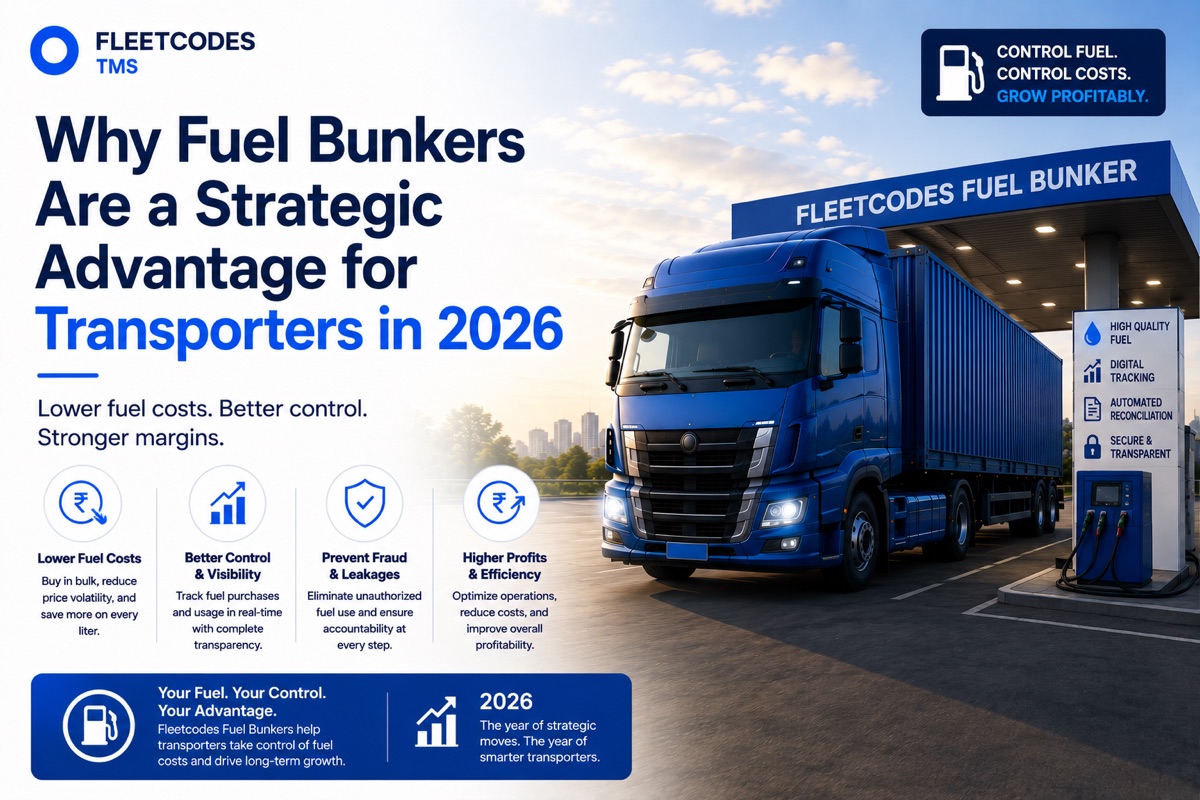
Fuel is your single biggest variable cost. Most transporters manage it reactively — paying pump prices, trusting driver receipts, and estimating consumption. The transporters gaining ground in 2026 are managing fuel as a strategic asset.
What Are Fuel Bunkers for Transporters?
Fuel bunkers for transporters are on-site or in-yard bulk diesel storage facilities — allowing fleet operators to purchase fuel in large volumes at wholesale or negotiated rates, store it securely at their depot, and dispense it directly to vehicles before they depart.
The concept is well-established in maritime and aviation logistics, where bunker fuel management is a core operational discipline. In road transport, particularly in India, fuel bunkers are gaining significant traction as fuel costs continue to represent 35–40% of total operating expenses for most fleets.
The strategic advantage isn't just about buying cheaper. It's about the total system of fuel intelligence platform capabilities that in-yard bunkering enables — from bulk pricing to theft prevention to precise per-vehicle consumption tracking.
See how Fleetcodes integrates with your fuel bunkering strategy → Book a Demo
The Economics of Bulk Fuel Purchasing for Fleets
The most immediate benefit of fuel bunkers is purchasing power. When you buy diesel at the pump, you pay retail price — the same rate as a private car owner. When you buy in bulk through a fuel supplier or oil company arrangement, you access:
- Volume discounts — typically ₹1.50–4.00 per litre below retail pump price depending on volume and supplier agreement
- Price hedging — bulk purchases at today's price protect against near-term price increases
- Payment terms — bulk fuel suppliers often offer 15–30 day payment terms versus immediate payment at the pump
To put the numbers in context for a 50-vehicle fleet averaging 400 litres per vehicle per month:
| Fuel Source | Price per Litre | Monthly Fuel Bill | Annual Fuel Bill | |---|---|---|---| | Retail pump | ₹95.00 | ₹19,00,000 | ₹2.28 Crore | | Bulk bunker | ₹92.00 | ₹18,40,000 | ₹2.21 Crore | | Saving | ₹3.00/litre | ₹60,000/month | ₹7.2 Lakhs/year |
This is before any fuel optimization or theft prevention savings — purely from the bulk purchasing differential. For larger fleets, the numbers scale proportionally.
Fleet Fuel Management: Controlling What You Own
Once fuel is in your bunker, fleet fuel management shifts from a passive expense category to an actively controlled one. Here's what changes:
Dispensing Control
With in-yard fuel bunkering for transporters, every litre dispensed is recorded — vehicle, driver, quantity, timestamp. This is fundamentally different from roadside fuelling, where the only record is a receipt that may or may not accurately reflect what was actually put in the tank.
Fuel management software connected to your dispensing system logs every dispensing event automatically — building a per-vehicle, per-trip consumption database that enables everything from theft detection to route cost analysis.
Eliminating Fuel Theft — Your Largest Hidden Loss
Fuel theft prevention system for fleets is one of the strongest arguments for bunkered fuel. Diesel theft in Indian logistics operations is a well-documented problem — estimates suggest 5–15% of fleet fuel expenditure is lost to theft and fraud in operations relying entirely on road-side fuelling.
Theft mechanisms include:
- Siphoning from vehicle tanks
- Fraudulent fuel receipts (claiming more than was dispensed)
- Collusion between drivers and petrol station operators
- Dispensing fuel to unauthorised vehicles
With in-yard bunkering, the opportunity for most of these theft methods is eliminated entirely — you control the fuel from purchase to dispensing.
AI fuel monitoring software in Fleetcodes cross-references dispensed fuel quantities against GPS-tracked distance travelled, flagging vehicles where consumption is inconsistent with expected use for the route and load. Anomalies are investigated, not absorbed.
Reducing Downtime with Fuel Bunkers
Reducing downtime with fuel bunkers is an operational benefit that's often overlooked in the financial analysis. When drivers refuel on the road, fuelling stops add time to every trip — sometimes significantly, particularly in locations where quality diesel is not immediately available or queues at pumps are long.
In-yard bunkering means every vehicle departs fully fuelled. No roadside stops for fuel on shorter routes. No wasted trip time at petrol stations. For a fleet running 30+ vehicles per day, the time saving accumulates into meaningful improvements in vehicle utilisation.
Fuel Management Software: The Intelligence Layer
Fuel management software is what transforms a bunker from a storage tank into a fuel intelligence platform. Without the software layer, you have cheaper diesel. With it, you have complete visibility and control over how every litre is used.
Fleetcodes integrates with fuel dispensing systems to deliver:
Real-Time Fuel Consumption Monitoring
Real-time fuel consumption monitoring in Fleetcodes tracks each vehicle's fuel usage against its established efficiency baseline. When a vehicle's consumption rises above its normal range — by 10%, 15%, 20% — an alert is raised for investigation.
This GPS fuel tracking system approach catches problems early: an injector issue that's adding 12% to fuel consumption on every trip, identified after 3 trips rather than discovered at the end of the month when reviewing fuel bills.
Route-Based Fuel Optimization
Route-based fuel optimization uses the fuel consumption data from your own fleet — your vehicles, your routes, your loads — to identify which routes and which vehicle types produce the best fuel efficiency.
Over time, this builds a detailed picture of your fleet's actual fuel performance: Route A is 8% more fuel-efficient than Route B for heavy loads; Vehicle X performs significantly better than Vehicle Y on hill routes; Driver A consistently achieves 10% better consumption than the fleet average on long-haul.
These insights feed back into dispatch decisions — assigning the right vehicle and driver to each route for the best overall fuel performance.
Fuel Reconciliation Software for Transporters
Fuel reconciliation software for transporters matches three data sets continuously: fuel purchased (bunker fill records), fuel dispensed (dispensing system logs), and fuel consumed (GPS-tracked distance against vehicle efficiency profiles).
Any significant discrepancy between these numbers — more dispensed than purchased, more claimed consumed than GPS distance justifies — is flagged automatically. This closes the audit loop that manual fuel management can never close.
Diesel Management System for Multi-Depot Operations
For transporters running logistics fuel management across multiple depots or yards, Fleetcodes' diesel management system provides consolidated visibility — total fuel holdings, consumption by location, cost per depot — in a single dashboard.
This is especially valuable for growing businesses where fuel management at each location has historically been independent, making it impossible to optimise bulk purchasing across the full operation.
Fleet Fuel Optimization: Driver Behaviour Is Your Biggest Lever
Beyond the hardware and systems, fleet fuel optimization has a significant human dimension. Driver behaviour accounts for 15–25% of fuel consumption variance between similar vehicles on similar routes.
The key behavioural factors in transport fuel management:
- Idling — a truck idling burns approximately 2–4 litres per hour. Unnecessary idling (waiting at customer docks with the engine running, extended rest stops with engine on) adds up quickly across a fleet
- Harsh acceleration — aggressive acceleration significantly increases fuel consumption, particularly in heavy vehicles
- Speeding — fuel consumption rises sharply above 80–85 km/h for heavy trucks. Speed management is fuel management
- Engine braking — using the engine and gears to slow down rather than brakes reduces both fuel consumption and brake wear
Fuel monitoring software in Fleetcodes tracks these behaviours via GPS and telematics data, generating per-driver fuel analytics reports that give managers the data to coach specific behavioural improvements — and to recognise and reward the drivers who are already doing it right.
The Multi-Fuel Bunkering Strategy: Looking Ahead
The most forward-thinking transporters in India are beginning to think about multi-fuel bunkering strategy — planning their fuel infrastructure for a future where diesel, CNG, LNG, and electric charging may all need to be available in the same yard.
Alternative fuels for transport fleets are an emerging operational reality. Government policy, emissions regulation, and total cost of ownership calculations are all pushing in this direction. A sustainable fuel bunkering system that can accommodate multiple fuel types — with the same level of consumption tracking and cost management — is the infrastructure that long-term fleet operators are beginning to plan for.
Fleetcodes is designed to accommodate multiple fuel types in its consumption and cost tracking modules — ensuring your fuel intelligence platform remains relevant as your fleet evolves.
FAQs
What are fuel bunkers for transporters? Fuel bunkers for transporters are on-site bulk diesel storage facilities that allow fleet operators to purchase fuel in volume at wholesale rates, store it at their depot, and dispense it directly to vehicles — providing cost savings, theft prevention, and complete consumption visibility.
How do fuel bunkers reduce logistics costs? Fuel bunkers reduce logistics costs in three ways: bulk purchase pricing saves ₹1.50–4.00 per litre versus retail, theft prevention eliminates the 5–15% of fuel typically lost in road-side fuelling operations, and reduced downtime from in-yard fuelling improves vehicle utilisation.
What is a fuel management software and what should it track? Fuel management software tracks fuel purchased, fuel dispensed per vehicle, GPS-verified fuel consumed per trip, driver behaviour affecting consumption, and any discrepancies between these figures. It should generate alerts for consumption anomalies and per-vehicle, per-route efficiency reports.
How does AI fuel monitoring software prevent theft? AI fuel monitoring software cross-references dispensed fuel quantities against GPS-tracked distance and vehicle efficiency profiles. When fuel is claimed or shown as consumed in a quantity inconsistent with the actual journey, the system flags the discrepancy automatically for investigation.
What is a multi-fuel bunkering strategy and why does it matter? A multi-fuel bunkering strategy plans fuel infrastructure to accommodate multiple energy types — diesel, CNG, LNG, and eventually electric charging — as fleet composition evolves. Forward-looking transporters are beginning this planning now to avoid costly infrastructure retrofits as alternative fuel adoption grows.
Smarter fuel management starts with the right platform. Fleetcodes connects your bunkering strategy with complete consumption intelligence. Book Your Free Fleetcodes Demo →