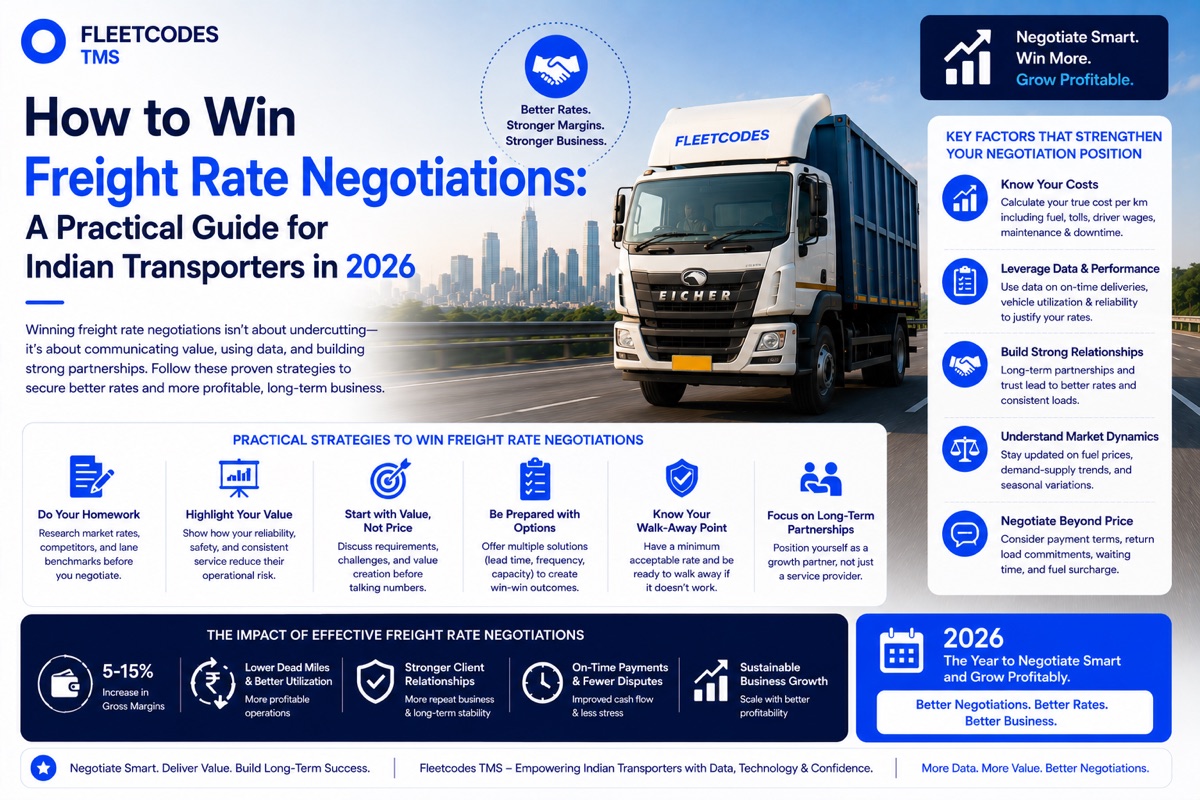
Most freight rate negotiations in India are won by the shipper — not because the shipper is a better negotiator, but because the shipper has better data. They know what they paid last month, what competitors charge, and what the market rate is. The transporter often knows only what they want to charge. That asymmetry is the problem this guide addresses.
Why Indian Transporters Consistently Lose Rate Negotiations
Freight rate negotiation India is structurally skewed against the transporter for one fundamental reason: shippers know their costs and the market; most transporters know only their revenue expectations.
A large FMCG shipper negotiating logistics rates has: data on what every competing transporter charged last quarter, knowledge of market rates on every lane they operate, a clear view of their logistics budget and what savings targets have been set by management, and in many cases a professional procurement team whose job is specifically to reduce freight spend.
The transporter on the other side of that conversation typically has: experience on the route, a rough sense of what fuel and driver costs are, and a rate from the last contract that may or may not cover their actual current costs.
The result is predictable. When one party negotiates on data and the other negotiates on gut feel, the data-equipped party wins.
The fix is not to become a more aggressive negotiator. It is to become a better-informed one. And in 2026, the information required to negotiate from a position of knowledge is available to any transporter running a connected fleet management platform.
The Data You Need Before Any Rate Conversation
Effective freight rate negotiation India starts with knowing your true cost per trip — not an estimate, not an average, but the actual verified cost for the specific route under negotiation.
Your true cost per trip on any route comprises:
Direct variable costs:
- Fuel: actual litres consumed × current diesel price (not estimated — GPS-verified consumption)
- Toll: actual FASTag transaction data for the route
- Driver wages: base rate + overtime + allowances for the trip duration
Indirect variable costs:
- Vehicle depreciation per km: total vehicle cost ÷ expected total km lifespan
- Maintenance cost per km: average annual maintenance spend ÷ annual km
- Tyre cost per km: average tyre cost ÷ km per set
Overhead allocation:
- Your proportion of depot, insurance, and administrative costs allocated per trip
When you add these together, you have your true cost per trip. Compare this to the rate you are charging — or being asked to accept — and you have the actual margin you are making on that route.
Most transporters who do this calculation for the first time discover that several of their highest-volume customer lanes are generating margins of 2–5% — sometimes less than the cost of the working capital required to service them.
Fleetcodes generates this profit-per-trip calculation automatically — combining billing data, GPS-verified fuel consumption, toll records, and driver settlement data into a per-trip margin figure visible in real time. When you walk into a rate negotiation, you know the precise margin on every run you have made for that customer in the last 6 months.
The 5 Rate Negotiation Levers Every Transporter Should Use
Lever 1: Lead with Cost Transparency, Not Just Rate Requests
The least effective approach to a rate negotiation is: "We need a rate increase." The shipper has heard this before. It sounds like a demand without a reason.
The most effective approach is cost-informed specificity: "Diesel costs have increased 14% since our last rate revision. Our average fuel consumption on your Pune–Mumbai lane is 22 litres per 100 km. At current prices, our fuel cost per trip has increased by ₹840. Our current rate was agreed when diesel was at ₹87/litre. We are asking to pass through ₹700 of that increase."
That is a negotiation with numbers. The shipper can agree, disagree, or propose an alternative — but they cannot dismiss it as a general complaint. Transporters who bring data to rate conversations consistently achieve better outcomes than those who bring assertions.
Lever 2: Know Your Lane-Level Profitability
Not all of a shipper's lanes are equally profitable for you. Your Ahmedabad–Surat lane may run at 18% margin because of consistent return loads and low empty km. Your Hyderabad–Vizag lane may run at 4% because of endemic deadhead on the return leg and high toll costs.
When a shipper pushes back on a rate increase across their entire contract, you do not need to negotiate all lanes as a bundle. Negotiate lane by lane, using your actual margin data to identify where you need relief most urgently and where you have room to be flexible.
Transport rate card India management in Fleetcodes stores per-customer, per-lane rate cards and compares them against actual trip costs — surfacing which lanes are genuinely profitable and which are margin-negative or marginal. This granularity transforms how you negotiate.
Lever 3: Price Empty Miles Into Your Rate
Empty miles are a real cost that many transporters absorb silently — because they have not calculated what they cost and therefore cannot justify recovering them from customers.
On a lane with a 30% average deadhead rate, the empty miles represent real fuel, driver time, and vehicle wear. If your loaded freight rate does not account for this return leg cost, you are effectively subsidising the shipper's freight cost with your own vehicle operating expense.
The negotiation approach: calculate the average empty km rate per loaded trip on the specific lane, add it as a line item in your rate justification, and present it as a route cost — not a surcharge. Most shippers understand this arithmetic when it is presented clearly. It is harder to argue with data showing that every ₹100 of loaded freight revenue costs you ₹28 in empty return transport cost.
Lever 4: Use Volume Commitments as Rate Levers
Rate negotiations are not only about the rate — they are also about the volume and regularity that determine how efficiently you can plan your fleet.
A shipper offering 50 trips per month with 48-hour booking notice on a fixed lane allows you to plan vehicle allocation efficiently, reduce empty miles through predictable scheduling, and maintain driver availability without overtime. That operational value is worth a discount relative to ad-hoc spot booking.
Conversely, a shipper offering similar volume but with 2-hour booking notice and highly variable timing creates operational planning challenges that cost you real money in vehicle availability, driver overtime, and missed return load opportunities. That cost should be reflected in the rate — or the booking terms should change.
Build these terms explicitly into rate negotiations: "We can offer you this rate for weekly volumes of 40+ trips with 24-hour advance booking notice. For spot bookings under 24 hours, the applicable rate is X."
Lever 5: Benchmark Against Market Data
Logistics pricing India data is more accessible in 2026 than at any previous point, through digital freight platforms, industry association rate publications, and logistics indices. Before any rate negotiation, know what the market is paying on your key lanes.
If market rates on your lane have moved up while your contracted rate has stayed fixed, you have a market-data argument for revision. If market rates have softened, be prepared for the shipper to cite this — and have a ready response about the service quality differential that justifies your position.
Truck freight charges India on key corridors are published by AITWA (All India Transporters Welfare Association) and several freight exchange platforms on a periodic basis. These benchmarks give your negotiation an external reference point that is harder to dismiss than your own cost data alone.
Handling the Five Most Common Shipper Pushbacks
"Market rates are down — your competitors are charging less."
Response: "We may not be the cheapest option on this lane. We are the option with a documented 98.2% on-time delivery record for your consignments over the last 6 months, zero cargo damage claims, and same-day digital POD and invoicing. The rate difference between us and the cheapest option is less than the cost of one disputed delivery."
"We gave you high volume — you should give us a better rate."
Response: "We value the volume and we have priced to reflect it. What the current rate does not reflect is the 22% increase in diesel since this rate was last revised and the introduction of new toll structures on the Pune–Nashik corridor that added ₹340 per trip."
"We are going out to tender — you need to sharpen your pencil."
Response: "We welcome the opportunity to participate. Before the tender closes, I would like to share our performance data for your account over the last 12 months — on-time delivery rate, damage rate, billing accuracy, and average invoice cycle time. We believe this data makes a strong case for why continuity has value."
"The economy is slow and our freight volumes are down."
Response: "We understand. We are happy to discuss a temporary volume adjustment to the committed minimums that triggers the current rate tier. On the rate itself, our fuel and compliance costs have not reduced with the economic environment — so we are not able to absorb a rate reduction at this time."
"We need 60-day payment terms."
Response: "Our current terms are 30 days. Extended payment terms have a working capital cost that would need to be reflected in the rate — approximately X% to account for the additional financing cost. Alternatively, we can maintain 30-day terms at the current rate."
The Negotiation Mindset Shift: From Rate-Taker to Rate-Setter
The underlying shift that separates transporters who consistently achieve adequate margins from those who are perpetually squeezed is not negotiation technique. It is the transition from rate-taker to rate-setter.
A rate-taker accepts the rate the market or the shipper offers, absorbs the margin impact of cost increases, and hopes the relationship continues. A rate-setter understands their costs precisely, knows their value to the shipper, and approaches rate conversations as a business-to-business commercial discussion with data on both sides.
Logistics cost analytics in Fleetcodes makes this transition possible. When you know your cost per trip by route, your margin per customer, your empty mile rate by lane, and your service quality metrics — you have the foundation to be a rate-setter in every negotiation you enter.
FAQs
What is the current transport rate per km in India in 2026? Freight rates per km in India vary significantly by route, vehicle type, load type, and seasonality. Approximate 2026 ranges: small commercial vehicle (SCV) ₹15–25/km, medium goods vehicle (MGV) ₹20–35/km, heavy goods vehicle (HGV) ₹25–45/km on national highway routes. Urban last-mile rates can be significantly higher on a per-km basis due to short distances and high stop frequency.
How should transporters calculate their minimum acceptable freight rate? The minimum acceptable rate equals total trip cost (fuel + toll + driver cost + vehicle depreciation per km + maintenance per km) divided by the billable load weight or trip distance, plus your target margin percentage. Any rate below your total trip cost is margin-negative — you are paying to carry the load.
How often should freight rates be revised in India? Best practice is to include automatic fuel adjustment clauses in rate contracts — linking the freight rate to a published diesel price index so that fuel cost changes are passed through automatically without requiring a full rate renegotiation. Full rate reviews should happen at contract renewal — typically annually — or when structural cost changes (toll increases, regulatory changes) make mid-term revision necessary.
What data does Fleetcodes provide for freight rate negotiation? Fleetcodes provides per-trip profit-and-loss data combining freight revenue, GPS-verified fuel cost, toll records, driver settlement cost, and vehicle cost allocation — giving transporters lane-level and customer-level profitability data to inform rate negotiations with specific, verifiable numbers.
How can small transporters negotiate rates when they lack bargaining power? Small transporters can improve their negotiation position through: documented service quality data (on-time rate, damage rate), cost transparency (showing exactly what a trip costs), specialisation (developing expertise in cargo types or lanes where rates are less commoditised), and leveraging industry rate benchmarks from AITWA and freight exchanges as external reference points.
You cannot negotiate well from a position of ignorance. Know your costs. Know your value. Come to the table prepared. See How Fleetcodes Gives You the Data to Negotiate Better →