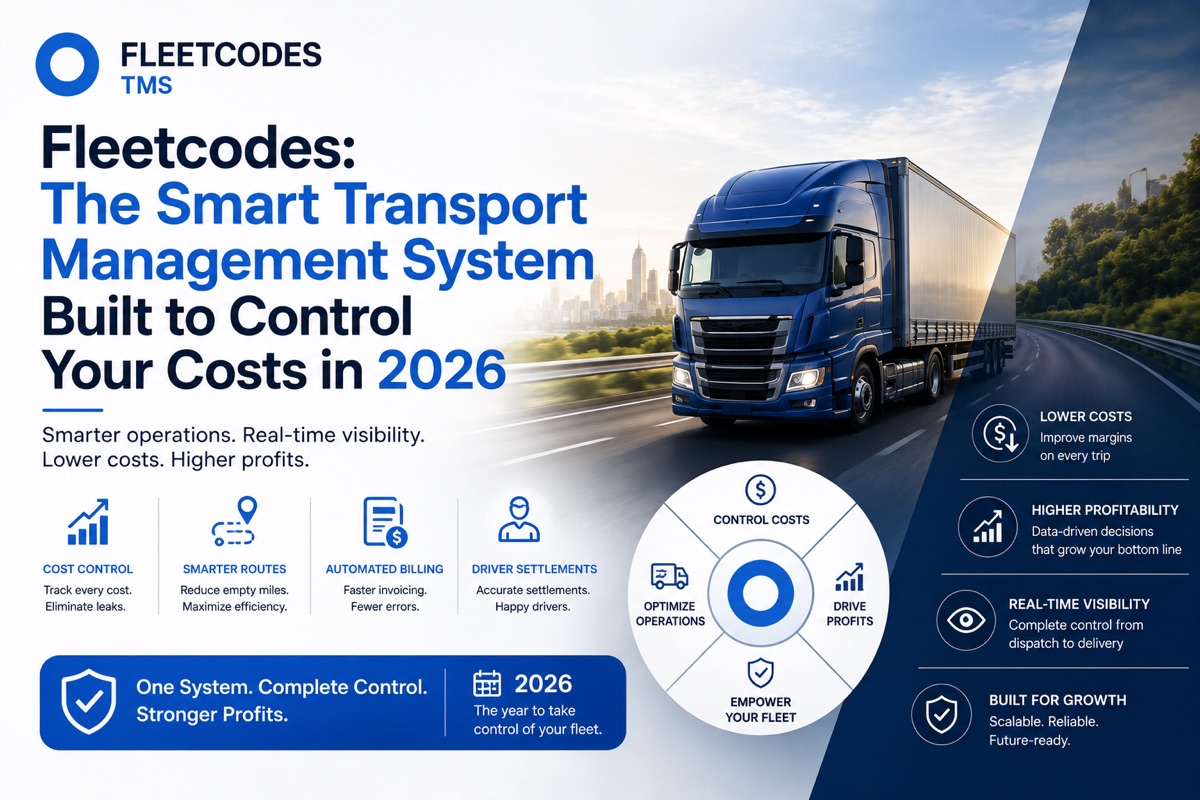
Most fleet management software tracks what happened. Fleetcodes is built to change what happens next — giving you active control over the costs that determine whether your logistics business is profitable.
Why Cost Control Is the Defining Challenge for Fleet Operators in 2026
Logistics is a margin-thin business. Fuel prices fluctuate. Driver wages are rising. Toll infrastructure is expanding. Maintenance costs on ageing vehicles are unpredictable. And customers — especially in competitive lanes — are always pushing for better rates.
In this environment, the logistics businesses that thrive aren't necessarily the ones with the most trucks. They're the ones that control their costs most effectively — knowing exactly where money is going, and having the tools to reduce waste at every level of the operation.
The challenge is that cost control in fleet management isn't passive. It requires data — granular, real-time data — from every corner of the operation. Fuel consumption per vehicle. Route deviation and its cost impact. Idle time burning diesel. Maintenance that was deferred until it became a breakdown. Driver behaviour that adds 15% to your fuel bill every month.
Most fleet operators have some of this data, somewhere. The problem is it lives in disconnected places — a fuel register here, a GPS report there, an accounts spreadsheet somewhere else — and by the time it's assembled, the moment to act has passed.
Fleetcodes changes this. As an automation-first transport management system software, Fleetcodes is built to bring all of this cost data together in real time — and give operations teams the tools to act on it before costs spiral.
See Fleetcodes' cost control dashboard in action → Book a Free Demo
The Six Cost Levers Fleetcodes Actively Controls
1. Fuel — Your Single Biggest Variable Cost
Fuel typically represents 35–40% of total operating costs for an Indian logistics fleet. It's also the cost most susceptible to waste through driver behaviour, poor route planning, and vehicle inefficiency.
Fleetcodes addresses fuel costs from multiple angles:
- Route optimisation — shortest practical routes are suggested at dispatch, reducing unnecessary kilometres
- Driver behaviour monitoring — excessive idling, harsh braking, and speeding (all of which increase fuel consumption significantly) are flagged via real-time tracking integration
- Fuel consumption tracking per vehicle — Fleetcodes builds a fuel efficiency profile for every vehicle, making it immediately visible when a truck's consumption spikes above its baseline
- Fuel expense validation — driver-submitted fuel receipts are cross-checked against actual distance travelled, preventing inflated claims
For a 100-vehicle fleet, reducing fuel waste by even 8% represents significant annual savings — often in the range of ₹50–80 lakhs depending on fleet size and route mix.
2. Empty Miles — Revenue You're Not Earning
As covered in depth in our guide on deadhead miles, empty return legs are one of the most expensive and most addressable cost items in fleet management shipping.
Fleetcodes tracks empty vs. loaded km per vehicle and per route, giving dispatchers real-time visibility into trucks finishing deliveries with no return load assigned — and the tools to fill those gaps before the truck leaves for base.
3. Maintenance — Reactive vs. Preventive
A truck that breaks down on a highway doesn't just cost repair money — it costs customer confidence, delays the load, and creates overtime or alternative vehicle costs to recover the delivery.
Fleetcodes manages preventive maintenance schedules for every vehicle in the fleet — tracking km since last service, scheduled service dates, and component-level maintenance history. When a service is due, the system generates an alert before the truck goes out on a run — not after it breaks down.
Preventive maintenance typically costs 3–4x less than reactive repair, and Fleetcodes makes it the default rather than the exception for fleet mgmt operations of any size.
4. Driver Costs — Wages, Advances, and Overtime
Driver costs are the second-largest expense item for most logistics businesses, and also one of the most difficult to manage without an integrated system.
Fleetcodes tracks every driver's trip assignments, hours worked, advances taken, and expense claims — giving the HR and accounts team a clean, auditable record that eliminates the guesswork from settlement calculations. Overtime is flagged automatically when trip scheduling creates it unnecessarily, allowing dispatchers to redistribute loads more evenly.
5. Toll and Detention Charges — The Invisible Cost Adds
Toll costs on long-haul routes are significant and often poorly tracked in manual systems. Detention charges — for trucks waiting beyond agreed loading/unloading windows — are frequently disputed and sometimes simply not billed.
Fleetcodes captures toll costs per trip from driver app inputs and cross-references them with route data. Detention time is automatically tracked against agreed loading windows, and the billing engine flags when charges should be applied to customers.
For fleet management india private limited businesses running multi-state operations, proper toll and detention tracking alone can recover meaningful revenue that was previously being absorbed as an operational loss.
6. Asset Utilisation — The Cost of Underperforming Vehicles
Every vehicle in your fleet represents a capital investment. A truck that runs only 15 days a month, or that consistently returns with empty km, is delivering poor return on that investment.
Fleetcodes' asset utilisation dashboard shows you exactly how each vehicle is performing — km operated, load ratio, revenue generated, and cost incurred — giving fleet managers the data to make decisions about fleet composition, vehicle allocation, and eventual replacement timing.
What a Cost-Controlled Operation Actually Looks Like
A well-managed logistics business using transport management system software like Fleetcodes doesn't just have lower costs — it operates with a fundamentally different culture of accountability.
Dispatchers don't just assign trips — they optimise them. Every dispatch decision is informed by cost data: which vehicle is most fuel-efficient for this route, which driver has the best performance record on this lane, what's the route with the best cost profile.
Managers don't just review monthly P&Ls — they act on daily cost signals. When a vehicle's fuel consumption spikes, the alert comes the same day — not at month end. When a driver's idle time is excessive, the operations manager sees it in real time.
The accounts team doesn't chase costs — the system surfaces them. Billing, settlement, and expense validation all happen within the same connected platform, eliminating the reconciliation work that consumes back-office capacity.
This is operational efficiency as a system property — built into how the operation runs, not achieved through individual heroics.
Fleetcodes vs. Manual Operations: A Direct Comparison
| Cost Category | Manual Operation | Fleetcodes | |---|---|---| | Fuel tracking | Monthly average, not per vehicle | Per-trip, per-vehicle, real time | | Route efficiency | Dispatcher experience, no optimisation | AI-assisted route optimisation | | Empty miles | Tracked rarely, if at all | Flagged in real time, dispatch prompted to fill | | Maintenance | Reactive, based on breakdowns | Scheduled preventive alerts per vehicle | | Driver costs | Monthly tally, prone to disputes | Per-trip calculation, transparent to drivers | | Toll/detention billing | Often missed or disputed | Automatically tracked and billed | | Profit per load | Unknown or estimated | Calculated in real time per trip |
The difference isn't incremental. It's the difference between logistics automation and manual firefighting.
Why Indian Logistics Businesses Choose Fleetcodes in 2026
Fleetcodes is purpose-built for the Indian logistics market — not adapted from a global TMS that wasn't designed for the complexity of operating across Indian states, managing diverse vehicle types, handling GST-compliant billing, and working with drivers who range from highly tech-savvy to smartphone newcomers.
The platform is designed to:
- Deploy fast — most operations are live within days, not months
- Scale smoothly — from 10 trucks to 1,000+, the platform grows with your fleet
- Integrate deeply — connect with your existing GPS, ERP, and accounting tools
- Deliver ROI quickly — most customers identify immediate cost saving opportunities within the first week of use
When you combine fleet management software that controls costs actively with the operational discipline that comes from having real-time data — your logistics business doesn't just cut expenses. It builds a competitive advantage that's difficult for less-sophisticated operators to match.
FAQs
What makes Fleetcodes different from basic fleet tracking software? Basic tracking software shows you where your trucks are. Fleetcodes is a full transport management system software — it connects dispatch, billing, driver management, real-time tracking, maintenance, and cost analytics into one platform. The difference is between knowing where your trucks are and knowing whether they're making you money.
How does Fleetcodes help with cost saving on fuel? Fleetcodes reduces fuel costs through route optimisation, driver behaviour monitoring (via GPS integration), per-vehicle fuel consumption tracking, and fuel receipt validation. Together, these typically deliver 8–12% fuel cost reduction for fleets transitioning from manual operations.
Is Fleetcodes suitable for fleet management india private limited companies? Yes. Fleetcodes is designed specifically for the Indian logistics market — including GST-compliant billing, multi-state operations, diverse vehicle type management, and support for the operational workflows common to Indian logistics businesses.
How does Fleetcodes improve delivery performance alongside cost control? Cost control and delivery performance are connected in the Fleetcodes system. Better route optimisation, preventive maintenance (fewer breakdowns), and real-time visibility all contribute to more reliable, on-time deliveries — improving delivery performance metrics while simultaneously reducing costs.
What is the implementation timeline for Fleetcodes? Most Fleetcodes customers are fully operational within 3–7 days. The platform is designed for straightforward deployment without heavy IT involvement, making it accessible for growing fleet operations across India.
Take control of every cost that affects your fleet's profitability. That's what Fleetcodes is built for. Book Your Free Demo →