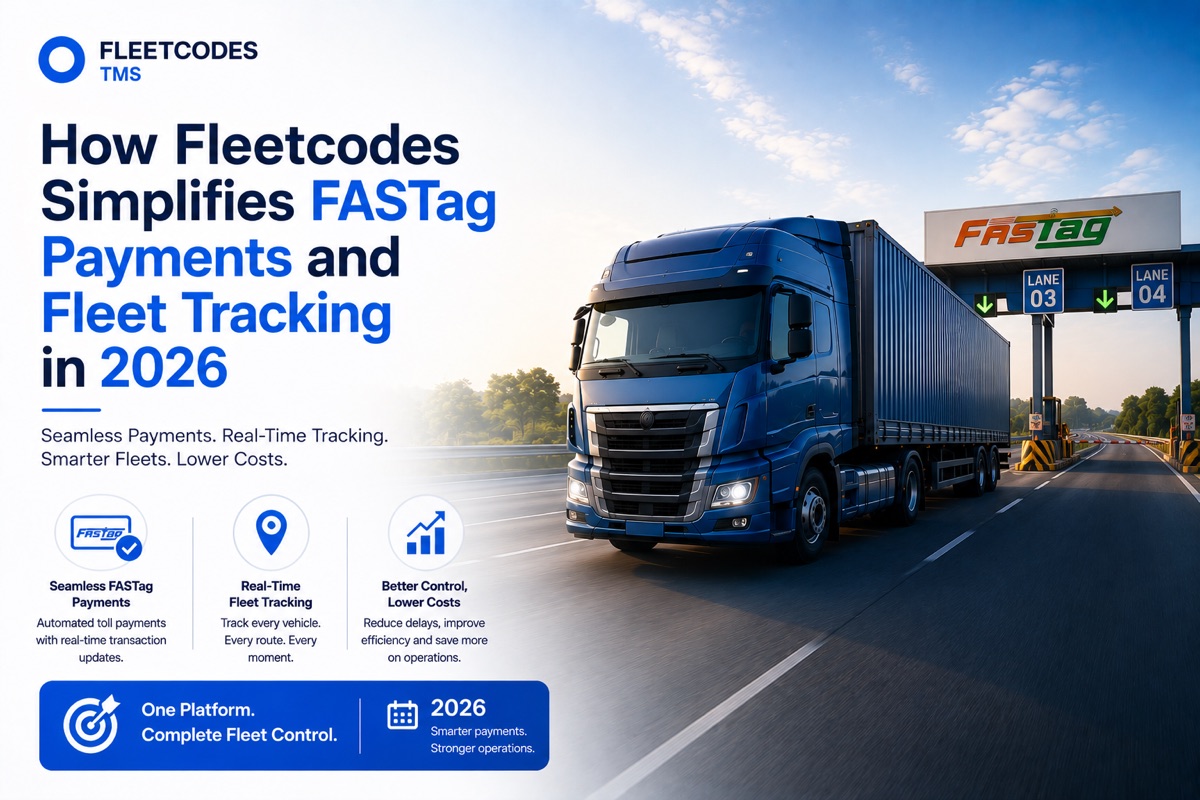
FASTag has made toll payments faster. But for fleet operators managing 50, 100, or 500 vehicles, the real challenge isn't the payment — it's tracking, reconciling, and controlling toll costs across an entire fleet. Fleetcodes solves this.
The FASTag Reality for Fleet Operators in 2026
India's FASTag mandate transformed how toll payments work on national highways and expressways. The contactless RFID system eliminated long queues, reduced delays, and digitised what was previously a cash-in-hand, manually-logged expense category.
But for fleet operators, FASTag solved one problem and created another. Yes, trucks move through toll plazas faster. But now you have dozens or hundreds of FASTag accounts — each with their own balance, their own transaction history, and their own recharge requirement. And somewhere, someone has to monitor all of them, recharge them before they hit zero, reconcile the transactions, and allocate the toll costs to the right trip and customer.
For most fleets still handling this manually, FASTag went from a cash management problem to a digital management problem — different in form, similar in effort.
Fleetcodes integrates FASTag data directly into fleet operations — turning toll management from a manual finance task into an automated part of trip cost accounting.
See how Fleetcodes simplifies FASTag management → Book a Demo
What Fleet FASTag Management Actually Involves
To understand why this matters, let's look at what managing FASTag for a 100-vehicle fleet actually requires today without an integrated platform:
Balance Monitoring Every vehicle has a FASTag account with a balance. When that balance drops below a threshold, the tag gets flagged at toll plazas — causing delays and frustrated drivers. With 100 vehicles, manually checking balances daily is a significant administrative task.
FASTag Recharge Keeping every account topped up requires either bulk recharge processes or individual account management. Without automation, this is another manual task — and a missed recharge can strand a truck at a toll.
FASTag Login and Account Management Managing multiple FASTag accounts — each with its own FASTag login credentials across potentially different issuing banks — creates an administrative overhead that scales poorly as fleets grow.
Transaction Reconciliation Every FASTag transaction is a data point — vehicle, plaza, time, amount. For finance teams, reconciling these transactions against trip records to allocate costs accurately to the right job, customer, and route is a time-consuming process when done manually.
FASTag Monthly Pass and Special Passes The FASTag monthly pass option — available on selected corridors for frequent users — offers significant savings for vehicles on fixed routes. But identifying which vehicles qualify, applying for passes, and tracking their usage requires active management.
FASTag Status and Exception Handling Blacklisted tags, low balance alerts, failed transactions, and FASTag status anomalies need to be caught and resolved quickly to avoid operational disruption.
How Fleetcodes Integrates FASTag into Fleet Operations
Fleetcodes connects to FASTag transaction data through NETC (National Electronic Toll Collection) integration — bringing toll payment data directly into the fleet management dashboard alongside GPS tracking, trip records, and billing.
Here's what this integration delivers:
Automatic Toll Cost Allocation Per Trip
Every FASTag transaction is automatically matched to the trip in progress at the time — based on vehicle ID, route, and timestamp. Toll costs are allocated to the correct trip record without manual entry, making them available for:
- Customer billing — toll charges passed through to the customer automatically
- Profit-per-trip calculation — actual toll costs included in trip profitability
- Driver settlement — toll expenses recorded against the driver's trip log
- Route cost analysis — accurate toll cost by route for rate setting and optimisation
Balance Monitoring and Recharge Alerts
Fleetcodes monitors FASTag balances across the entire fleet and sends automatic alerts when any vehicle's balance drops below a configured threshold — giving the finance team time to recharge before a trip is affected.
This eliminates the balance-monitoring task entirely for operations managers and replaces reactive recharge management with proactive alerts.
FASTag Status Dashboard
A single dashboard view of FASTag status across all vehicles — active tags, low balance warnings, recent transactions, and monthly spend by vehicle — replaces the need to log into multiple bank portals or manually compile reports.
Monthly Pass Tracking
Fleetcodes tracks FASTag monthly pass validity and usage for vehicles on fixed corridors — flagging when passes are expiring and when new passes should be applied for based on trip frequency analysis.
More Cost-Effective Route Planning
When toll costs are automatically tracked per route, Fleetcodes can surface route comparisons that factor in actual toll spend — helping dispatchers choose routes that are more cost-effective overall, not just shorter in distance.
The Real Numbers: What Toll Cost Visibility Means for Your Fleet
Toll costs represent a significant and often poorly tracked expense category for Indian logistics fleets. On national highway routes, toll charges can add ₹500–₹2,000 or more per trip depending on distance and vehicle class.
For a 100-vehicle fleet averaging 15 trips per vehicle per month, that's potentially ₹75 lakh to ₹3 crore per year in toll expenditure — an amount that deserves active management, not passive recording.
Fleetcodes gives you:
- Real-time toll spend visibility across the entire fleet
- Per-route toll cost benchmarks so you know what's normal and what's anomalous
- Monthly pass ROI tracking — are the passes you're paying for actually being used?
- Customer billing accuracy — are you recovering all toll costs you're entitled to bill through?
Many fleets discover, upon implementing automated toll tracking, that they've been systematically under-billing customers for toll pass-throughs — recovering meaningful revenue that was previously being silently absorbed.
FASTag Apply: Getting New Vehicles onto the Network
For growing fleets adding new vehicles, the FASTag apply process — registering new tags with the NETC network and the issuing bank — can be a friction point. Fleetcodes simplifies onboarding by integrating new vehicle FASTag data directly into the fleet dashboard as soon as registration is complete, ensuring new trucks are tracked from their first trip.
Fleetcodes + FASTag: A Connected Fleet Finance Picture
The value of integrating FASTag into Fleetcodes extends beyond convenience. It completes the cost picture for every trip in a way that manual systems can't:
| Trip Cost Component | Manual Tracking | Fleetcodes | |---|---|---| | Freight revenue | Billing system | Automated from rate card | | Fuel cost | Driver log / estimate | GPS + consumption tracking | | Toll cost | FASTag statement / estimate | Automatic per-trip allocation | | Driver wages | Payroll spreadsheet | Automated settlement module | | Maintenance cost | Separate records | Per-km allocation from vehicle profile | | True profit per trip | Unavailable / estimated | Calculated automatically |
When toll costs are automatically captured and allocated — alongside fuel, wages, and maintenance — Fleetcodes gives you genuine profit visibility at the trip level. That's the difference between running a fleet and running a profitable fleet.
FAQs
What is FASTag and how does it work for fleet vehicles? FASTag is an RFID-based electronic toll payment system mandatory for vehicles on Indian national highways. For fleet vehicles, FASTag accounts are linked to a prepaid wallet that's debited automatically at toll plazas — eliminating cash transactions and queuing delays.
How does Fleetcodes help with FASTag recharge management? Fleetcodes monitors FASTag balances across all fleet vehicles and sends automatic low-balance alerts to the finance team — ensuring vehicles are recharged proactively before a trip is disrupted by an insufficient balance.
Can Fleetcodes track toll costs per trip automatically? Yes. Fleetcodes matches every FASTag transaction to the active trip record for that vehicle — allocating the exact toll cost to the right job for customer billing, profitability calculation, and reporting.
What is the FASTag monthly pass and how does Fleetcodes help manage it? The FASTag monthly pass provides unlimited toll access on selected corridors for a fixed monthly fee — more cost-effective than per-trip charges for vehicles on fixed routes. Fleetcodes tracks monthly pass usage and validity, flagging renewal requirements and helping identify which vehicles would benefit from pass conversion based on trip frequency.
How does FASTag integration make fleet operations more cost-effective? By automatically capturing and allocating toll costs per trip, Fleetcodes enables route comparisons that factor in actual toll spend — helping dispatchers make more cost-effective routing decisions and ensuring that all billable toll costs are recovered from customers accurately.
Complete trip cost visibility — fuel, toll, wages, maintenance — all in one platform. Book Your Free Fleetcodes Demo →