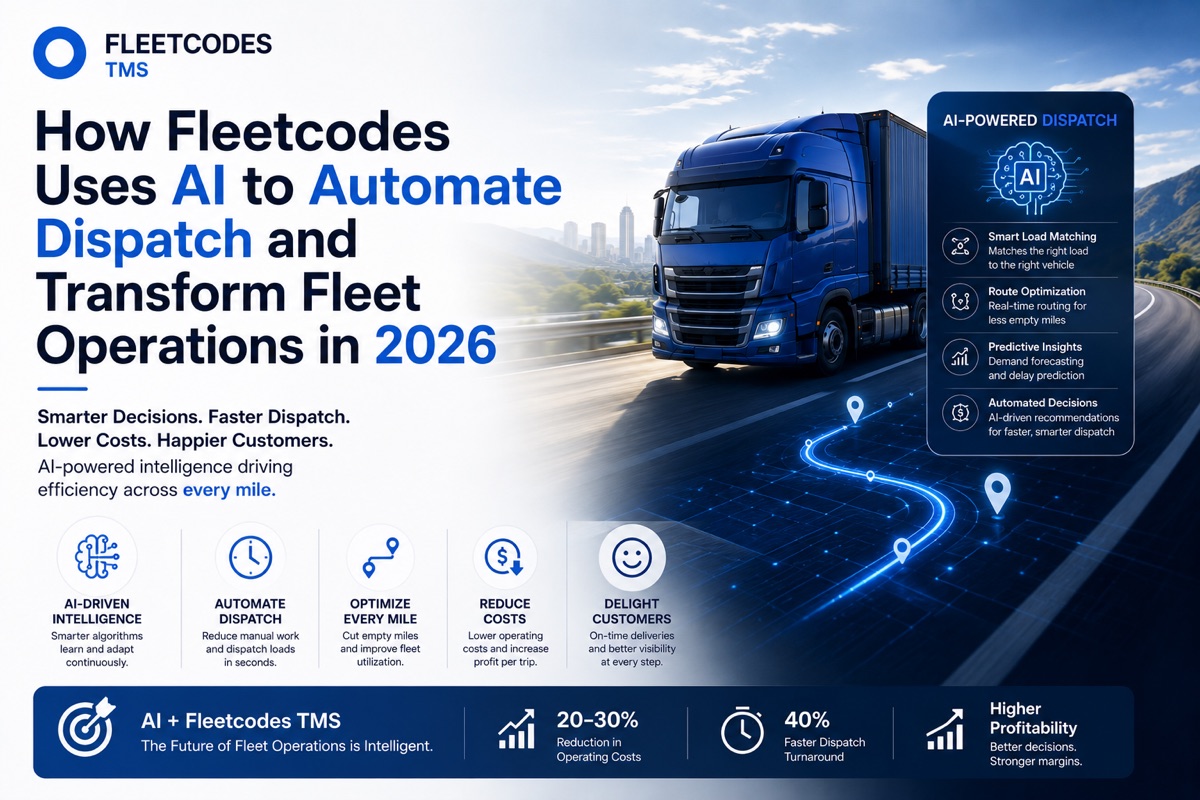
Dispatch is one of the most decision-intensive roles in any logistics operation. In 2026, AI isn't replacing your dispatchers — it's making every decision they take faster, smarter, and more profitable.
Why Dispatch Is the Nerve Centre of Fleet Profitability
Every load movement in a logistics business starts with a dispatch decision. Which vehicle? Which driver? Which route? Which sequence of deliveries maximises utilisation while meeting all delivery commitments?
Get these decisions right consistently, and your fleet runs efficiently — high vehicle utilisation, minimal empty miles, on-time deliveries, controlled fuel costs.
Get them wrong — or make them slowly — and the ripple effects are immediate. Trucks sit idle while drivers wait for assignments. Loads are assigned to the wrong vehicle, adding unnecessary kilometres. Routes aren't optimised, burning extra fuel. And in peak periods, overloaded dispatchers making manual decisions under time pressure make mistakes that cost the business real money.
This is why logistics automation in dispatch is one of the highest-value improvements any fleet management operation can make in 2026. And it's precisely what Fleetcodes is built to deliver.
See Fleetcodes' AI dispatch features in action → Book a Free Demo
What AI Dispatch Automation Actually Means
There's a lot of loose use of the term "AI" in fleet management software marketing. Let's be specific about what Fleetcodes' AI-powered dispatch automation actually does — and why it matters for your operation.
Fleetcodes applies machine learning and optimisation algorithms to the dispatch workflow in three distinct ways:
1. Intelligent Load-to-Vehicle Matching
When a new load enters the system, Fleetcodes doesn't just show a list of available vehicles. It analyses the load's requirements against the entire fleet — vehicle type, current location, current load status, driver hours available, vehicle maintenance schedule, and historical performance on similar routes — and surfaces the best match.
This means a dispatcher isn't sorting through 40 vehicles manually. They're confirming a recommendation that already accounts for every relevant variable.
2. Route Optimisation at Scale
For fleets handling multiple pickups and deliveries per truck per day, manual route planning is a significant time sink — and rarely produces the optimal sequence. Fleetcodes' route engine calculates the most efficient sequence of stops for each truck, factoring in:
- Road conditions and traffic patterns
- Customer delivery windows
- Vehicle load capacity and sequence constraints
- Fuel efficiency of the specific vehicle on the specific route
- Real-time updates that reroute around delays
This is operational efficiency that compounds over thousands of trips — each individually optimised, collectively adding up to significant savings in fuel, time, and driver hours.
3. Predictive Dispatch Planning
Beyond reactive load matching, Fleetcodes uses historical trip data to help operations teams plan proactively. The system identifies patterns — routes that consistently run late, vehicles that consistently underperform on certain lane types, demand patterns that predict busy periods — and surfaces this intelligence for dispatchers to act on before problems occur.
This shifts dispatch from a reactive function (respond to today's loads) to a proactive one (anticipate tomorrow's requirements and position the fleet accordingly).
The Manual Dispatch Problem at Scale
To understand why AI dispatch matters, consider what manual dispatch looks like at 100+ vehicles:
A dispatcher has a whiteboard (or a spreadsheet) showing vehicle locations, availability, and assignments. They receive a load booking. They mentally run through the available vehicles, check driver hours, think about the route, make a call.
This works when volumes are manageable. But as fleet size grows, the number of variables in every dispatch decision increases exponentially. A dispatcher managing 50 trucks is making hundreds of micro-decisions per day — and the quality of those decisions degrades with fatigue, time pressure, and information overload.
The result is:
- Suboptimal vehicle assignments that add unnecessary costs
- Routing decisions based on familiarity rather than optimisation
- Missed opportunities to fill empty return legs
- Delays in assignment that cause vehicles to sit idle during high-demand periods
Fleet management shipping operations that scale their dispatcher headcount in proportion to fleet size are solving the wrong problem. The right answer is transport management system software that makes each dispatcher exponentially more capable — not more dispatchers.
Real-Time Tracking as the Foundation for AI Dispatch
AI dispatch doesn't work without data — and the foundation of that data is accurate, real-time visibility into where every vehicle is and what it's doing.
Fleetcodes integrates with your GPS infrastructure to provide:
- Live vehicle positions updated in real time across the dispatch dashboard
- Trip status tracking — loaded, in transit, at customer, delivered, returning
- Driver status — available, on-duty, on break, off-duty
- ETA predictions calculated dynamically based on current traffic and progress
- Exception alerts — delays, route deviations, idle time breaches, and vehicle issues flagged immediately
This real-time tracking layer is what makes intelligent dispatch possible. When the system knows exactly where every vehicle is and what it's doing, it can make genuinely good recommendations — not guesses based on last-known positions.
For customers, this visibility also transforms the experience. Rather than calling your ops team for an update, customers access their own portal and see live tracking, estimated arrival times, and delivery confirmation in real time. This is how transport management system software directly supports increase delivery performance goals.
AI Dispatch in Practice: A Day in the Life
7:00 AM — Load Schedule Review The operations manager opens Fleetcodes. The AI has already analysed the day's confirmed bookings and suggested optimal vehicle and driver assignments for 80% of loads, based on availability, vehicle specs, and route efficiency. The manager reviews and confirms, making adjustments where needed.
9:30 AM — New Urgent Load Comes In A high-priority booking arrives mid-morning. Fleetcodes instantly identifies the three best-positioned available vehicles, highlights the recommended match, and shows the cost and time impact of the assignment. Decision made in under 60 seconds.
11:45 AM — Route Deviation Alert A driver has deviated from the optimised route. Fleetcodes flags the deviation with the estimated additional fuel cost and adjusted ETA, and notifies the dispatcher. The driver is contacted and course-corrected.
2:00 PM — Return Load Opportunity A vehicle completing a delivery 180 km away is flagged — there's an available load originating 25 km from the delivery point that fits the vehicle's specs and timing. The dispatcher is prompted to assign it, avoiding a full empty return leg.
5:00 PM — End of Day Review The Fleetcodes dashboard shows the day's fleet mgmt performance — vehicle utilisation, on-time delivery rate, fuel consumption vs. benchmark, empty km percentage, and revenue per vehicle. Tomorrow's planning starts with full context from today.
This is logistics automation applied to the most complex, decision-intensive part of fleet operations — and it's available to every Fleetcodes customer from day one.
The Impact on Operational Efficiency and Delivery Performance
Logistics businesses that adopt AI-assisted dispatch through Fleetcodes typically see:
| Metric | Typical Improvement | |---|---| | Vehicle utilisation rate | +15–25% | | On-time delivery performance | +20–30% | | Fuel cost per km | -8–12% | | Empty miles as % of total | -30–40% | | Dispatcher capacity (loads per head) | 2–3x | | New driver onboarding speed | 50% faster with AI-assisted routing |
These aren't projections — they reflect what happens when you replace manual, experience-based dispatch decisions with AI-assisted decisions that are consistent, data-driven, and scalable.
For fleet management india private limited operations growing beyond 50–75 vehicles, this kind of capability is the difference between controlled, profitable growth and operational chaos.
Why Fleetcodes' Approach to AI Is Built for Indian Logistics
AI-powered dispatch has been available in global logistics platforms for years. But most of those platforms weren't built for the Indian market — and the differences matter.
Fleetcodes' AI dispatch is specifically calibrated for:
- Indian road and traffic conditions — including state highway patterns, seasonal disruptions, and urban vs. rural route characteristics
- Multi-state compliance — factoring in e-way bill requirements, state border crossing times, and regional regulations into route recommendations
- Mixed fleet types — from small pick-up vans to heavy multi-axle trucks, the system handles the full range of vehicle types common in Indian logistics
- Variable load patterns — optimising for the demand patterns typical of manufacturing, FMCG, e-commerce, and project logistics in India
This is fleet management software built with deep understanding of the market it serves — not a global product force-fitted to Indian requirements.
FAQs
Does AI dispatch in Fleetcodes replace human dispatchers? No. Fleetcodes' AI assists dispatchers by surfacing recommendations, flagging issues, and automating routine decisions. Human dispatchers remain in control of every assignment — but they make better decisions faster, with more information, and with significantly less manual effort.
How does Fleetcodes' AI improve over time? The system learns from your specific operation — your routes, your vehicles, your delivery patterns, your customers' requirements. Recommendations improve as the platform accumulates data from your trips, making suggestions progressively more accurate and relevant.
What GPS integration does Fleetcodes support? Fleetcodes integrates with major GPS and real-time tracking platforms used in Indian logistics. Your existing GPS infrastructure can feed directly into the Fleetcodes dispatch dashboard without requiring a hardware replacement.
How does AI dispatch contribute to cost saving? By optimising vehicle-to-load matching, route efficiency, and empty mile reduction, AI dispatch directly reduces fuel costs, driver overtime, and vehicle wear — delivering measurable cost saving across the full operation.
Is Fleetcodes AI dispatch suitable for fleets of all sizes? Yes. The AI dispatch tools in Fleetcodes are valuable from 15 vehicles upward. Smaller fleets benefit from the consistency and optimisation; larger fleets benefit from the scalability — enabling dispatchers to manage far more loads than would be possible manually.
AI-powered dispatch. Real-time visibility. Complete fleet control. That's Fleetcodes. Book Your Free Demo Today →