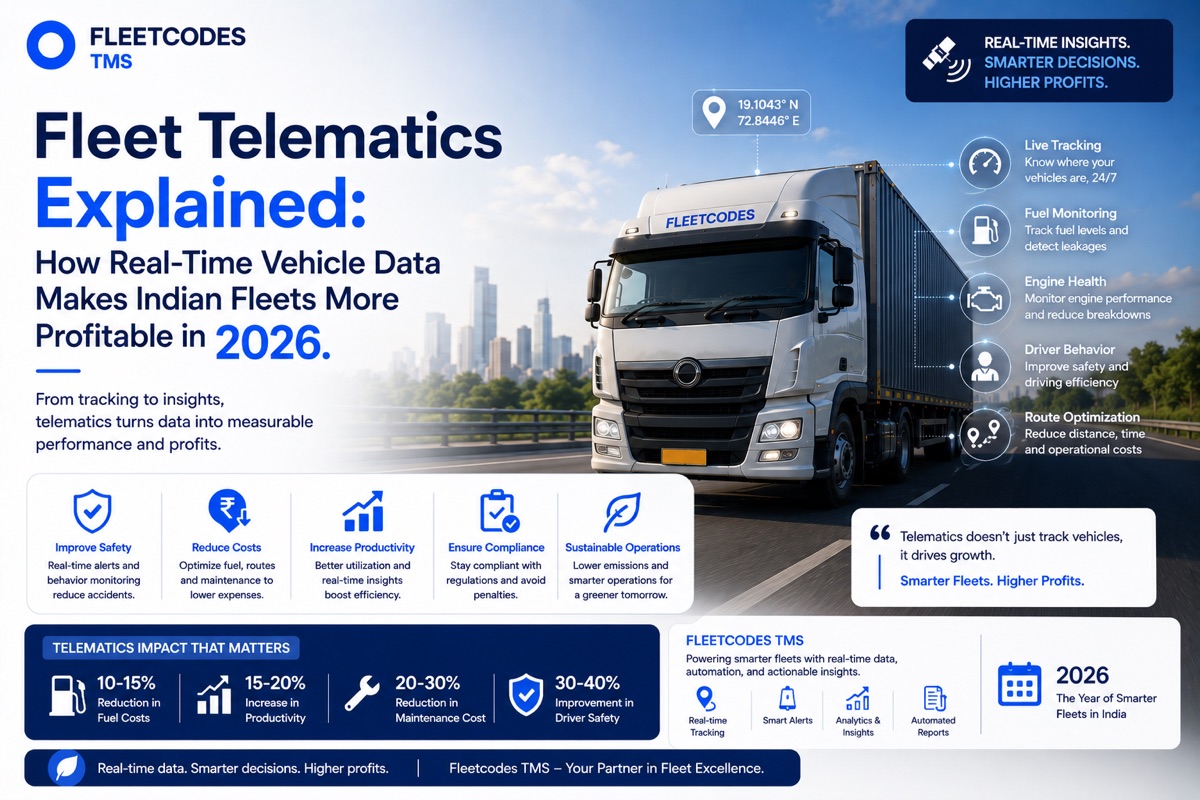
The Indian telematics market is valued at ₹555 crore in 2026 and growing at 18% annually. Yet the majority of fleet operators using GPS tracking are capturing only a fraction of the available intelligence. The gap between tracking and insight is where fleet profitability hides.
What Is Fleet Telematics?
Fleet telematics India refers to the technology that combines GPS location tracking, vehicle diagnostics, wireless communication, and data analytics to monitor and manage commercial vehicles in real time. The word itself is a portmanteau of "telecommunications" and "informatics" — and that combination captures what telematics actually delivers: communication data about vehicles that becomes information for decisions.
In practice, a telematics system consists of:
- A hardware device installed in or connected to the vehicle (typically plugging into the OBD-II port or hardwired via a dedicated device)
- A wireless communication link — 4G in most modern deployments in India
- A software platform that receives, stores, and analyses the data stream from the vehicle
- Dashboards and alerts that surface actionable information to fleet managers and dispatchers
Vehicle telematics software India has matured significantly. What was once primarily a stolen vehicle recovery tool has evolved into a comprehensive fleet intelligence platform — covering location, speed, engine diagnostics, fuel consumption, driver behaviour, maintenance forecasting, and compliance.
The Indian telematics market is growing at 18% CAGR, driven by expanding 4G coverage, falling hardware costs, AIS 140 compliance mandates, and the growing recognition among fleet operators that GPS location alone is not sufficient for operational management.
What Telematics Data Actually Tells You
The gap between "we have GPS" and "we have a telematics platform" is the gap between knowing where your truck is and understanding what is happening across your entire fleet — and what that means for profitability.
Here is what a comprehensive vehicle telematics software India deployment captures:
Location and Movement Data
- Real-time GPS coordinates updated at configurable intervals (typically every 30–60 seconds in Indian deployments)
- Trip history — complete route replay for any vehicle on any date
- Time at location — arrival, departure, and dwell time at every stop
- Distance travelled per trip, per day, per month
This is what basic GPS tracking provides. It is useful, but it is only the foundation.
Engine and Vehicle Diagnostics
- Engine on/off status and idling time
- Vehicle speed in real time and historically per trip
- Fuel level (with hardware support) or fuel consumption estimates from engine data
- Engine fault codes — warning lights and diagnostic trouble codes (DTCs) transmitted to the fleet dashboard
- Odometer readings — synchronised to actual vehicle odometer for accurate maintenance scheduling
This layer is what separates telematics from tracking. When you know your vehicle's engine is throwing a fault code, you can schedule maintenance before a breakdown. When you know how long each vehicle idles per day, you can quantify the fuel cost and act on it.
Driver Behaviour Analytics
- Speeding events — instances of speed above defined thresholds, with timestamp and location
- Harsh braking — sudden deceleration events flagged per trip
- Harsh acceleration — sudden acceleration events that waste fuel and increase drivetrain wear
- Cornering behaviour — excessive lateral G-force events
- Idling time — engine running without vehicle movement, beyond defined threshold
Driver analytics turns individual driving events into a per-driver performance profile over time. This is not about surveillance — it is about having objective data for driver coaching, safety management, and fuel cost accountability.
Geofence and Compliance Events
- Entry and exit timestamps for configured geographic zones (customer sites, depots, state borders)
- Out-of-hours movement alerts (vehicle moving outside defined operational windows)
- Route deviation — distance from planned route exceeding defined threshold
- AIS 140 compliance data — mandatory for commercial vehicles operating on Indian roads
AIS 140 GPS India compliance is a mandatory regulatory requirement for commercial vehicles, administered by the Ministry of Road Transport and Highways. Any fleet operating in India should be using hardware certified to the AIS 140 standard — and the compliance data from AIS 140 devices integrates directly into telematics platforms.
From Data to Profitability: The Five Applications That Matter
Understanding what telematics data captures is the start. Understanding how to turn that data into operational decisions that improve profitability is where the real value lies.
1. Fuel Cost Reduction Through Behaviour Data
Fuel is 35–40% of operating costs for most Indian logistics fleets. Telematics for logistics makes the fuel cost impact of driver behaviour visible — and visibility creates accountability.
When a fleet manager can show a driver that their idling time last month cost ₹4,200 in unnecessary fuel, that conversation is fundamentally different from a general instruction to "drive more carefully." Specific, data-backed feedback changes behaviour. Changed behaviour reduces fuel costs — typically 8–12% across a fleet transitioning from unmonitored to telematics-monitored operations.
The same data also surfaces the outlier situations: a vehicle whose fuel consumption is significantly above its fleet average for comparable trips. Sometimes this is driver behaviour. Sometimes it is a mechanical issue — a fuel leak, a clogged injector, a tyre pressure problem. Catching it with data is faster and cheaper than catching it with a breakdown.
2. Predictive Maintenance — Catching Failures Before They Happen
Vehicle diagnostics fleet management data is the foundation of predictive maintenance. When your telematics platform is receiving engine fault codes, odometer readings, and performance data in real time, it can flag developing issues weeks before they become operational failures.
Unplanned fleet downtime is one of the most significant cost items in Indian logistics — and consistently underestimated. When a truck breaks down on a highway, the direct repair cost is typically the smallest component. Add: delivery delay penalties, driver standby costs, emergency parts procurement at premium prices, and customer relationship damage.
Indian fleet customers using telematics-based predictive maintenance have reported 75% reductions in breakdown events and 10–30% improvements in fleet uptime. The same data that prevents breakdowns also optimises maintenance scheduling — so vehicles are serviced at the right time based on actual usage, not a fixed calendar interval.
3. Route Efficiency Analysis and Optimisation
GPS fleet tracking India data, when analysed over time, reveals the actual performance of every route in your operation — not just the theoretical route, but the real route driven, with real time, real distance, and real fuel consumed.
This historical route data enables several practical decisions:
- Identifying which routes have consistently high actual time versus planned time — and investigating why (traffic patterns, customer loading delays, inefficient stop sequences)
- Comparing different route options for the same origin-destination pair using actual fleet data rather than mapping estimates
- Understanding which vehicle types perform best on which route types — and making allocation decisions accordingly
- Detecting systematic route deviations that are adding distance and fuel cost without operational justification
Over time, IoT fleet management India route analysis compounds. Fleets that analyse and optimise routes systematically using telematics data consistently outperform those that rely on dispatcher experience alone — both in fuel efficiency and in delivery time reliability.
4. Fleet Utilisation and Asset Performance
Telematics data makes fleet utilisation genuinely visible. You can see:
- Which vehicles are operated how many hours and kilometres per day
- Which vehicles are consistently underutilised (suggesting excess capacity or poor allocation)
- Which vehicles are driven significantly more than others (suggesting uneven wear and disproportionate maintenance costs)
- Time at depot versus time in operation — and whether that ratio makes sense for your business
This utilisation visibility is valuable for two reasons. It improves day-to-day allocation decisions (the dispatcher can see which vehicles are actually available and which are at a customer location). And it informs longer-term fleet strategy — which vehicles to replace, which routes need additional capacity, when to expand.
5. Customer Service and Delivery Performance
Fleet tracking software India data feeds directly into customer service quality. When dispatchers can see live vehicle positions and ETA predictions, they can proactively communicate delays to customers before a call comes in. When customers can access their own tracking portal, the volume of inbound "where is my delivery?" calls drops significantly.
This is not a soft benefit. For logistics businesses competing on service quality — particularly those serving FMCG, pharma, or e-commerce customers with tight delivery SLAs — the ability to manage and communicate delivery performance in real time is a commercial differentiator.
AIS 140 Compliance: The Mandatory Baseline for Indian Fleets
Any discussion of fleet telematics India for commercial vehicles must address AIS 140. The Automotive Industry Standard 140 mandates that all commercial vehicles operating in India (above a specified category) must be fitted with IRNSS-compatible vehicle location tracking devices certified to the AIS 140 standard.
AIS 140 compliance involves:
- Installation of a VLTD (Vehicle Location Tracking Device) certified to AIS 140 standards
- Transmission of location data to the state transport department's command and control centre
- Emergency button functionality (for driver safety)
- Immobiliser integration in some vehicle categories
Beyond regulatory compliance, AIS 140 devices provide the location and basic vehicle data that feeds into fleet management platforms. When selecting a telematics provider, ensure hardware is AIS 140 certified and that the platform can receive and use AIS 140 data streams from your existing hardware.
The Software Layer: Where Telematics Data Becomes Fleet Intelligence
Hardware captures data. Software turns it into intelligence. This distinction is critical for fleet operators evaluating OBD GPS tracker India and telematics solutions.
The most common gap in Indian fleet technology is having reasonable hardware (GPS trackers in every vehicle) but inadequate software — a basic location dashboard that shows current positions but provides no analytics, no driver behaviour insights, no maintenance forecasting, and no integration with dispatch or billing operations.
A full fleet management software EV and diesel platform like Fleetcodes acts as the intelligence layer above your GPS hardware. Fleetcodes integrates with your existing GPS and telematics hardware, receiving the location and vehicle data stream and connecting it with your operational data — trip assignments, customer bookings, billing records, driver settlements.
The result is fleet intelligence that goes beyond "where is the truck?" to answer the operational questions that actually matter:
- Is this truck on the right route and on schedule for this delivery?
- What is the fuel consumption on this trip versus the baseline for this route and vehicle?
- Which vehicles need maintenance attention this week based on their diagnostic data?
- What is the actual cost of this trip — fuel, driver time, toll — and what is the margin on the freight rate charged?
This is telematics data fleet profitability in practice: every data point from every vehicle connected to the operational and financial picture of the business.
Choosing the Right Telematics Setup for Your Fleet
A practical evaluation framework for GPS fleet tracking India and telematics solutions:
| Factor | What to Look For | |---|---| | Hardware certification | AIS 140 certified, with 4G connectivity | | Data refresh rate | 30–60 second updates for operational dispatch use | | Driver behaviour data | Speeding, idling, harsh events tracked per driver | | Engine diagnostics | Fault code reading from OBD interface | | Software integration | Does it connect with your TMS and dispatch system? | | India-specific features | AIS 140 data forwarding, multi-state compliance support | | Offline capability | Data buffering when network is unavailable | | Support | Local support in India, not just international helpdesk |
The telematics market in India has many hardware providers. The differentiator is often the software layer — and whether that software connects to the operational workflows that determine whether the data actually changes how the fleet is managed.
FAQs
What is fleet telematics in India? Fleet telematics combines GPS tracking, vehicle diagnostics, wireless communication, and data analytics to monitor commercial vehicles in real time. In India, it is growing at 18% CAGR driven by AIS 140 mandates, falling hardware costs, and the increasing recognition that location data alone is insufficient for profitable fleet management.
What is AIS 140 and is it mandatory for Indian commercial vehicles? AIS 140 is the Automotive Industry Standard for Vehicle Location Tracking Devices in India, mandated by the Ministry of Road Transport and Highways for commercial vehicles. It requires certified GPS hardware transmitting location data to state command and control centres, with emergency button functionality.
How does telematics improve fleet profitability? Telematics improves profitability through: fuel cost reduction via driver behaviour monitoring (8–12% savings), preventive maintenance that avoids breakdown costs, route efficiency analysis, better vehicle utilisation visibility, and improved delivery performance that strengthens customer relationships.
What is the difference between GPS tracking and fleet telematics? GPS tracking provides vehicle location. Fleet telematics provides location plus engine diagnostics, fuel consumption, driver behaviour analytics, maintenance forecasting, and integration with dispatch and billing operations. Telematics turns location data into fleet intelligence.
How does Fleetcodes use telematics data? Fleetcodes integrates with your existing GPS and telematics hardware, receiving vehicle location and diagnostic data and connecting it with your trip records, customer bookings, driver data, and billing information. This integration turns raw vehicle data into operational intelligence — visible to dispatchers in real time and to management in performance dashboards.
Your GPS hardware is already collecting data. Fleetcodes turns that data into decisions. See How Fleetcodes Integrates with Your Telematics — Book a Demo →