Ask most Indian fleet operators to show you their Standard Operating Procedures and you will get one of two answers. Either a vague gesture toward "how we've always done things" — or a name. The name of the one dispatcher, manager, or owner whose head holds the entire operational logic of the business.
The Hidden Risk in Every Knowledge-Dependent Fleet
A fleet SOP India problem is not a paperwork problem. It is a business resilience problem.
When operational knowledge lives in one person's head — how loads are prioritised, which customers get called first when there is a delay, how driver settlements are calculated, what triggers a maintenance check — the business becomes hostage to that person's continued presence. When they take a day off, quality drops. When they resign, chaos follows.
This is not a small-fleet problem. It is as common in 100-vehicle operations as in 15-vehicle ones. And it is one of the primary reasons Indian logistics businesses struggle to scale beyond a certain size — because growth requires consistent, reproducible operations, and consistent operations require documented, automated processes.
In 2026, the best-run fleets treat SOPs as infrastructure — as important as their vehicles and their depots. And the most forward-thinking ones are going a step further: not just documenting their SOPs, but automating them through logistics workflow automation platforms that execute the process without requiring anyone to remember to do it.
Fleetcodes is built specifically for this — an AI-first TMS that learns your operational SOPs and runs them autonomously.
See how Fleetcodes automates your fleet SOPs → Book a Free Demo
What Is a Fleet SOP and Why Does It Matter?
A transport operations manual SOP — Standard Operating Procedure — is a documented, step-by-step description of how a specific task or workflow is performed in your operation. Not how it should theoretically be done. How it actually gets done, by your team, with your systems, for your customers.
A good fleet SOP answers four questions for every process:
- Who is responsible?
- What exactly happens, in what sequence?
- When is it triggered and what is the deadline?
- What confirms it has been done correctly?
Five processes are so central to operational and financial performance that they deserve to be treated as non-negotiable foundations.
The 5 Core Fleet SOPs Every Indian Transporter Needs
SOP 1: Load Assignment and Dispatch
The dispatch SOP transport is the highest-frequency decision in any fleet — happening dozens or hundreds of times per day. Done consistently, it maximises vehicle utilisation and minimises empty miles. Done inconsistently, it creates compounding inefficiency that erodes margins invisibly.
A documented dispatch SOP covers: how load requests are received and logged, the checks required before assigning a load (vehicle availability, driver hours, vehicle type, route efficiency), how priority conflicts are resolved, what information is communicated to the driver, and what confirmation is required before departure.
How Fleetcodes automates it: The AI dispatch engine analyses all available vehicles against each incoming load — type, location, driver hours, route history, fuel efficiency — and surfaces the optimal assignment. The dispatcher confirms. The system notifies the driver via app. The e-way bill is linked. No steps are skipped because the sequence is enforced by the platform.
SOP 2: Digital POD and Delivery Confirmation
The POD SOP governs what happens at the point of delivery — and directly controls how fast you get paid.
A documented delivery confirmation SOP covers: what the driver must capture at delivery (recipient signature, goods condition, timestamp, exceptions), how discrepancies are reported, what triggers the billing cycle, and how disputes are escalated.
How Fleetcodes automates it: Drivers capture digital POD through the Fleetcodes app — recipient signature, photo, geotag, timestamp — in under two minutes. The confirmed POD instantly triggers invoice generation. No paper. No delay. No manual handoff from driver to billing team. The SOP executes automatically the moment delivery is confirmed.
SOP 3: Driver Settlement Calculation
Driver settlement disputes are one of the leading causes of attrition in Indian logistics. The root cause is almost always the same: the settlement process is opaque, inconsistent, and slow — because it has never been formally documented or systematised.
A documented driver settlement SOP covers: what components make up a driver's pay (base rate, per-km allowance, advances, expenses, bonuses), what data sources are used for each component, what the settlement cycle is, and how disputes are raised and resolved.
How Fleetcodes automates it: Settlement is calculated automatically from trip data — GPS-verified distance, confirmed deliveries, submitted expenses, advance records, and applicable bonuses. The summary is visible to the driver in the app before finalisation. Every component is documented and auditable. Disputes fall because the numbers are transparent to both parties.
SOP 4: Preventive Maintenance Scheduling
Reactive maintenance is the most expensive maintenance model. A vehicle that breaks down costs 3–4x more to fix than the same component serviced on schedule. Yet most Indian fleets operate reactively, because they have no systematic process for tracking and triggering maintenance before it is needed.
A documented fleet management checklist maintenance SOP covers: service intervals per vehicle class, who schedules and approves maintenance, how load gaps are managed when a vehicle is in service, what documentation is required, and what triggers an unscheduled inspection.
How Fleetcodes automates it: Every vehicle has a maintenance profile with intervals tracked against actual km and operating data. When service is due, the system alerts the maintenance team and flags the vehicle on the dispatch dashboard. Assignments automatically exclude vehicles in maintenance. Service records are logged digitally — auditable and available for insurance or resale documentation.
SOP 5: Compliance and E-Way Bill Management
For multi-state operations, compliance documentation is a daily operational task. When any document is missed — e-way bill, vehicle permit, driver licence — the consequences range from checkpoint detention to significant financial penalties.
A documented compliance SOP covers: who generates e-way bills and at what point, how validity is monitored on long-haul trips, what vehicle and driver checks happen before departure, and how compliance exceptions are escalated.
How Fleetcodes automates it: Fleetcodes integrates with the GST e-way bill portal, generating bills from trip data automatically. Vehicle document expiry dates are stored and flagged before they become a problem. Drivers see their document status in the app. Compliance monitoring runs continuously — not as a manual checklist depending on someone remembering.
From SOP Documentation to SOP Automation: The Progression
Most fleet operators who begin documenting SOPs discover the process surfaces inconsistencies they had not noticed before — two dispatchers applying different priority rules, settlement calculations that vary by who does them, maintenance checks that happen sometimes but not always.
This is the value of documentation before automation. You cannot automate an inconsistent process.
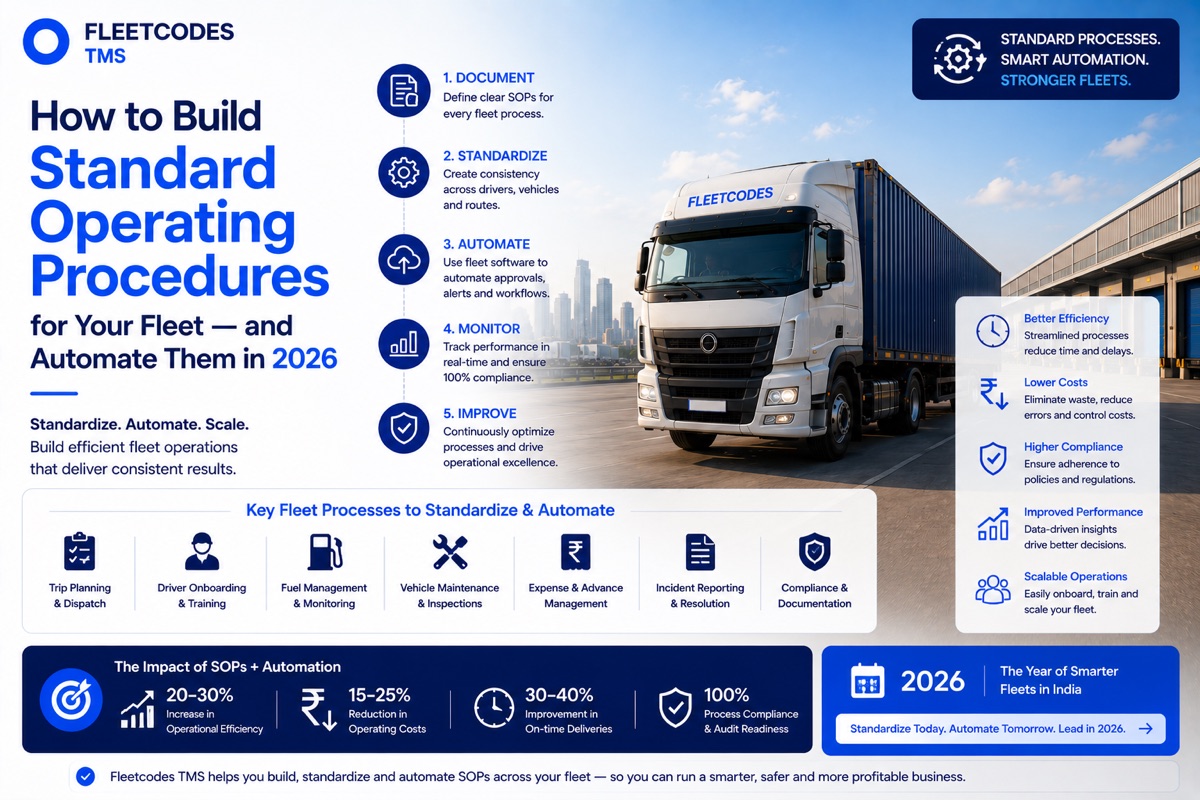
Step 1 — Document: Write down how each core process actually works today. Interview the people who do it. Note variations and edge cases.
Step 2 — Standardise: Agree on the single correct process. Resolve variations. Define how exceptions are handled.
Step 3 — Configure: Set up Fleetcodes to reflect the standardised SOP — dispatch rules, billing triggers, settlement parameters, maintenance intervals, compliance alerts.
Step 4 — Automate: Let the system run the process. Your team manages exceptions. The standard runs without manual intervention.
Step 5 — Improve: Fleetcodes analytics surface where processes work and where they create exceptions. Refine SOPs over time. The AI fleet automation India system learns and improves with your operation.
The Business Result: Consistent Operations That Scale
When fleet operations run on documented, automated SOPs rather than individual knowledge:
Quality becomes consistent. Dispatch decisions, billing accuracy, driver settlements, and compliance do not depend on who is working that day. The process is the same every time.
The business becomes scalable. Adding vehicles, routes, and customers does not require proportionally adding management overhead — because the process runs in the system, not in people's heads.
The business becomes resilient. When a key person is unavailable, the operation continues. The SOPs are in the system — not in a single person's memory.
This is what Fleetcodes means when it says it "learns your SOPs and runs your logistics autonomously." It is not a marketing phrase. It is a description of what transport process automation is built to deliver.
FAQs
What is a fleet SOP and why is it important in Indian logistics? A fleet SOP is a documented, step-by-step description of how a specific operational process is performed — dispatch, delivery confirmation, driver settlement, maintenance, compliance. SOPs make operations consistent, scalable, and independent of any single person's knowledge.
How does logistics workflow automation connect to fleet SOPs? Logistics workflow automation translates documented SOPs into system-enforced processes — so the steps happen automatically in the correct sequence, triggered by the right events, without requiring manual coordination. The SOP defines what should happen; automation ensures it always does.
How long does it take to configure fleet SOPs in Fleetcodes? Most customers complete core SOP configuration — dispatch rules, billing triggers, settlement parameters, maintenance schedules, compliance alerts — within 7–10 days of deployment. The documentation phase typically takes 2–5 days of structured discussion with the operations team.
Can Fleetcodes handle SOPs that differ from standard templates? Yes. Fleetcodes is configurable to the specific SOPs of each operation — different dispatch priority rules, different settlement structures, different maintenance intervals per vehicle class. The system learns your specific process, not a generic one.
What happens when an exception falls outside the standard SOP? Fleetcodes flags exceptions and routes them to the appropriate person for a human decision. The system handles the standard; your team handles the exceptions — the human-in-the-loop model that makes automated dispatch workflow safe in a complex operational environment.
Your SOPs are the intellectual infrastructure of your fleet business. Document them. Automate them. Watch your operation run without you having to be everywhere at once. Book a Free Fleetcodes Demo — See Your SOPs Automated →