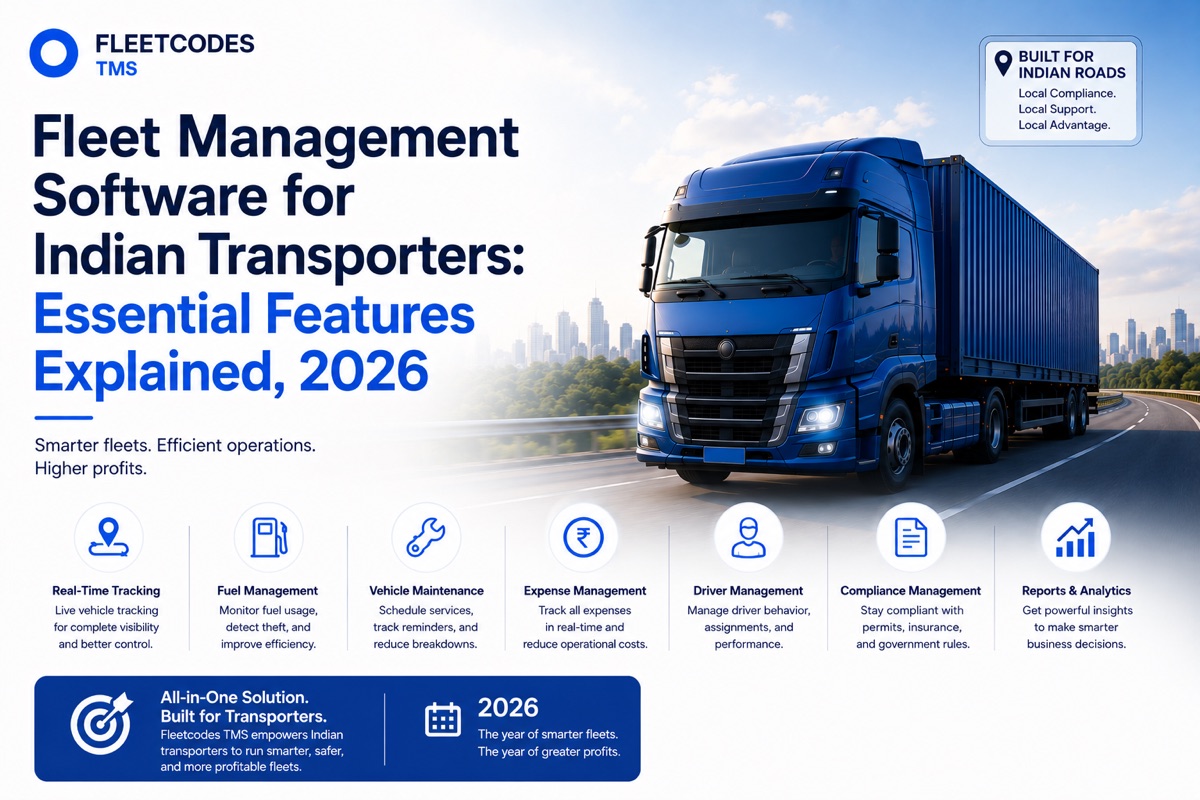
There are hundreds of fleet management platforms available globally. Maybe a dozen are actually built for how Indian logistics businesses operate. Here's how to tell the difference — and what features you genuinely cannot afford to be without.
Why "Built for India" Matters More Than You Think
AI fleet management software India is a different product requirement from fleet management software designed for European or American logistics markets. The operational environment is fundamentally different:
- Multi-state GST and e-way bill compliance is mandatory and complex
- Road infrastructure varies dramatically — from national expressways to single-lane state highways to urban congestion
- Driver smartphone literacy varies widely, requiring apps designed for users with limited tech experience
- Mixed fleet types — from tata ace to 32-ton multi-axle — operate in the same business
- Fuel management involves multiple state-specific price points and vendor relationships
- Payment workflows are India-specific — NEFT, UPI, and FASTag integration are baseline requirements
A global transport management system India solution that handles European road networks well but doesn't generate e-way bills natively, doesn't support Indian carrier payment workflows, and wasn't designed for a driver using a budget smartphone in patchy 4G coverage — is not the right tool for your operation.
This guide covers the features that genuinely matter for Indian transporters, and how Fleetcodes delivers each one.
See the full Fleetcodes feature set — Book a Demo
Feature 1: AI-Powered Dispatch Planning
The single most impactful feature in any modern AI fleet management software India is intelligent dispatch — the ability to match loads to vehicles automatically, based on a comprehensive analysis of fleet state, route characteristics, and operational constraints.
Fleetcodes' dispatch planning software uses AI to:
- Evaluate every available vehicle against every incoming load simultaneously
- Factor in vehicle type, current location, driver hours, fuel efficiency on the route, and historical delivery performance
- Surface the optimal assignment with supporting rationale
- Flag conflicts or constraints — driver hours close to limit, vehicle due for service — before they become problems on the road
For dispatchers managing 50–200+ vehicles, this capability is transformational. Decisions that previously required 10–15 minutes of mental coordination are confirmed in under 60 seconds.
Feature 2: Real-Time GPS Tracking with Operational Integration
GPS tracking is table stakes. What matters is how that tracking data integrates with the rest of your operation.
In Fleetcodes, live GPS data feeds directly into:
- Dispatch dashboard — dispatchers see vehicle positions, load status, and ETA in one view
- Customer portal — customers track their delivery in real time without calling your team
- Billing module — actual route and distance data feeds into invoice calculations, preventing estimate-based billing errors
- Driver analytics — route deviation, idle time, and speed data captured continuously per driver
This integration is what separates operational visibility from mere location tracking. Knowing where your truck is matters. Knowing what it costs, whether it's on route, and when it will arrive — all in the same system — is what drives fleet profitability.
Feature 3: Logistics Automation Software — End-to-End Workflow
Manual handoffs between dispatch, operations, billing, and settlement are where errors, delays, and leakage occur. Logistics automation software in Fleetcodes eliminates these handoffs:
| Manual Process | Automated in Fleetcodes | |---|---| | Creating billing record from trip sheet | Auto-generated from trip data | | Applying customer rate card to invoice | Applied automatically from stored rate card | | Tracking POD receipt before invoicing | Digital POD triggers invoice on confirmation | | Calculating driver settlement from trip logs | Automated from trip, expense, and advance records | | Generating e-way bill at dispatch | Integrated with GST portal, generated from trip data | | Raising detention charges | Auto-triggered from geofence arrival/departure timestamps |
Every row in this table is a staff-hour saved, an error eliminated, and a delay removed from your operation.
Feature 4: Predictive Fleet Analytics and Maintenance Management
Predictive fleet analytics is one of the most underdeveloped areas in most basic fleet tracking tools — and one of the highest-value capabilities in a full fleet optimization platform.
Fleetcodes tracks every vehicle's maintenance history, mileage since last service, fuel consumption trends, and component-level alerts. The AI layer analyses these patterns to:
- Predict when each vehicle is likely to need servicing based on actual usage — not just a fixed km schedule
- Flag early signs of mechanical issues (fuel consumption spikes, unusual engine alerts) before they become breakdowns
- Schedule maintenance in service windows that minimise operational disruption
- Track maintenance cost per vehicle over time, identifying vehicles approaching end-of-economic-life
The difference between preventive and reactive maintenance in fleet operations is substantial — both in direct repair costs (preventive is 3–4x cheaper than reactive) and in the operational cost of a vehicle off the road unexpectedly.
Feature 5: Fuel Management — Tracking, Control, and Optimization
Fuel management is the largest single variable cost in any fleet — and the one with the most potential for savings through better data.
Fleetcodes delivers AI fleet management software India fuel control through:
- Per-vehicle consumption profiles — each vehicle has a baseline consumption rate. Deviations are flagged automatically
- Per-trip fuel cost tracking — actual fuel cost allocated to each trip for profitability calculation
- Driver behaviour fuel impact — idling time, harsh acceleration, and speeding are tracked and their fuel cost impact quantified
- Fuel expense validation — driver-submitted fuel receipts cross-referenced against actual distance travelled
- Route-level fuel benchmarks — understanding which routes are fuel-efficient and which are not, enabling better vehicle allocation
For most fleets, implementing structured fuel management through Fleetcodes delivers 8–12% fuel cost reduction within the first three months.
Feature 6: Freight Audit Automation
Freight audit automation is essential for logistics businesses that both issue invoices to customers and receive invoices from carriers. Errors flow in both directions — and without systematic audit, they go uncorrected.
Fleetcodes automates freight audit by:
- Comparing invoices raised against trips completed — flagging any deliveries that were completed but not billed
- Cross-checking carrier invoices against agreed rate cards and actual trip data — identifying overcharges before payment
- Reconciling customer payments against invoices — flagging short payments and disputed charges for follow-up
- Generating audit trails for every billing action — essential for customer dispute resolution and internal compliance
Freight audit automation in Fleetcodes typically recovers 2–5% of revenue that was being lost to billing gaps and carrier overcharges in manual operations.
Feature 7: Transporter ERP — Financial and Compliance Integration
A transporter ERP goes beyond operational fleet management to connect the financial and compliance dimensions of a transport business:
- GST-compliant invoicing — all invoices generated by Fleetcodes are GST-structured and ready for submission
- E-way bill integration — e-way bills generated directly from trip data via GST portal API, without a separate login or manual entry
- FASTag toll tracking — toll costs captured per trip automatically and allocated to the correct job
- Driver settlement and payroll — automated settlement calculations feeding into payroll records
- Management reporting — P&L by customer, route, vehicle, and driver — available in real time, not assembled manually at month end
This is the difference between fleet software that tracks trucks and a transporter ERP that runs a transport business — end to end.
Feature 8: AI Logistics Management — The Intelligence Layer
AI logistics management in Fleetcodes is the layer that connects all other features into a decision-support system:
- Dispatch recommendations surface the optimal load assignment
- Predictive alerts surface the vehicles or routes that need attention before they cause problems
- Revenue analytics surface the billing gaps that are costing money
- Performance dashboards surface the drivers, routes, and customers driving the highest profitability
- Exception alerts surface anything happening across the fleet that deviates from the expected pattern
This is operational visibility at its most complete — not a dashboard of raw data, but a system that interprets that data and surfaces exactly what your team needs to act on.
How to Evaluate Fleet Management Software Against These Features
When assessing any fleet optimization platform against this feature list, use these questions:
- Does the dispatch feature give AI recommendations, or just show availability?
- Does GPS tracking integrate with billing, or is it a separate system?
- Is e-way bill generation native, or does it require a separate portal login?
- Does the driver app work reliably in low-connectivity conditions?
- Is fuel tracking per-vehicle and per-trip, or is it a fleet-wide estimate?
- Is maintenance management predictive, or just a service interval reminder?
- Does billing automation apply surcharges and detention automatically?
Fleetcodes is built to answer yes to every question on this list — because these aren't premium features. They're the baseline of what effective AI fleet management software India looks like in 2026.
FAQs
What features should AI fleet management software India have? Essential features include AI dispatch planning, real-time GPS with operational integration, logistics automation for billing and settlements, predictive fleet analytics, structured fuel management, freight audit automation, e-way bill integration, and a driver app designed for Indian conditions.
How does predictive fleet analytics reduce costs? Predictive fleet analytics identifies maintenance needs, fuel consumption anomalies, and operational issues before they cause failures — replacing reactive problem-solving with proactive management. Preventive maintenance alone typically costs 3–4x less than reactive repairs.
What is the difference between a transport management system India and basic GPS tracking? GPS tracking shows vehicle location. A full transport management system India connects location data with dispatch, billing, driver management, compliance, and financial reporting — turning operational data into a complete business management system.
How does Fleetcodes handle fleet profitability reporting? Fleetcodes generates profit-per-trip, per-route, per-customer, and per-vehicle reports automatically by combining revenue data from billing with cost data from fuel tracking, driver settlement, maintenance, and toll records — giving management real-time margin visibility at every level.
What makes Fleetcodes a transporter ERP rather than just a TMS? Fleetcodes covers the full operational and financial cycle of a transport business — dispatch, tracking, digital POD, billing, driver settlement, maintenance management, compliance, and reporting — making it a complete operational foundation, not just a trip management tool.
Every feature your operation needs. Built specifically for Indian transporters. Book Your Free Fleetcodes Demo →