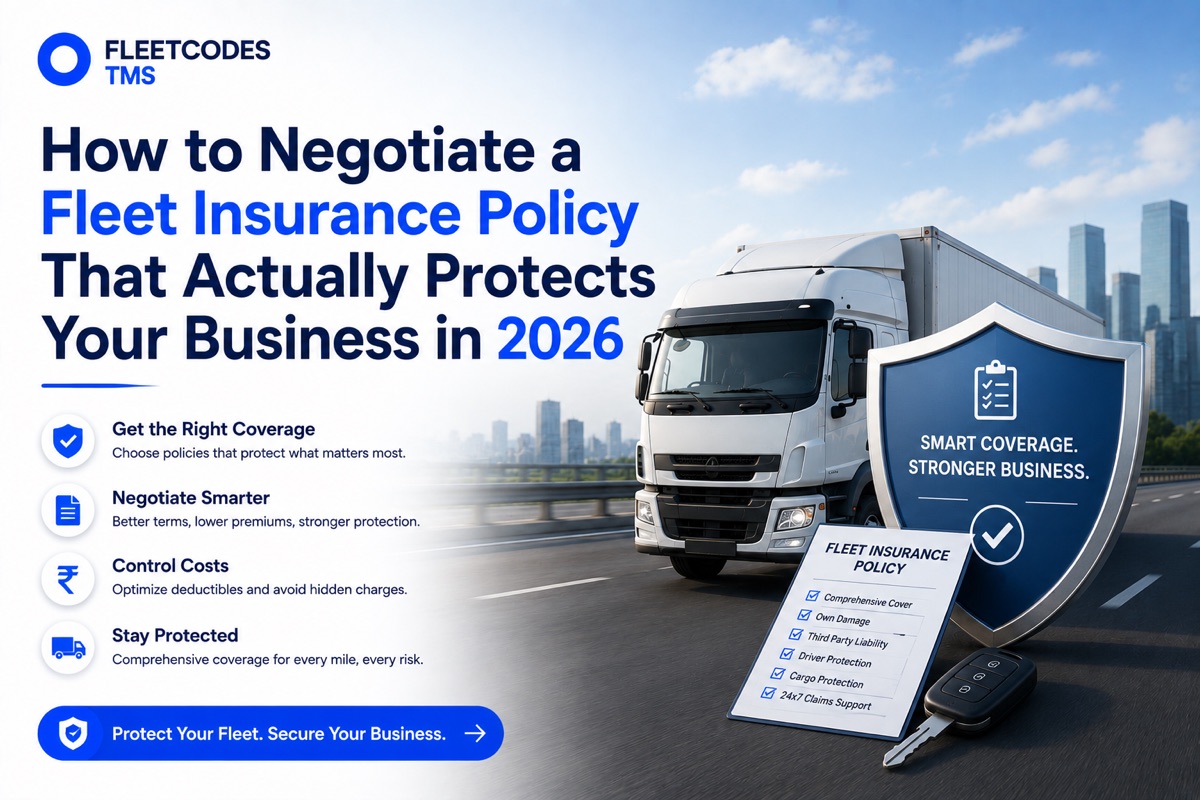
India's logistics industry operates in one of the world's highest-risk commercial driving environments — overloaded highways, unpredictable weather, urban congestion, rising repair costs, cargo theft exposure, and increasing accident severity. Yet many fleet operators still negotiate insurance policies based almost entirely on premium price. In 2026, that approach is becoming operationally dangerous.
Why Fleet Insurance Is No Longer Just a Compliance Requirement
For transport operators, insurance is often viewed as:
- Annual paperwork
- Regulatory necessity
- Cost-control exercise
But commercial vehicle insurance directly affects:
- Fleet cash flow stability
- Accident recovery timelines
- Vehicle downtime exposure
- Driver liability risk
- Contract compliance eligibility
- Business continuity during operational disruptions
A poorly negotiated insurance structure can create severe operational consequences even when the fleet is technically insured.
The real problem is not lack of insurance.
It is inadequate insurance design.
The Biggest Mistake Fleet Operators Make During Insurance Renewal
Most fleets negotiate insurance with one objective:
"Get the lowest premium possible."
This creates predictable long-term problems:
- High deductibles
- Inadequate own-damage coverage
- Claim exclusions
- Poor settlement timelines
- Weak roadside support
- Limited add-on protection
- Reduced cashless network access
Lower premiums often transfer operational risk back onto the transporter.
This becomes painfully visible only after:
- A major accident
- Engine damage
- Total-loss incidents
- Cargo disputes
- Third-party claims
- Multi-vehicle accidents
Insurance negotiation should not begin with premium comparison.
It should begin with operational risk mapping.
Understanding the Core Components of Fleet Insurance
A commercial fleet insurance structure typically includes multiple layers of protection.
Third-Party Liability Insurance
Mandatory under Indian law, third-party insurance covers:
- Injury liability
- Death compensation
- Third-party property damage
This is the legal minimum requirement for vehicle operation.
But third-party coverage alone does not protect the fleet business operationally.
Own Damage Insurance for Commercial Vehicles
Own damage insurance protects the fleet's own vehicles against:
- Accident damage
- Fire
- Theft
- Natural disasters
- Riot damage
- Certain operational incidents
For high-utilisation fleets, own-damage coverage is operationally critical because repair costs for modern BS6 commercial vehicles have increased significantly.
Add-On Protection Layers
Modern fleet policies increasingly include:
- Zero depreciation cover
- Engine protection
- Consumable coverage
- Roadside assistance
- Return-to-invoice protection
- Loss-of-income riders
- Driver personal accident coverage
The importance of these add-ons depends heavily on:
- Fleet age
- Route profile
- Vehicle financing structure
- Operational intensity
Why BS6 Commercial Vehicles Changed Fleet Insurance Economics
BS6 commercial vehicles introduced:
- Advanced electronics
- Emission-control systems
- Complex sensors
- Higher spare-part costs
- Sophisticated engine architecture
As a result:
- Repair bills increased
- Workshop dependency grew
- Downtime duration extended
- Claim values rose significantly
Minor accidents that previously involved simple repairs now frequently require:
- Sensor recalibration
- ECU replacement
- Advanced diagnostics
- OEM-authorised servicing
Fleet insurance negotiations in 2026 must account for this new repair-cost reality.
Zero Depreciation Coverage: When It Actually Matters
Many insurers market zero depreciation commercial vehicle insurance aggressively.
But it is not universally necessary for every fleet.
Zero-dep coverage is most valuable for:
- New vehicles
- Premium BS6 trucks
- Financed fleets
- High-value long-haul assets
- Fleets with high accidental exposure
Without zero-dep protection, claim settlements often deduct depreciation on:
- Plastic parts
- Rubber components
- Fiberglass elements
- Certain assemblies
For fleets operating newer commercial vehicles, this deduction can become financially significant.
However, for older vehicles nearing lifecycle replacement, the economics may differ.
The correct approach is operationally selective coverage — not blanket policy selection.
Fleet Loss Ratio: The Metric That Controls Your Premium
Insurance companies evaluate fleets heavily through loss ratio analysis.
Fleet loss ratio measures:
Total claims paid ÷ Total premium collected
If a fleet consistently generates high claims relative to premiums, insurers typically respond through:
- Premium increases
- Higher deductibles
- Reduced negotiation flexibility
- Coverage restrictions
This creates an important operational insight: Insurance cost is influenced not only by accidents — but by operational discipline itself.
How Operational Behaviour Affects Insurance Premiums
In 2026, insurers increasingly analyse fleet operational behaviour through:
- GPS tracking
- Driver risk scoring
- Route risk profiles
- Accident history
- Vehicle uptime patterns
- Telematics data
- Maintenance discipline
This is reshaping fleet insurance pricing models entirely.
For example: A fleet demonstrating:
- Stable driving patterns
- Lower harsh-braking incidents
- Strong maintenance compliance
- Controlled night-driving exposure
- Lower idle-risk zones
may negotiate significantly better premiums than fleets lacking operational visibility.
Insurance pricing is gradually moving toward behaviour-based risk evaluation.
Telematics-Based Fleet Insurance Is Growing Rapidly
Telematics fleet insurance in India is becoming increasingly important for commercial operators.
Telematics systems provide insurers with operational risk visibility through:
- Driver behaviour monitoring
- Speed analysis
- Route-risk exposure
- Braking patterns
- Vehicle utilisation trends
- Accident reconstruction data
For insurers, this improves risk assessment accuracy.
For fleets, it creates an opportunity: Operational discipline can now directly improve insurance negotiation leverage.
In many cases, fleets with strong telematics visibility are securing:
- Premium discounts
- Better claim processing
- Faster investigations
- Improved renewal negotiations
Technology is increasingly becoming part of insurance strategy itself.
The Hidden Clauses Fleet Operators Ignore
Many transporters discover policy weaknesses only during claim disputes.
Commonly overlooked areas include:
Driver Clause Restrictions
Claims may be impacted if:
- Driver licence validity lapses
- Endorsements are missing
- Driver records are incomplete
Route Restrictions
Some policies contain:
- Geographic limitations
- Hazard-zone exclusions
- Cross-border restrictions
Cargo and Overloading Disputes
Accidents involving overloaded vehicles can create claim complications.
Delay-Related Losses
Most standard fleet policies do not compensate for:
- Delivery penalties
- Customer escalation losses
- Revenue downtime
- Contractual service failures
Understanding these exclusions is as important as comparing premium price.
How to Actually Negotiate Better Fleet Insurance
Strong fleet insurance negotiation begins before speaking to insurers.
Step 1: Build Operational Data Visibility
Insurers negotiate more favourably with fleets that can demonstrate:
- Maintenance discipline
- Driver monitoring
- Low accident rates
- Route visibility
- Downtime management
Operational data improves negotiation credibility.
Step 2: Negotiate Coverage Structure — Not Just Premium
Focus on:
- Deductibles
- Claim settlement timelines
- Add-on selection
- Network garage quality
- Breakdown support
- Cashless availability
The cheapest policy is often operationally the most expensive during claims.
Step 3: Segment Vehicles by Operational Risk
Different vehicles may require different coverage structures depending on:
- Age
- Route exposure
- Cargo sensitivity
- Financing status
- Utilisation intensity
Risk-based segmentation improves premium efficiency.
Step 4: Use Claims History Strategically
A clean claims history improves negotiation leverage.
But even fleets with moderate claim history can improve positioning by showing:
- Corrective operational controls
- Driver training programs
- Maintenance improvements
- Technology adoption
Insurers increasingly reward visible operational maturity.
How Fleet Technology Supports Insurance Optimization
Modern fleet platforms increasingly help transporters improve insurance readiness through:
- Driver behaviour analytics
- GPS visibility
- Maintenance tracking
- Incident documentation
- Route-risk analysis
- Vehicle utilisation monitoring
- Breakdown history records
This operational transparency improves:
- Risk management
- Claim defensibility
- Renewal negotiations
- Premium optimisation
Fleet insurance is increasingly shifting from:
"post-accident compensation"
toward:
"continuous operational risk management."
How Fleetcodes Helps Fleets Improve Insurance Readiness
Fleet operations inside Fleetcodes help transporters improve operational visibility through:
- Driver performance analytics
- GPS route tracking
- Maintenance scheduling
- Incident history management
- Vehicle health monitoring
- Operational reporting
- Fuel and utilisation visibility
As insurers increasingly evaluate operational risk behaviour, connected fleet systems help transporters negotiate from a stronger data position.
For modern fleets, operational visibility is becoming financially valuable far beyond logistics alone.
The Future of Fleet Insurance in India
Over the next few years, fleet insurance will become significantly more dynamic.
The industry is moving toward:
- Usage-based insurance
- Real-time risk scoring
- AI-driven premium modelling
- Predictive accident analysis
- Behaviour-linked pricing
- Integrated telematics underwriting
In this environment, fleets with poor operational visibility may pay increasingly higher insurance costs.
The competitive advantage will belong to fleets that can prove operational discipline continuously through data.
FAQs
What is the most important part of fleet insurance negotiation? The most important factor is aligning coverage with operational risk rather than choosing the lowest premium alone. Claim quality, deductibles, downtime exposure, and repair-cost protection matter significantly.
How does telematics reduce fleet insurance premiums? Telematics systems provide insurers with visibility into driver behaviour, route risk, and operational discipline. Safer fleets with stronger monitoring often qualify for better premium negotiations.
What is own damage insurance for commercial vehicles? Own damage insurance covers damage to the insured commercial vehicle itself, including accidents, fire, theft, and certain natural disasters.
Is zero depreciation cover useful for commercial fleets? Zero depreciation coverage is especially useful for newer BS6 vehicles where repair costs and spare-part pricing are high. It reduces depreciation deductions during claim settlement.
What affects fleet insurance premium pricing in India? Premiums are influenced by fleet loss ratio, accident history, vehicle type, operational routes, telematics visibility, driver behaviour, maintenance discipline, and claim frequency.
In logistics, accidents may be unavoidable. Financial instability after accidents is not. The fleets that negotiate insurance strategically are not merely buying protection — they are protecting operational continuity itself. See How Fleetcodes Helps Fleets Improve Operational Visibility →