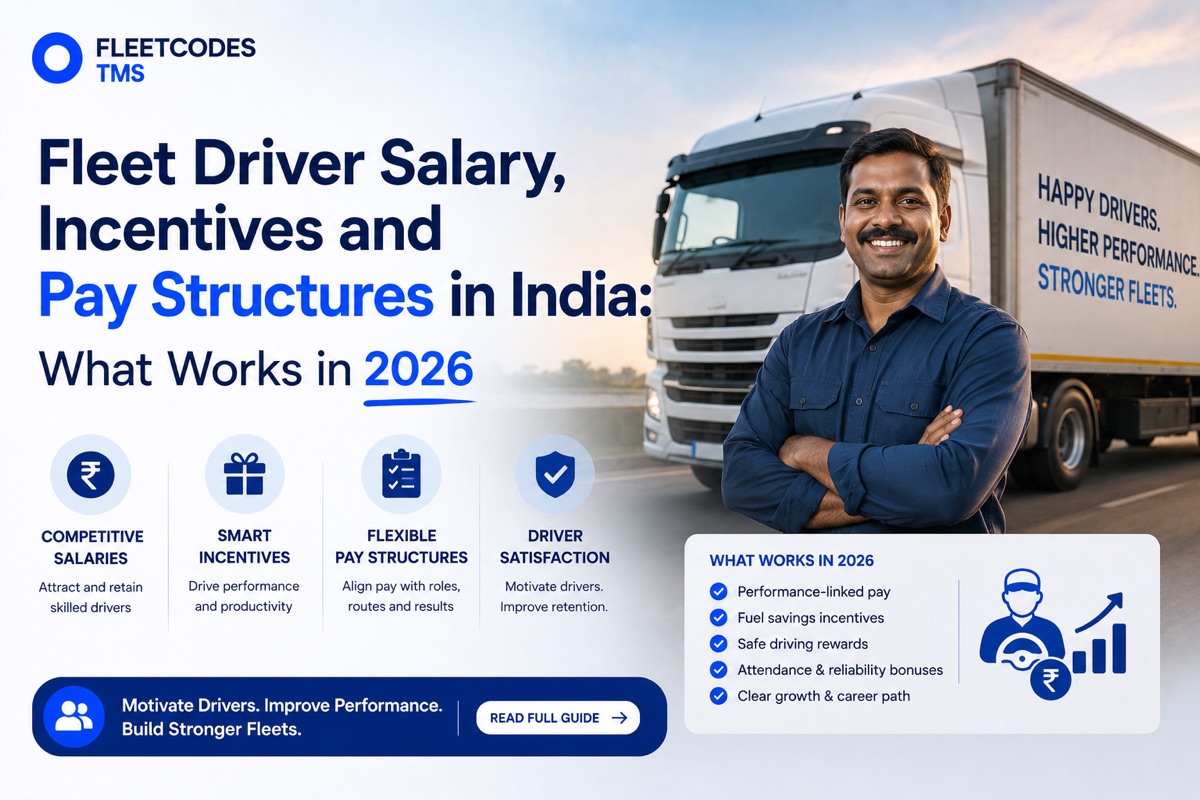
India moves over 90% of its freight through road transport — but the industry continues to face one of its biggest operational bottlenecks: driver retention. Behind delayed deliveries, idle vehicles, route disruptions, and fleet underutilisation lies a workforce issue that many transporters still underestimate. In 2026, driver compensation systems are becoming a core operational strategy — not just a payroll function.
Why Driver Retention Has Become a Critical Fleet Problem
For years, the logistics industry treated driver shortage as a hiring issue.
But the reality is more structural.
Many drivers leave fleets because of:
- Unpredictable income
- Delayed settlements
- Lack of transparency
- Poor incentive systems
- Operational stress
- Unclear deductions
- Irregular allowances
- Excessive waiting time during trips
In many fleets, drivers still do not know:
- How incentives are calculated
- When trip settlements will happen
- What deductions were applied
- How route earnings differ
- What performance actually improves income
This uncertainty creates distrust.
And distrust drives attrition faster than salary alone.
Truck Driver Salary in India Is Rising — But So Are Expectations
In 2026, average commercial vehicle driver income in India has increased compared to previous years due to:
- Driver shortages
- Longer freight corridors
- Inflationary pressure
- Growing e-commerce demand
- Higher fleet utilisation
- Expansion of organised logistics operators
But higher salary alone is not solving retention.
Drivers increasingly evaluate:
- Payment predictability
- Settlement speed
- Incentive fairness
- Route quality
- Waiting-time compensation
- Family stability
- Operational treatment
A fleet offering slightly lower fixed salary but highly transparent and stable earnings may retain drivers more effectively than fleets offering inconsistent higher payouts.
The industry is gradually shifting from:
"salary-focused hiring"
toward:
"earnings-experience management."
Why Traditional Driver Pay Structures Fail
Many Indian fleets still use loosely structured payment models:
- Base salary
- Per-trip allowance
- Fuel savings bonus
- Informal cash settlements
- Manual deductions
This creates several operational problems.
Income Volatility
Drivers struggle to estimate monthly earnings accurately.
Dispute Frequency
Manual calculations create recurring conflicts around:
- Fuel deductions
- Toll reimbursements
- Delay penalties
- Route allowances
- Advance adjustments
Lack of Performance Visibility
Drivers often cannot see:
- Which behaviour improves earnings
- How incentives are linked to performance
- Why another driver earned more
Without transparency, incentive systems lose motivational value.
Fleet Driver Pay Structures Are Becoming More Structured
Modern fleets increasingly use layered compensation models.
A typical fleet driver pay structure in India now combines:
Fixed Base Salary
Provides income stability and retention predictability.
Trip-Based Earnings
Linked to:
- Distance covered
- Route type
- Cargo category
- Vehicle category
Performance Incentives
Connected to:
- Fuel efficiency
- On-time delivery
- Safe driving behaviour
- Low idle time
- Reduced breakdown incidents
- Compliance adherence
Operational Allowances
Including:
- Food allowance
- Night halt allowance
- Loading/unloading compensation
- Border waiting compensation
- Remote-area route premiums
Retention Bonuses
Some fleets increasingly offer:
- Quarterly continuity bonuses
- Accident-free rewards
- Long-term loyalty incentives
The objective is creating predictable and measurable earning logic.
Driver Incentive Systems Only Work When Drivers Trust Them
Many fleets introduce incentive systems but fail operationally because drivers do not understand how payouts are calculated.
Effective driver performance incentive systems for fleets require:
- Clear earning rules
- Real-time visibility
- Automated calculations
- Transparent trip records
- Minimal manual adjustments
Drivers are far more motivated by:
"visible achievable incentives"
than by vague monthly bonus promises.
For example: A driver app showing:
- Fuel-efficiency score
- Expected bonus
- Trip completion incentives
- Delay deductions
- Upcoming payout status
creates behavioural alignment much more effectively than manual settlement discussions.
Fuel Efficiency Incentives: Useful but Often Mismanaged
Fuel is one of the largest fleet operating costs, so many operators incentivise mileage performance.
But poorly designed fuel incentives create unintended consequences.
If incentives focus only on mileage numbers, drivers may:
- Underuse AC systems
- Avoid necessary idling
- Drive unsafely
- Delay reporting mechanical problems
- Manipulate refuelling behaviour
Modern fleets increasingly balance fuel incentives with:
- Safety scoring
- Route difficulty adjustment
- Vehicle condition analysis
- Traffic-condition context
The objective is not just higher mileage.
It is operationally healthy driving behaviour.
Waiting Time Is One of the Biggest Hidden Driver Frustrations
One of the most underestimated driver-retention problems is unpaid waiting time.
Drivers frequently lose productive hours during:
- Warehouse loading delays
- Border clearance
- Consignee unloading delays
- Documentation bottlenecks
- Route restrictions
In many fleets, these delays are treated as "part of the job."
But from the driver's perspective:
- Working hours increase
- Earnings per hour decline
- Trip productivity falls
Leading logistics operators increasingly compensate:
- Detention time
- Delayed unloading
- Extended waiting windows
because driver dissatisfaction often originates from operational inefficiency rather than salary itself.
Driver Settlement Automation Is Becoming Essential
Manual settlement systems create:
- Delayed payouts
- Accounting disputes
- Cash leakage
- Operational mistrust
- Administrative overload
This is why driver settlement automation is becoming increasingly important in Indian logistics.
Automated settlement systems can calculate:
- Trip earnings
- Allowances
- Fuel incentives
- Toll reimbursements
- Penalties
- Advances
- Bonus structures
in real time.
The operational advantage is not only efficiency.
It is trust.
When drivers can clearly see:
- What they earned
- Why they earned it
- What deductions occurred
- When payment will happen
settlement friction reduces dramatically.
Driver Apps Are Changing Compensation Transparency
Modern fleet driver apps increasingly include:
- Salary visibility
- Trip earnings tracking
- Incentive dashboards
- Settlement history
- Allowance records
- Performance scores
This transparency fundamentally changes driver-fleet relationships.
Historically, compensation discussions were:
- Verbal
- Manual
- Difficult to verify
Now, digital visibility reduces ambiguity.
For younger drivers entering organised logistics fleets, salary transparency is increasingly expected — not optional.
Driver Attrition Is an Operational Cost Multiplier
High driver turnover creates hidden operational losses:
- Idle vehicles
- Recruitment cost
- Route disruption
- Training expense
- Increased accident probability
- Lower customer consistency
- Dispatch inefficiency
Replacing drivers repeatedly is operationally expensive.
Retention-focused fleets increasingly recognise that:
driver stability improves fleet stability.
This is especially important for:
- Dedicated-route operations
- High-value cargo
- Temperature-sensitive freight
- Enterprise logistics contracts
Experienced drivers often perform significantly better operationally than constantly rotating workforce pools.
How Fleet Technology Helps Driver Compensation Management
Modern fleet systems increasingly integrate:
- Trip tracking
- Driver scoring
- Fuel analytics
- Settlement automation
- Allowance calculation
- Attendance tracking
- Route profitability analysis
This creates a connected compensation environment where payouts align directly with operational performance.
Instead of relying on fragmented spreadsheets and manual calculations, fleets can manage compensation through data-driven workflows.
The industry is gradually moving toward:
operationally integrated workforce management.
How Fleetcodes Supports Driver Management and Settlements
Driver operations inside Fleetcodes help fleets manage:
- Trip-linked settlements
- Driver earnings visibility
- Fuel-performance tracking
- Incentive calculations
- Allowance management
- Driver app transparency
- Route-wise operational records
- Settlement history
By connecting driver compensation with operational workflows, the platform helps fleets reduce disputes, improve transparency, and strengthen retention.
For Indian logistics operators, driver trust is increasingly becoming an operational advantage.
The Future of Driver Compensation in Indian Logistics
Over the next decade, fleet driver compensation will become increasingly data-driven.
The industry is moving toward:
- Performance-linked earnings
- Real-time payout visibility
- Automated settlement systems
- AI-based driver scoring
- Route-risk-adjusted incentives
- Digital payroll ecosystems
The fleets that succeed will not simply pay drivers more.
They will create compensation systems that drivers perceive as:
- Fair
- Predictable
- Transparent
- Achievable
In logistics, operational reliability ultimately depends on workforce stability.
And workforce stability increasingly depends on trust in the earning system itself.
FAQs
What is the average truck driver salary in India in 2026? Driver income varies significantly based on route type, vehicle category, fleet structure, and experience. Long-haul and specialised freight drivers typically earn higher compensation due to operational complexity and longer working cycles.
What are common driver incentives used by fleets? Fleets commonly use incentives linked to fuel efficiency, safe driving behaviour, on-time delivery, low idle time, accident-free operations, and retention continuity.
Why is driver settlement automation important? Automated settlement systems reduce payout delays, calculation disputes, manual errors, and operational mistrust while improving compensation transparency.
How do driver apps improve retention? Driver apps provide visibility into earnings, incentives, trip history, and settlement status, helping reduce confusion and improve trust between drivers and fleet operators.
Why is driver attrition a major logistics problem? High attrition increases recruitment costs, vehicle idle time, route disruption, training expense, and operational instability across the fleet network.
The future of Indian logistics will not be defined only by smarter fleets or better technology. It will also be defined by which companies build compensation systems that drivers actually trust. See How Fleetcodes Helps Fleets Manage Driver Operations and Settlements →