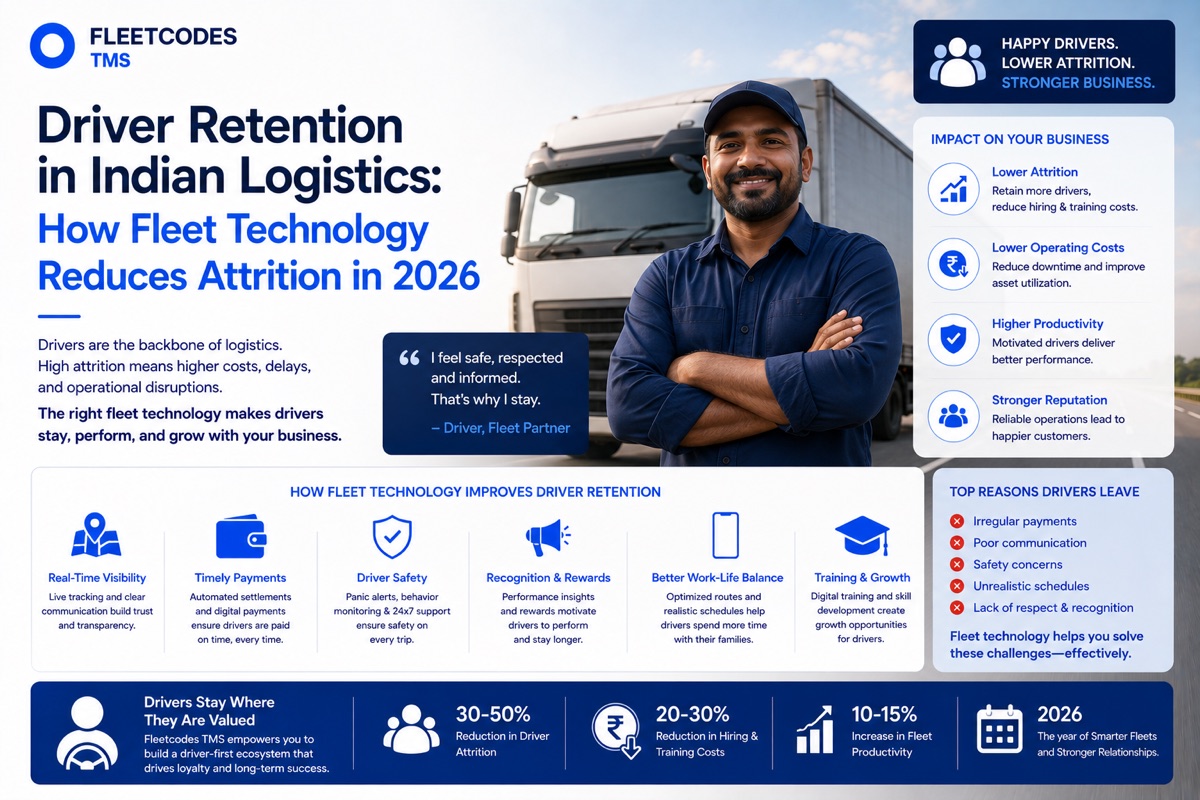
India needs 2.2 million more truck drivers by 2030. The shortage is already here. And the businesses losing the most drivers aren't losing them to better pay — they are losing them to better working conditions. Technology is a large part of what makes those conditions better.
The Driver Shortage Is the Logistics Sector's Most Underrated Crisis
When Indian logistics businesses talk about operational challenges, the conversation usually goes to fuel costs, toll expenses, or billing delays. Driver attrition rarely gets the same analytical attention — even though it is, for many operations, the highest-cost and most disruptive operational problem they face.
The numbers tell the story. India's trucking sector currently has a shortfall of over 2 million drivers relative to freight demand. The shortfall is growing — not because fewer people have driving licences, but because fewer trained, experienced drivers are choosing to stay in trucking as a profession. The sector is losing drivers faster than it is replacing them.
The Vasudha Foundation's research on India's trucking workforce identifies the core problem clearly: it is not just about wages. Experienced drivers leave because of poor working conditions, unpredictable income, lack of transparency in how they are paid, and a general sense that the profession offers no career progression, no dignity, and no tools that make the job easier.
Fleet operators who address these issues — and technology is a significant tool for addressing several of them — retain their best drivers. Those who don't, cycle through expensive churn that quietly erodes operational quality, customer relationships, and profit.
Why Drivers Leave: The Four Core Attrition Drivers
Understanding truck driver retention India starts with understanding why drivers actually leave. Four factors dominate:
1. Settlement Disputes and Payment Uncertainty
Ask any experienced driver what frustrates them most about working for a transport company and you will hear the same answer repeatedly: they don't know what they will be paid until they receive it — and they frequently disagree with the number when they do.
Driver settlements in manual operations involve a complex tally of base trip pay, per-kilometre allowances, advance deductions, expense claims, overnight allowances, and any fines or deductions the fleet operator applies. When this calculation is done manually by an accounts department at the end of the month, with no visibility for the driver during the month, disputes are inevitable.
A driver who believes they completed 14 trips and should receive ₹28,000 but receives ₹22,000 with no explanation is not going to wait for a detailed reconciliation. They are going to start looking for another employer.
2. No Visibility into Trip Assignments and Status
In traditionally managed fleets, drivers often find out about their next assignment through a phone call — sometimes the night before, sometimes that morning. There is no advance schedule, no systematic way to know what the week looks like, no ability to plan personal time around work.
The unpredictability is not just inconvenient. For drivers who have families and commitments, the inability to plan — compounded by the physical demands of long-haul driving — makes the job feel unsustainable over time.
3. Manual Paperwork Burden
Paper trip sheets, manual expense claims, physical POD forms that need to be physically returned to the office — the paperwork burden on drivers is significant and largely invisible to fleet managers. A driver who completes 3 deliveries in a day and then has to manually fill out 3 trip sheets, retain 3 sets of expense receipts, and find a way to get the paper PODs back to the office is spending an hour on administration for every day of driving.
This is not why they became a truck driver. It is a source of frustration that compounds over months and years.
4. No Recognition of Good Performance
In manual fleet operations, driver performance assessment is almost entirely informal. Good drivers — those who consistently deliver on time, conserve fuel, handle cargo carefully, and maintain their vehicles — rarely receive any formal recognition. There is no data to support a case for a pay increase, no visible track record of excellent performance.
Meanwhile, drivers who consume more fuel, take longer routes, or cause more vehicle wear are often equally invisible in terms of accountability. The absence of data means everyone is treated roughly the same — and the good drivers, who have the most options, are the most likely to leave.
How Fleet Driver Management Software Changes the Retention Equation
Fleet driver management software addresses each of these four attrition drivers directly. Here is how the Fleetcodes approach works in practice:
Transparent, Automated Driver Settlement
Fleetcodes calculates driver settlements automatically from trip data — combining base pay, per-kilometre rates, expense claims, advance deductions, and any applicable bonuses or deductions into a settlement summary that is generated at the end of each trip or pay cycle.
Critically, this summary is visible to the driver through the Fleetcodes driver app before it is finalised. A driver can see exactly what they have earned, what deductions have been applied, and why — without needing to ask the accounts team for a manual breakdown.
The effect on reduce driver attrition logistics operations is measurable. When drivers trust the settlement process — when they can see the numbers and understand them — the most common source of disputes and resentment is eliminated. Drivers who are paid accurately, transparently, and on time do not leave for other operators over payment issues.
Trip Assignments Through the Driver App
The Fleetcodes driver app gives drivers advance visibility into their upcoming trip assignments. Instead of waiting for a phone call, drivers can see their assignment details — pickup location, delivery points, load specifications, and customer instructions — as soon as the dispatcher confirms them in the system.
This predictability has a direct impact on driver experience. Drivers can plan around their schedule. They know what the next day looks like before they go to sleep. For drivers with families, this improvement in predictability matters enormously — it is the difference between trucking feeling like an unmanageable lifestyle and a manageable profession.
Digital Trip Management — Eliminating the Paper Burden
Through the Fleetcodes driver app, drivers update trip status, capture digital PODs (with recipient signature and photo), and submit expense claims — all from their phone. No paper trip sheets. No physical POD copies to carry back to the office. No manual expense receipts (photo submission with geo-tag replaces physical receipts).
The driver app for fleet India experience Fleetcodes delivers is designed for drivers across the full range of smartphone literacy — with simple, intuitive screens, regional language support, and offline functionality for routes where network coverage is unreliable.
A driver who spends 15 minutes on digital trip administration versus 60 minutes on paper administration across their working day has a meaningfully better job experience. Over a year, that difference is significant.
Performance Analytics That Create Career Paths
Driver performance analytics in Fleetcodes tracks fuel efficiency, on-time delivery rate, POD capture rate, route adherence, and driving behaviour metrics per driver — building an individual performance record over time.
This data serves two retention functions. First, it creates the evidence base for recognising and rewarding high performers — managers can identify their best drivers with data, not intuition, and can make a case for performance-linked pay increases that is objective and defensible.
Second, it creates accountability for underperformance in a structured, factual way. A driver who is struggling on a specific metric — fuel consumption, for example — can be coached with specific data rather than vague feedback. Coaching with data feels fair. Vague criticism feels arbitrary — and arbitrary treatment is a significant driver of attrition.
The Business Cost of Driver Attrition
To understand why investment in fleet driver management software pays back quickly, consider the full cost of losing and replacing a driver:
| Cost Component | Estimated Amount | |---|---| | Lost productivity during vacancy | ₹30,000–70,000 per month of unfilled role | | Recruitment costs (agent, advertising) | ₹5,000–20,000 per hire | | New driver onboarding and route familiarisation | 2–4 weeks at reduced productivity | | Customer service impact of inconsistent drivers | Difficult to quantify — significant | | Vehicle wear from inexperienced drivers on route | ₹5,000–15,000 additional maintenance per transition |
For a 50-vehicle fleet with 25% annual driver turnover — which is common in manually operated Indian logistics businesses — the total attrition cost is typically ₹25–50 lakhs per year. For a 100-vehicle fleet, double that.
Against this, the cost of implementing a driver app and settlement automation is modest. And the ROI is not theoretical — it is the difference between 25% annual turnover and 10% annual turnover, compounded by the operational quality improvement that comes from having experienced, engaged drivers on your routes.
Practical Steps to Improve Driver Retention
Technology is part of the answer, not all of it. The fleet operations that retain their best drivers combine technology with operational culture:
Structured onboarding: New drivers who understand the system, their routes, and the performance expectations from day one settle in faster and stay longer. Fleetcodes supports this with digital trip assignment and app-based onboarding that gets new drivers operational quickly.
Regular performance conversations, backed by data: Monthly check-ins with individual drivers — using Fleetcodes performance analytics as the factual foundation — are more effective than annual reviews or ad-hoc feedback.
Pay on time, every time: This sounds basic, but it is among the most powerful retention factors. Automated settlement in Fleetcodes eliminates the delays and disputes that make late or incorrect payment so common in manual operations.
Clear advancement paths: Drivers who can see a career progression — senior driver, trainer, eventually dispatcher or operations role — stay longer than those who see trucking as a job with no ladder. Documenting performance with data over time creates the evidence for those conversations.
FAQs
What is the main cause of driver shortage in India logistics? The driver shortage in India has two dimensions: not enough new drivers entering the profession, and experienced drivers leaving faster than they are replaced. The exit rate is driven primarily by poor working conditions, settlement disputes, unpredictable scheduling, and the absence of technology that makes the job more manageable.
How does a driver app reduce fleet driver attrition? A driver app reduces attrition by eliminating the paperwork burden, providing advance visibility into trip assignments, enabling transparent settlement tracking, and giving drivers a professional, modern tool that makes the job easier — all of which contribute to higher job satisfaction and lower turnover.
What should fleet driver management software track to improve retention? Key metrics include settlement transparency (drivers can see their own earnings calculation), trip assignment advance notice, digital POD capture rate, fuel efficiency per driver, on-time delivery performance, and driving behaviour indicators. Together these give both drivers and managers the data for fair, evidence-based performance conversations.
How long does it take to see driver retention improvements after implementing fleet technology? Most Fleetcodes customers see measurable improvement in driver satisfaction within the first month of deployment — primarily driven by settlement transparency and the elimination of paperwork friction. Measurable attrition rate improvement typically shows within 3–6 months.
Does Fleetcodes driver app work with limited mobile data or poor connectivity? Yes. The Fleetcodes driver app includes offline functionality — drivers can update trip status, capture PODs, and log expenses even without network coverage. Data syncs automatically when connectivity is restored.
Your drivers are your most important operational asset. Fleetcodes gives them the tools they deserve — and gives you the visibility to keep your best people. Book a Free Fleetcodes Demo →