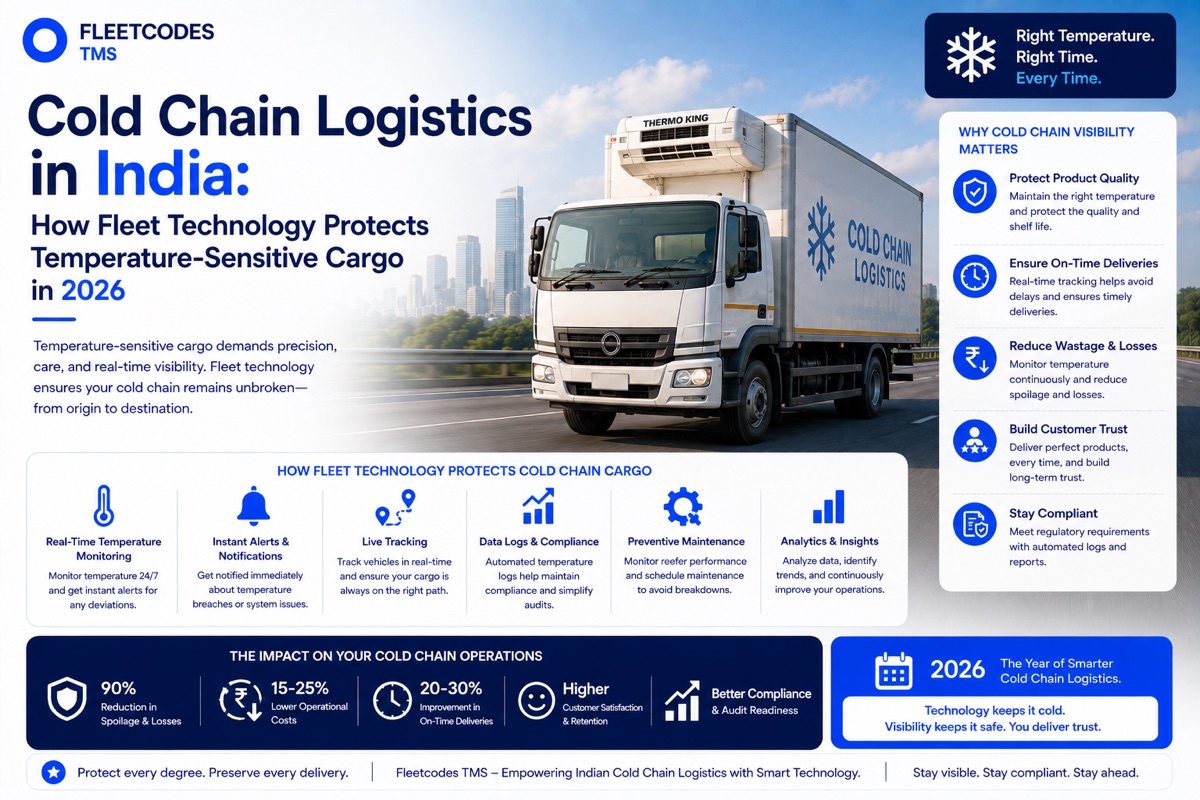
India wastes approximately 30–40% of all perishable goods — worth an estimated ₹90,000 crore annually — due to cold chain failures. The primary cause is not a shortage of refrigerated vehicles. It is a shortage of the visibility, alerting, and workflow discipline that modern fleet technology provides.
The Cold Chain Opportunity — and the Cold Chain Problem
Cold chain logistics India is one of the fastest-growing segments of the country's freight market. Pharma logistics, organized food retail, quick commerce, and agricultural exports are all driving rapidly expanding demand for temperature-controlled transport. India's cold chain market is projected to reach ₹3.3 lakh crore by 2030, growing at 12–14% annually.
The opportunity is clear. The operational challenge is equally clear.
Unlike ambient freight, where a delay is inconvenient, a temperature excursion in cold chain logistics destroys the cargo entirely. A pharma consignment that breaches 8°C during transit may become clinically unsafe. A food shipment that drops below -18°C and then warms above 0°C has its cold chain integrity compromised and must be rejected. An agricultural export that arrives at a port with a documented temperature breach loses its phytosanitary certification.
These failures do not just cost the transporter the freight revenue. They cost the consignor the full value of the cargo — and in regulated sectors like pharmaceuticals, they carry compliance and liability consequences that go well beyond the immediate financial loss.
The Indian pharmaceutical sector alone requires stringent GDP (Good Distribution Practice) compliance for cold chain shipments — mandating documented temperature records, validated equipment, and traceable chain of custody from origin to recipient. Transporters who cannot demonstrate this compliance are progressively excluded from pharma contracts.
Temperature controlled transport India that uses manual temperature logging, paper records, and reactive alarm response is not adequate for the requirements of 2026's cold chain market. The transporters winning in this space are those with real-time monitoring, automated alerting, and digital documentation baked into their operations.
How Cold Chain Failures Actually Happen
Understanding the failure points in reefer truck India operations is the first step toward preventing them. Temperature excursions in transit typically originate from five causes:
1. Reefer Unit Malfunction
Refrigeration units fail. Compressors develop faults. Fuel tanks for standalone refrigeration units run low. In a manually managed operation, these failures are discovered when the driver notices a warning light — or when the cargo is inspected at destination and found compromised.
2. Door Breach and Cargo Handling
Every time a reefer door is opened — for loading, for multi-drop deliveries, for roadside inspections — warm ambient air enters the cargo space. Excessive dwell time with doors open, frequent multi-stop deliveries without pre-cooling, and poorly designed loading sequences all cause temperature excursions that accumulate through the journey.
3. Precooling Failures
A common and easily preventable cause of cold chain failure is deploying a reefer that has not been adequately pre-cooled before loading. Placing cold cargo into a warm vehicle causes an immediate temperature spike that may take hours to recover from — and in some cases never does within the transit window.
4. Route Delays
A consignment designed for an 8-hour transit that takes 14 hours due to traffic, breakdowns, or checkpoint delays may exhaust its temperature margin. Without real-time visibility into route progress and temperature status, nobody knows there is a problem until the delivery arrives.
5. Documentation Gaps
In regulated cold chain — particularly pharma — the physical temperature record is as important as the actual temperature maintained. A shipment that maintained correct temperatures but cannot document them fails GDP compliance just as surely as one that did not. Paper loggers that must be manually read and transcribed introduce both accuracy risk and audit risk.
The Technology Stack for Effective Cold Chain Fleet Management
Cold storage transport software and telematics for temperature-controlled operations involve several interconnected technology layers:
Real-Time Temperature Monitoring
IoT temperature sensors placed within the cargo compartment transmit continuous temperature and humidity readings to a fleet management platform. Unlike data loggers that must be downloaded manually at destination, real-time sensors provide live temperature data visible to the dispatcher and the operations team throughout the journey.
The operational value is immediate: a temperature excursion at 3 hours into a 10-hour journey can be caught and corrected — either by the driver addressing a reefer fault or by dispatching a replacement vehicle — rather than being discovered as a completed loss at destination.
Temperature monitoring fleet data in Fleetcodes integrates with compatible sensor hardware, displaying live cargo temperature alongside vehicle GPS position in the dispatch dashboard. When temperature exceeds configured thresholds — high or low — an automatic alert is raised immediately to the dispatcher and operations manager.
Automated Temperature Excursion Alerts
An alert that tells you the temperature went out of range after delivery is a compliance record. An alert that tells you the temperature is approaching the excursion threshold while the vehicle is still 3 hours from destination is an operational intervention opportunity.
Fleetcodes configures alert thresholds for both breach points (when temperature has exceeded the limit) and pre-breach warnings (when temperature is trending toward the limit) — giving the operations team time to act before a loss is incurred.
Alert routing matters as much as alert generation. The right person must receive the right alert at the right time. In Fleetcodes, temperature alerts are routed to the dispatcher on duty, the vehicle's assigned driver via the app, and a customer notification if the consignment involves a pharma or food customer with SLA visibility requirements.
Geofence-Based Door Monitoring
Combining GPS geofencing with temperature data creates a powerful cold chain audit trail. When the system detects that a vehicle has been stationary at a delivery point for an extended period, it can cross-reference this with temperature data to assess the impact of the door opening on cargo temperature — and flag situations where extended loading or unloading is causing thermal stress.
For multi-drop cold chain TMS India operations, this door-open time data is operationally valuable for customer conversations: if a customer's extended loading dock dwell time is consistently causing temperature challenges, the data makes that case objectively rather than anecdotally.
Digital Temperature Records for Compliance
Pharma cold chain logistics in India requires documented temperature records as part of GDP compliance. These records must show: temperature throughout the journey, any excursions, corrective actions taken, and chain of custody.
Digital temperature logging through Fleetcodes creates a timestamped, tamper-evident temperature record for every trip — automatically generated, stored in the platform, and retrievable for audit, compliance reporting, or customer documentation requests without manual compilation.
This documentation quality is increasingly a procurement criterion for pharma and organized food retail customers. Transporters who can provide digital, GPS-timestamped temperature records for every shipment are differentiating on compliance capability — not just price.
Cold Chain Specific Operational Best Practices
Beyond technology, effective temperature controlled transport India operations require operational discipline:
Pre-trip equipment verification: Every reefer unit should be functionally tested and pre-cooled to setpoint temperature before loading. A quick departure that skips pre-cooling is a common source of early-journey temperature spikes. Fleetcodes' pre-trip checklist feature can enforce this verification before a vehicle is marked as ready for departure.
Cargo loading sequence: Multi-temperature consignments require careful loading sequence planning to ensure each product remains in its correct temperature zone throughout the journey. This is a dispatcher responsibility that should be part of the dispatch SOP for cold chain operations.
Driver cold chain training: Drivers on reefer routes need specific training on refrigeration unit operation, door management discipline, and the procedure when a temperature alarm triggers. A driver who knows what to do when the reefer alarm sounds is the last line of defence before a cargo loss.
Backup vehicle protocols: For high-value or time-critical cold chain consignments, having a backup reefer vehicle available — or a rapid-response arrangement with a nearby transporter — is a business continuity investment that pays for itself the first time a mid-journey breakdown is recovered without cargo loss.
The Spoilage-to-Technology ROI Calculation
The ROI case for cold chain fleet technology is straightforward: any investment in refrigerated vehicle tracking and temperature monitoring that prevents even a single significant cargo loss typically pays back the annual technology cost many times over.
For a transporter running 20 reefer vehicles carrying pharmaceutical cargo at an average consignment value of ₹5–15 lakh:
| Scenario | Without Technology | With Fleetcodes Temperature Monitoring | |---|---|---| | Temperature excursion detection | At destination — full loss | Mid-journey — intervention possible | | Average cargo loss per excursion | Full consignment value | Partial or zero, depending on intervention | | GDP compliance documentation | Manual — audit risk | Automatic digital record — audit ready | | Customer retention on pharma contracts | At risk from compliance gaps | Strengthened by documented compliance | | Annual insurance premium impact | Higher — higher claim frequency | Lower — lower claim frequency |
For fleet operators looking to grow in pharma, organised retail, or export food segments, cold chain technology is not an optional upgrade. It is the operational baseline those customers require.
FAQs
What is cold chain logistics and why is it important in India? Cold chain logistics is the transportation of temperature-sensitive goods — pharma, food, agricultural products — within a defined temperature range from origin to destination. In India, inadequate cold chain infrastructure causes an estimated ₹90,000 crore in annual spoilage losses. Better fleet technology is addressing this through real-time monitoring and automated alerting.
What technology is used in temperature-controlled transport in India? Key technologies include IoT temperature sensors with real-time wireless data transmission, GPS fleet tracking integrated with temperature data, automated alert systems for threshold breaches, geofence-based door monitoring, and digital temperature record systems for compliance documentation.
What is GDP compliance in pharma cold chain logistics? Good Distribution Practice (GDP) is the regulatory standard for pharmaceutical distribution in India, mandating documented temperature records, validated equipment, and traceable chain of custody for temperature-sensitive medicines. Transporters carrying pharma goods must demonstrate GDP compliance — which requires digital temperature records, not paper logs.
How does Fleetcodes support cold chain operations? Fleetcodes integrates with compatible temperature sensor hardware to display live cargo temperature alongside GPS position in the dispatch dashboard. Automated alerts are triggered on threshold breach and pre-breach warnings. Digital temperature records are automatically generated for every trip, providing audit-ready compliance documentation.
How does real-time temperature monitoring reduce cold chain losses? Real-time monitoring detects temperature excursions while the vehicle is in transit — when corrective action is still possible. A mid-journey reefer fault detected at 3 hours into a 10-hour run can be addressed before cargo is compromised. The same fault discovered at destination results in total cargo loss.
Temperature-sensitive cargo requires temperature-intelligent fleet operations. Real-time monitoring turns cold chain management from reactive to proactive. Explore Fleetcodes for Cold Chain Fleet Management →