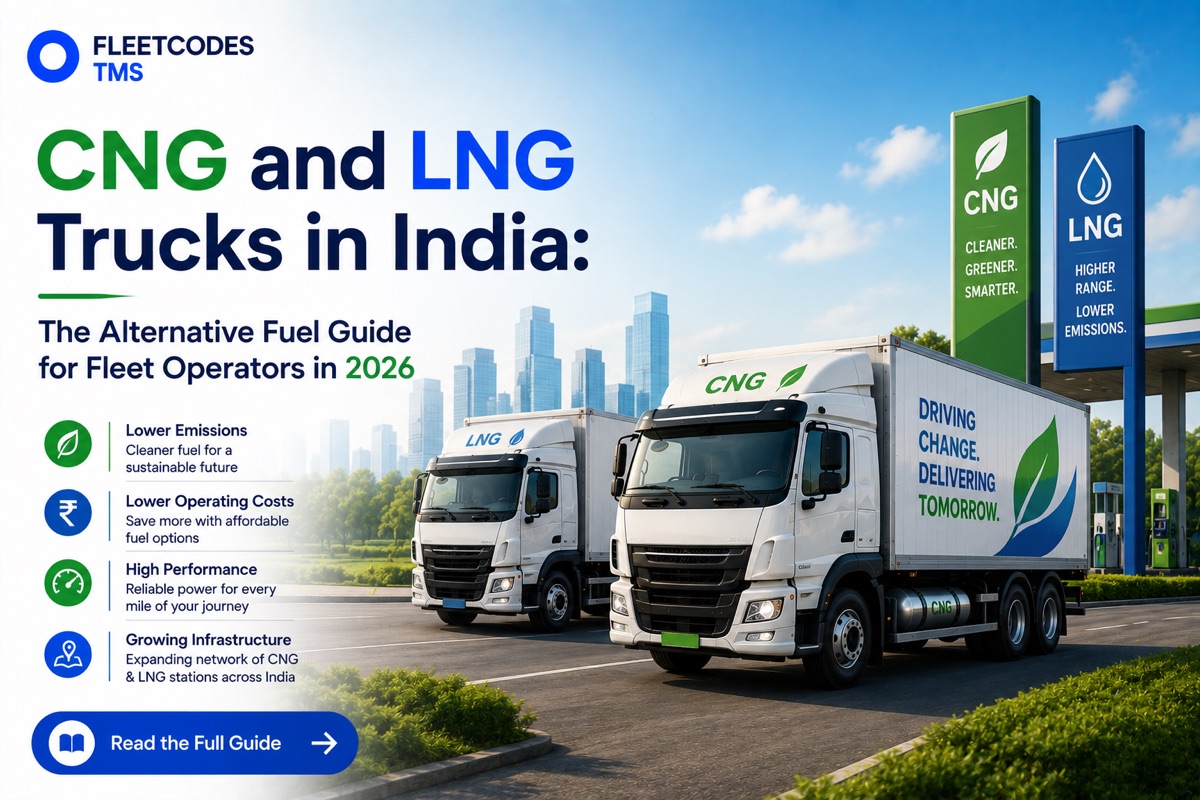
India's logistics sector consumes billions of litres of diesel every year — making fuel the single largest operating expense for most transport fleets. In 2026, rising diesel volatility, BS6 compliance pressure, and government-backed gas infrastructure expansion are accelerating a major industry shift toward CNG and LNG commercial vehicles.
Why Alternative Fuel Adoption Is Accelerating in Indian Logistics
For years, diesel dominated Indian freight operations because it offered:
- High torque
- Long-range capability
- Widespread fuel availability
- Familiar maintenance ecosystems
But operating economics are changing rapidly.
Three forces are pushing fleets toward alternative fuels:
Rising Diesel Cost Volatility
Fuel cost fluctuations directly affect freight margins. For many transporters, diesel accounts for 35–50% of total operating expenditure.
Small fuel price increases create disproportionate pressure on:
- Long-haul contracts
- Fixed-rate freight agreements
- Distribution fleet profitability
- Empty-run economics
As competition compresses freight rates, fleets are increasingly looking for structural fuel-cost reduction rather than temporary savings.
Expansion of India's Gas Infrastructure
India's national gas expansion strategy is significantly improving:
- CNG station availability
- LNG corridor infrastructure
- Commercial gas distribution access
- Highway refuelling coverage
The operational feasibility gap that previously limited gas-based trucking is shrinking quickly.
What was once practical only for urban fleets is now becoming viable for intercity logistics operations as well.
Enterprise Sustainability Pressure
Large enterprise shippers increasingly evaluate transport partners on environmental compliance and sustainability reporting.
Sectors such as:
- FMCG
- E-commerce
- Automotive
- Retail distribution
- Export logistics
are beginning to prioritise transport vendors with lower-emission fleet capability.
Alternative fuel adoption is becoming both an operational and commercial differentiator.
Understanding the Difference Between CNG and LNG Trucks
Although both use natural gas, CNG and LNG serve very different logistics applications.
CNG Trucks
Compressed Natural Gas (CNG) vehicles store gas under high pressure.
They are primarily suited for:
- Urban logistics
- Short-to-medium distance operations
- Distribution fleets
- Municipal transport
- Intra-city delivery
Typical operational characteristics:
- Lower operating cost per kilometre
- Shorter driving range
- Lower refuelling complexity
- Easier urban deployment
CNG fleets are becoming increasingly common in:
- Last-mile logistics
- FMCG distribution
- Parcel delivery
- City fleet operations
LNG Trucks
Liquefied Natural Gas (LNG) is stored at cryogenic temperatures, allowing significantly higher energy density.
LNG trucks are designed for:
- Long-haul freight
- Highway transportation
- High-mileage logistics operations
- Interstate cargo movement
Operational advantages include:
- Longer range capability
- Higher payload efficiency compared to CNG
- Reduced refuelling frequency
- Better suitability for heavy commercial operations
In India, LNG adoption is still developing but is increasingly relevant for:
- Dedicated corridor fleets
- Bulk cargo movement
- Industrial logistics
- Container transportation
CNG vs Diesel Fleet Cost: The Real Operational Comparison
The primary reason fleets evaluate CNG is fuel economics.
On paper, CNG operating cost per kilometre is often significantly lower than diesel.
But real-world fleet economics are more complex.
Areas Where CNG Fleets Save
Lower fuel expense Natural gas pricing often provides measurable per-kilometre savings compared to diesel.
Reduced engine vibration CNG engines generally produce smoother combustion, potentially reducing certain wear patterns.
Lower emissions compliance burden Alternative fuel vehicles align better with tightening environmental regulations and sustainability targets.
Urban operational compatibility Many cities increasingly favour cleaner commercial vehicles for urban access and municipal contracts.
Hidden Operational Trade-Offs
However, fleet operators must also account for:
- Reduced payload capacity due to cylinder weight
- Longer refuelling queues at busy stations
- Lower route flexibility
- Infrastructure dependency
- Limited rural fuel access
- Different maintenance expertise requirements
For some fleets, operational inefficiencies can offset part of the fuel savings if deployment planning is poor.
This is why alternative fuel adoption must be evaluated operationally — not just financially.
The Biggest Challenge: Fuel Infrastructure Reliability
The success of any alternative fuel fleet depends on infrastructure reliability.
CNG Station Network in India
India's CNG station network is expanding aggressively, especially in:
- Delhi NCR
- Maharashtra
- Gujarat
- Karnataka
- Tamil Nadu
But coverage quality still varies significantly.
Common operational problems include:
- Long refuelling wait times
- Station congestion during peak hours
- Uneven pressure quality
- Limited heavy vehicle access at urban stations
For fleets operating tight delivery windows, refuelling delays can disrupt dispatch schedules.
Route planning becomes inseparable from fuel planning.
LNG Corridor Development
LNG infrastructure is improving along key freight corridors, but network density remains limited compared to diesel.
Long-haul LNG operations require:
- Carefully mapped fuel corridors
- Planned refuelling intervals
- Dispatch visibility into fuel availability
- Driver training for LNG handling
As infrastructure expands, LNG economics become increasingly attractive for high-mileage interstate fleets.
Mixed Fuel Fleet Management Is Becoming the New Operational Reality
Most transport companies in India will not transition entirely away from diesel immediately.
Instead, fleets are entering a mixed-fuel phase:
- Diesel vehicles
- CNG city fleets
- LNG highway fleets
- Early EV adoption in selected routes
This creates a new operational complexity layer.
Fleet operators now manage:
- Multiple fuel cost structures
- Different maintenance schedules
- Vehicle-specific dispatch logic
- Fuel infrastructure dependencies
- Mixed compliance standards
Traditional spreadsheet-based operations struggle to handle this complexity efficiently.
How Fleet Technology Helps Manage Alternative Fuel Operations
Alternative fuel fleets require tighter operational visibility than traditional diesel fleets.
Fleet management systems increasingly help operators track:
- Fuel efficiency trends
- Route-specific fuel economics
- Station-level fuel planning
- Vehicle utilisation by fuel type
- Refuelling downtime
- Maintenance cycles
- Driver fuel behaviour
- Range utilisation patterns
For example: A city distribution vehicle operating short urban routes may be optimally assigned to CNG.
A long-haul interstate route with stable LNG corridor access may justify LNG deployment.
A remote-area route with weak gas infrastructure may still remain diesel-dependent.
The operational objective is not fuel replacement alone.
It is route-fuel optimisation.
BS6 Commercial Vehicles and the Transition Phase
India's BS6 commercial vehicle regulations accelerated a major technology transition in fleet operations.
BS6 diesel vehicles significantly reduced emissions compared to older commercial vehicles.
But they also introduced:
- Higher vehicle complexity
- More advanced emission systems
- Increased maintenance sensitivity
- Higher compliance requirements
For many transporters, this transition opened the conversation around alternative fuels entirely.
The industry is now balancing:
- Cleaner diesel technology
- Gas-powered commercial vehicles
- Electrification pilots
- Future hydrogen possibilities
The transition is no longer theoretical.
It is operationally underway.
Fleet Electrification vs CNG and LNG: What Happens Next?
Many operators ask:
"Should fleets move directly to EVs instead of CNG or LNG?"
The answer depends heavily on operational profile.
Electric fleets currently perform best in:
- Fixed urban routes
- Short-range operations
- Predictable delivery cycles
CNG and LNG remain more practical for:
- Long-distance freight
- High daily utilisation
- Heavy-load transport
- Interstate operations
In reality, India's freight ecosystem will likely remain multi-fuel for years.
Different transport applications will adopt different energy systems based on:
- Route structure
- Payload type
- Infrastructure maturity
- Cost economics
- Operational uptime requirements
How Fleetcodes Supports Alternative Fuel Fleet Operations
Fleet operations inside Fleetcodes help transporters manage mixed-fuel logistics environments through:
- Fuel-cost visibility
- Route profitability tracking
- Maintenance scheduling
- Vehicle utilisation analytics
- Refuelling pattern monitoring
- Dispatch optimisation
- Driver performance analysis
As fleets diversify across diesel, CNG, LNG, and future electric vehicles, operational visibility becomes increasingly critical.
The challenge is no longer just managing vehicles.
It is managing energy efficiency across the fleet network.
FAQs
Are CNG trucks profitable for Indian fleets in 2026? CNG trucks can significantly reduce operating fuel costs for urban and short-to-medium-distance logistics operations. However, profitability depends on route structure, station availability, payload impact, and fleet utilisation efficiency.
What is the difference between LNG and CNG trucks? CNG trucks are typically suited for shorter urban and regional operations, while LNG trucks support longer-range interstate freight because LNG provides higher energy density and longer driving range.
Is LNG practical for long-haul trucking in India? LNG is becoming increasingly viable on major freight corridors where infrastructure is expanding. It is particularly relevant for high-mileage fleets operating predictable interstate routes.
How does alternative fuel adoption affect fleet maintenance? CNG and LNG vehicles have different maintenance requirements compared to diesel vehicles, including fuel-system management, specialised servicing, and infrastructure-related operational planning.
Can fleets operate diesel, CNG, and LNG vehicles together? Yes. Many Indian transporters are entering a mixed-fuel operational phase where different vehicle types are assigned based on route economics, fuel availability, and cargo requirements.
India's logistics industry is not moving toward a single fuel future — it is moving toward an operationally optimised fuel ecosystem. The fleets that adapt fastest will not simply reduce fuel costs; they will redesign how freight moves across the country. See How Fleetcodes Helps Manage Modern Fleet Operations →