In Indian road transport, cargo damage and loss are facts of operational life. What separates transporters who absorb these events professionally from those who face commercial and financial crises is not luck — it is preparation. And preparation starts with understanding your insurance.
Why Cargo Insurance Is Not Optional in Indian Logistics
Cargo insurance India is one of those subjects that most transporters understand just enough to think they are covered — until they are not.
The reality of freight movement in India is that losses happen. Road accidents, vehicle fires, theft, monsoon flooding, loading damage, pilferage, and unexplained shortages collectively affect a significant portion of goods in transit every year. For any transporter carrying goods on behalf of a shipper, these events create liability — and potentially, significant financial exposure.
Under the Carriage by Road Act, 2007, which governs road freight transport in India, a transporter who signs a lorry receipt (bilty) accepts legal custody of the goods. If those goods are lost or damaged during transport, the transporter is liable — unless they can establish that the loss was due to an Act of God, inherent vice in the goods, or the fault of the consignor.
That liability window is wide enough to cause serious financial damage to a business without adequate freight insurance India coverage.
The Three Types of Cargo Insurance Indian Transporters Should Know
1. Goods in Transit Insurance
Goods in transit insurance is the most directly relevant policy for road transporters. It covers goods owned by or in the custody of a transporter while they are being transported from one point to another.
For transporters, a goods in transit policy can be structured in two ways:
Transporter's Liability Policy: Covers the transporter's legal liability for loss or damage to goods while in their custody — up to the limit of the policy. This is the policy that protects the transporter from claims made by the consignor or consignee for goods damaged or lost during transport.
Open Policy (Annual): An annual policy covering all goods transported by the insured fleet during the policy period, up to an aggregate or per-consignment limit. More cost-effective for high-volume fleets than insuring consignment by consignment.
Per-Trip Marine Cargo Policy: For specific high-value consignments, a marine cargo policy (which applies to road transport despite the name) can be taken out per trip — covering that specific consignment for its full declared value.
2. Carrier's Legal Liability Insurance
A carrier's legal liability (CLL) policy specifically covers the transporter's exposure under the Carriage by Road Act and under the terms of the bilty. Unlike a goods policy that covers the value of goods, CLL covers what the transporter is legally obligated to pay — which may be different, depending on the contractual terms between transporter and shipper.
For transporters who move goods under standardised rate contracts, a CLL policy is often more practical than a per-consignment goods policy — because it aligns the insurance coverage directly to the legal liability position.
3. Marine Cargo Insurance (for Containerised and High-Value Goods)
Despite its name, marine cargo insurance India applies to goods transported by any mode — road, rail, air, or sea. For high-value consignments (electronics, pharmaceuticals, jewellery, capital equipment), a marine cargo policy offers broader coverage than a standard transporter's liability policy and typically covers the full declared value of the goods.
For transporters regularly carrying high-value cargo on behalf of importers or exporters, understanding when to recommend that the shipper take out marine cargo cover — versus when the transporter's own policy is sufficient — is commercially important.
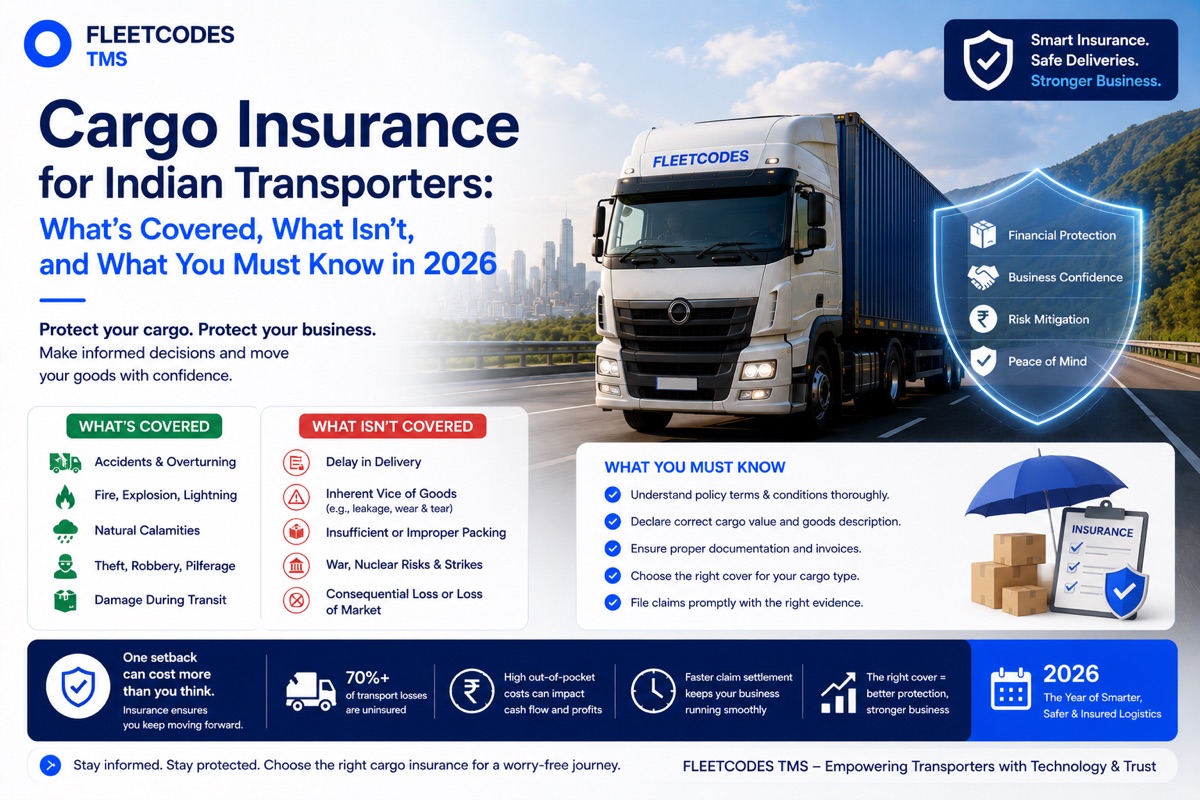
What Cargo Insurance Typically Covers
Standard transit insurance for trucks coverage includes:
- Accidental damage: Damage to goods resulting from a road accident — overturning, collision, or vehicle impact
- Fire and explosion: Loss or damage caused by vehicle fire, explosion, or lightning strike
- Theft: Loss of goods due to theft — though this is often subject to specific conditions (see exclusions below)
- Natural catastrophes: Damage caused by flood, cyclone, or other defined natural events
- Loading and unloading damage: Damage occurring during the loading or unloading process — though this coverage varies by policy
- Malicious damage: Deliberate damage to goods by third parties — riots, strikes, or vandalism in some policies
What Cargo Insurance Typically Does NOT Cover
This is where most cargo claim process India disputes originate. Understanding exclusions before you need to make a claim is essential.
Common exclusions in Indian cargo insurance policies:
Inherent vice: Deterioration, leakage, or damage arising from the natural properties of the goods themselves — perishables that decay, liquids that leak, fragile goods that break under normal transit vibration. Unless specifically endorsed, inherent vice is excluded from most standard policies.
Improper packaging: Goods damaged because they were not adequately packed for road transport. If the shipper hands over poorly packaged goods and they are damaged in transit, the claim may be rejected on the grounds that the damage resulted from inadequate packaging — not from the transporter's fault.
Consequential losses: The cargo insurance covers the value of the goods — not the consequential economic loss from the delay (missed production schedule, penalty for late delivery, loss of a customer). Consequential loss coverage requires a separate, specific endorsement.
Theft without forced entry or violence: Many standard policies exclude theft unless it involved forced entry into the vehicle or violence against the driver. Pilferage — the gradual disappearance of goods over time — is frequently excluded unless specifically covered.
Driver negligence (in some policies): Some transporter liability policies exclude losses caused by the gross negligence of the driver — unauthorised stops, abandoning the vehicle, allowing unauthorized access. Review your policy terms carefully.
Electrical and mechanical breakdown of goods: If refrigerated or temperature-sensitive goods are damaged because the vehicle's refrigeration unit failed mechanically, this may fall outside standard cargo cover and require a specialist policy.
How to File a Cargo Insurance Claim That Succeeds
The difference between a successful cargo claim process India outcome and a rejected one is often documentation — not the merits of the claim.
Step 1 — Report immediately. As soon as damage or loss is discovered, notify your insurer. Most policies require notification within 24–48 hours of discovery. Delayed notification is a common ground for claim rejection.
Step 2 — Preserve the evidence. Do not dispose of damaged goods, repair damage, or clean the vehicle before the surveyor has inspected. Photograph everything — the vehicle, the goods, the damage, the load position, the loading bay if relevant.
Step 3 — Gather your documentation. A cargo claim requires: the original bilty/lorry receipt, the invoice for the goods (establishing value), the e-way bill, the vehicle insurance certificate, the driver's licence, the vehicle's fitness certificate, the FIR (for theft claims), and the surveyor's report.
Step 4 — File the FIR for theft claims. For theft or robbery, an FIR at the nearest police station is mandatory for the claim to be processed. File it immediately — delays in FIR filing create grounds for claim denial.
Step 5 — Cooperate with the surveyor. The insurer will appoint a surveyor to inspect the damage and establish the cause. Full cooperation — providing documentation, access to the vehicle and driver — is both a policy requirement and in your commercial interest.
Step 6 — Submit the claim in writing. Follow up verbal notification with a written claim letter within the timeframe specified in your policy — typically 7–15 days of the loss event.
How Clean Documentation Strengthens Your Claim
One of the strongest practical advantages of digital freight documentation is the quality of evidence it creates for insurance claims.
Consider what a claim file looks like with paper-based documentation: a handwritten bilty that may be partially illegible, a driver's verbal account of what happened, a disputed goods condition at loading because there is no objective record, and no precise timestamp for when the delivery was attempted.
Now consider what a claim file looks like with digital documentation: a timestamped digital bilty with all consignment details structured and searchable, a GPS track of the entire trip showing the exact route taken, a geofenced arrival record at the delivery point, a digital POD attempt record with photo evidence of the goods condition at delivery, and a driver app log showing every status update from loading to attempted delivery.
Insurers and surveyors make claim settlement decisions based on evidence. The fleet operator who presents a complete, consistent, timestamped digital evidence trail consistently achieves faster and more complete claim settlements than the one presenting partial paper records.
This is not a reason to choose a TMS for insurance purposes. It is a recognition that fleet risk management India benefits from the same operational discipline that improves billing and driver management — and that digital documentation serves all of these purposes simultaneously.
Practical Tips for Choosing Cargo Insurance
Get the right sum insured. Under-insuring goods to reduce premiums is a false economy. In the event of a total loss, you receive only the proportion of the loss that your sum insured covers relative to the goods' actual value. Insure for full replacement value, not depreciated value.
Read the theft clause carefully. If your fleet runs through high-risk areas or carries high-value cargo, ensure your policy covers theft without requiring forced entry — or take out a separate endorsement for this risk.
Understand your deductible. Most commercial cargo policies carry a deductible (excess) — the amount you bear for each claim before the insurer pays. Understand this number before you need to claim.
Consider an annual open policy if volume justifies it. For fleets running consistent volumes, an annual open policy with per-consignment sub-limits is typically more cost-effective than individual consignment insurance.
Maintain a claims record. Insurers use claims history in renewal pricing. Documenting claims accurately — including recoveries from responsible third parties — keeps your record clean and your premiums competitive.
FAQs
What is goods in transit insurance and is it mandatory for Indian transporters? Goods in transit insurance covers loss or damage to goods while they are being transported. It is not legally mandatory for all transporters under Indian law, but it is commercially essential — because the Carriage by Road Act creates legal liability for transporters who sign a bilty for goods that are subsequently lost or damaged.
What is the difference between freight insurance and cargo insurance in India? The terms are often used interchangeably. Strictly speaking, freight insurance covers the freight charges (the transporter's revenue) in the event of loss, while cargo insurance covers the value of the goods themselves. Most transporters need cargo or goods-in-transit cover rather than freight insurance per se.
How long does a cargo insurance claim take to settle in India? Claim settlement timelines vary by insurer and complexity. Simple, well-documented claims with clear causation are typically settled within 30–60 days. Complex claims, theft claims requiring police investigation, or claims involving disputed liability can take 3–6 months or longer. Complete, consistent documentation accelerates settlement.
Does cargo insurance cover goods stolen from a parked vehicle overnight? This depends on the specific policy terms. Many standard policies exclude or limit theft from unattended vehicles, especially overnight. Review your policy's theft conditions carefully, and consider an endorsement for this risk if your operation involves overnight parking with loaded vehicles.
What documents are required to file a cargo insurance claim in India? Standard requirements include: original bilty/lorry receipt, goods invoice (establishing value), e-way bill, vehicle insurance and fitness certificates, driver's licence, surveyor's report, and (for theft) an FIR. Digital equivalents of these documents are accepted by most insurers and typically process faster than paper submissions.
Understanding your cargo insurance before you need it is one of the most valuable hours you can spend as a fleet operator. Do it before the next claim — not after.