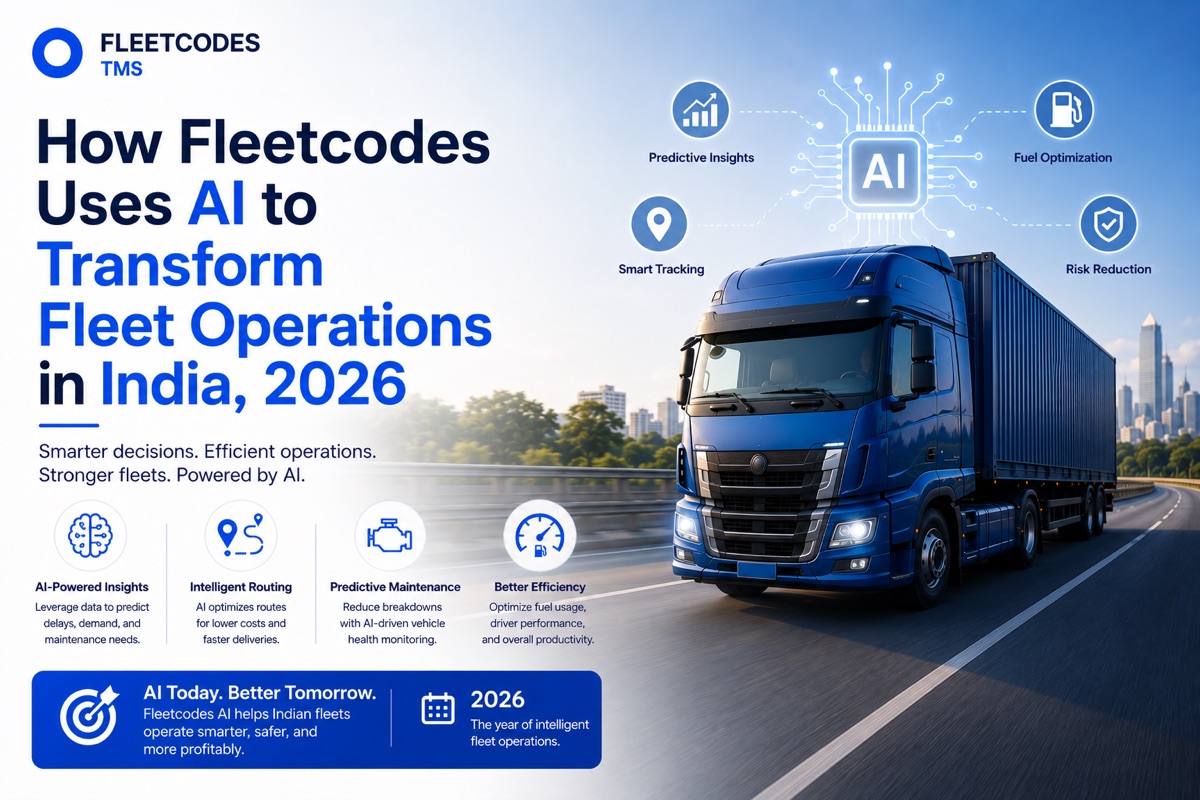
AI fleet management software in India is no longer a concept reserved for global logistics giants. In 2026, it's what separates fleet operators that grow profitably from those that grind harder for thinner margins.
Why AI Is the Most Important Shift in Indian Fleet Management Right Now
The Indian logistics sector moves over 4.6 billion tonnes of freight per year. Yet the majority of that movement is still coordinated through spreadsheets, WhatsApp groups, and experience-based instinct. Dispatchers rely on memory. Rate cards live in email threads. Fuel costs are estimated, not measured. Driver performance is assessed in conversations, not data.
This works — until it doesn't. As fleet size grows, as customer expectations tighten, and as fuel and labour costs rise, the manual approach becomes a ceiling on how efficiently and profitably your operation can run.
AI fleet management software India built for this market doesn't replace your team's knowledge. It amplifies it — giving every dispatcher, operations manager, and driver better information, faster, so every decision made is the best available one.
Fleetcodes is built as an AI-first fleet optimization platform for Indian logistics — and this is what that means in practice.
See Fleetcodes AI in action — Book a Free Demo
What AI Fleet Management Actually Means — No Jargon
The term AI gets stretched over almost everything in software marketing. Here are the five specific ways AI fleet management software India delivers real operational value inside Fleetcodes:
1. AI Dispatch Planning
AI dispatch planning is the highest-leverage AI application in fleet operations. Every time a load needs to be assigned, Fleetcodes analyses the full fleet state — vehicle location, current load, driver hours available, vehicle type, historical performance on the route, and fuel efficiency — and surfaces the optimal match in seconds.
What used to take a dispatcher 10–15 minutes of mental coordination happens automatically. The dispatcher reviews and confirms. The AI does the heavy lifting.
At scale — managing 100+ vehicles across multiple routes simultaneously — this transforms the quality and consistency of every dispatch decision made, every single day.
2. Logistics Automation Software — Eliminating Manual Handoffs
Logistics automation software removes the manual steps between operational events. In Fleetcodes:
- Load confirmed → trip auto-created in dispatch queue
- Driver confirms delivery → digital POD captured → invoice triggered automatically
- Trip closed → driver settlement calculated instantly
- Vehicle hits service interval → maintenance alert raised without anyone checking a register
Each of these handoffs, done manually, introduces delay, error, and staff time. Done automatically through logistics automation software, they happen at the speed of data.
3. Predictive Fleet Analytics
Predictive fleet analytics moves operations from reactive to proactive. Fleetcodes analyses historical trip data, vehicle performance records, and route patterns to surface forecasts that help operations teams act before problems occur:
- Which vehicles are likely to need unscheduled maintenance in the next 30 days
- Which routes have historically high delay probabilities at specific times of day
- Which drivers show patterns associated with fuel overconsumption
- Which customer lanes are likely to see demand spikes based on booking history
This is fleet optimization platform intelligence that goes beyond tracking what happened — it tells you what is likely to happen next.
4. Route Optimization
Route optimization in Fleetcodes calculates the most cost-effective route for each specific trip by factoring in real-time traffic, vehicle fuel efficiency on specific road types, toll costs, delivery time windows, and driver hours. The result is routes optimised for actual trip cost — not just distance. Cumulative fuel optimization savings across a fleet are substantial.
5. Driver Analytics
Driver analytics in Fleetcodes turns every trip into a performance data point. Fuel consumption per driver, on-time delivery rates, idle time, harsh braking events, and route adherence are tracked continuously — building individual profiles that identify coaching opportunities and recognise high performers with data, not guesswork.
The Fleet Productivity Multiplier
One of the most significant effects of AI fleet management software India isn't a single dramatic improvement — it's the compound effect of many smaller improvements running simultaneously across the operation.
| Operation Area | Without AI | With Fleetcodes AI | |---|---|---| | Dispatch decision time | 10–15 mins per load | Under 60 seconds | | Route efficiency | Experience-based | Optimised per trip cost | | Fuel monitoring | Monthly average | Per vehicle, per trip, real time | | Maintenance | Reactive after breakdown | Predictive alerts before failure | | Driver performance | Anecdotal assessment | Data-driven, per-trip analytics | | Billing cycle | 3–7 days post-delivery | Same day, auto-triggered |
Each row is a fleet productivity gain. Together, they represent a fundamentally different operational capability — one that scales as your fleet grows, without requiring proportionally more management overhead.
How Fleetcodes AI Learns Your Specific Operation
What separates Fleetcodes from a standard transport management system is that the AI layer learns from your specific operation over time.
As trips accumulate, the platform develops increasingly accurate models of your specific routes, vehicle fleet characteristics, customer behaviour, and driver profiles. Predictive fleet analytics in month six of a Fleetcodes deployment are meaningfully more accurate than in month one — and better still in month twelve.
Early adoption isn't just about solving today's problems. It's about building an AI system that knows your operation deeply — and compounds in value the longer it runs.
AI Dispatch Planning in Practice: A Day in a 100-Vehicle Fleet
7:00 AM — Load Planning 34 loads to assign across 28 available vehicles. AI dispatch planning surfaces optimal assignments in under 4 minutes. Dispatcher makes 3 adjustments based on known customer preferences. All loads dispatched by 8:15 AM.
9:30 AM — Predictive Maintenance Alert Fleetcodes flags MH-12-AB-3456: fuel consumption 14% above baseline over 8 trips — a pattern historically associated with injector wear. Maintenance scheduled before the vehicle goes out on a long-haul run. Breakdown avoided.
11:45 AM — Route Deviation Flag A driver deviates 47 km from the optimised route. Alert raised. Driver contacted. Route corrected. Estimated fuel saving on that trip: ₹1,800.
5:00 PM — Week-Close Analytics Logistics automation software generates the performance summary automatically: 94% on-time delivery, fuel 6% below baseline, empty miles at 18% (down from 27% eight weeks prior). No manual report assembly required.
This is trip management when AI is handling what AI does best — processing operational data continuously and surfacing only what needs human attention.
Why AI Fleet Management Is Especially Valuable in India
The case for AI fleet management software India is stronger than in many other markets:
Road infrastructure variability — Indian highways, state roads, and urban routes vary enormously in speed, reliability, and cost. Route optimization AI learns these differences and routes accordingly. Manual dispatch cannot.
Multi-state compliance complexity — e-way bill management and regional permit requirements create compliance overhead that AI monitors continuously and flags proactively.
Fuel cost volatility — with diesel prices varying by state and changing frequently, fuel optimization through AI monitoring delivers compounding savings.
Driver workforce diversity — consistent, data-based driver analytics works across different experience levels and regional backgrounds in ways that anecdotal performance management cannot.
FAQs
What is AI fleet management software and how does it work in India? AI fleet management software uses machine learning and automation to optimise dispatch decisions, predict maintenance needs, improve route efficiency, and analyse driver performance. Fleetcodes is built specifically for Indian logistics operations, learning from your specific routes, vehicles, and customers over time.
How does AI dispatch planning improve fleet operations? AI dispatch planning analyses the full fleet state to recommend optimal load-to-vehicle assignments in seconds — reducing dispatch time, improving vehicle utilisation, and removing human error from the most frequent decision in fleet management.
What is predictive fleet analytics? Predictive fleet analytics uses historical trip and vehicle data to forecast future events — maintenance needs, route delays, fuel spikes — before they occur, moving fleet management from reactive problem-solving to proactive operational control.
How does Fleetcodes deliver fuel optimization? Fleetcodes monitors per-vehicle fuel consumption against baseline profiles, flags deviations in real time, optimises routes for fuel efficiency, and identifies driver behaviours that increase fuel costs — typically delivering 8–12% fuel cost reduction.
Is Fleetcodes suitable for small fleets in India? Yes. Fleetcodes delivers AI fleet management value from 15 vehicles upward. Early adoption is advantageous — the AI begins learning your specific operation from day one, compounding in accuracy and value over time.
AI dispatch. Predictive analytics. Route optimisation. Driver insights. All built for India. Book Your Free Fleetcodes Demo →