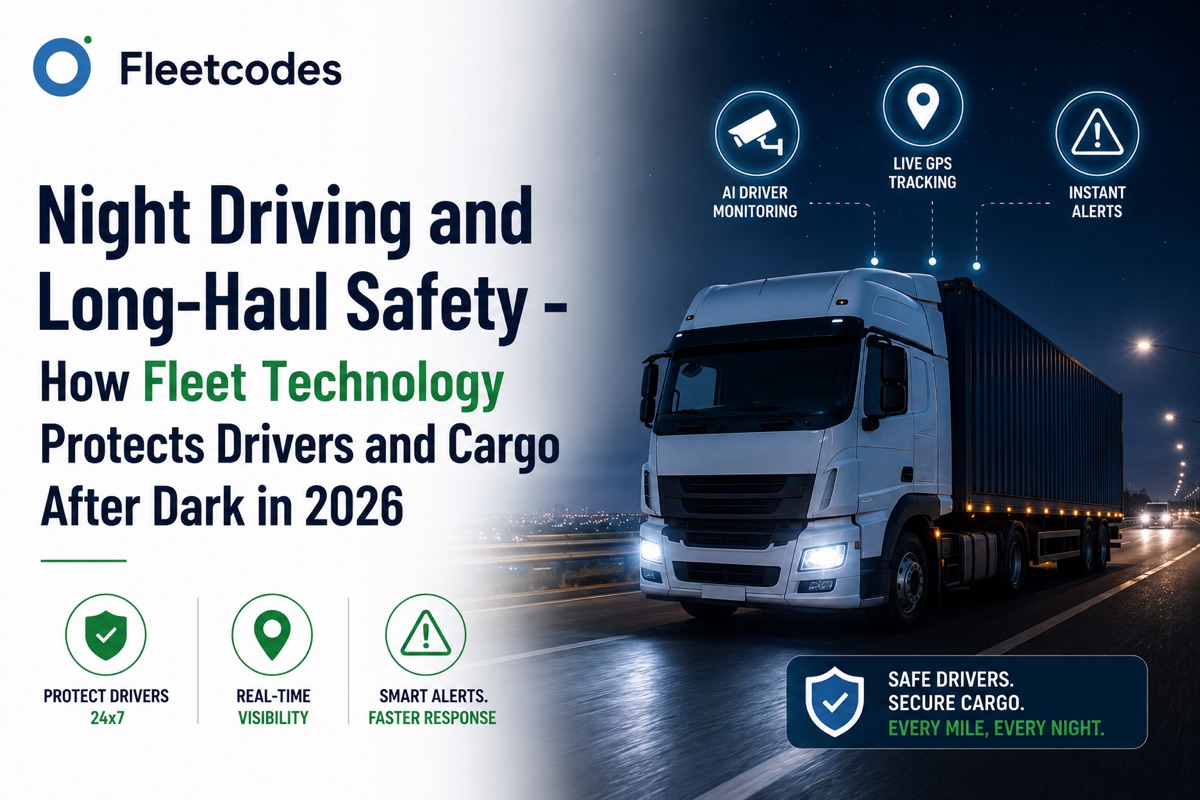
Most conversations about fleet management focus on cost — cost per km, billing cycles, fuel efficiency. But there's a quieter, more urgent conversation every fleet owner running long-haul routes needs to have: what happens to your drivers and your cargo between 10 PM and 6 AM.
A significant majority of fatal truck accidents in India occur during night-time hours, driven by driver fatigue, poor visibility, longer unbroken driving stretches, and — often — the complete absence of real-time visibility into what's happening on the road after dark.
Why Night Driving Is Different
- Fatigue compounds silently. A driver on the road since early morning who continues into the night is operating on accumulated fatigue that doesn't show up in a simple "hours since last stop" count.
- Response time matters more. A breakdown or medical issue at 2 AM on a highway stretch with limited traffic is a very different emergency than the same event at noon.
- Cargo risk increases. Theft and pilferage rates are meaningfully higher on unmonitored night routes, particularly for high-value freight.
How Fleet Technology Changes the Picture
1. Real-Time GPS Tracking, Around the Clock
Live vehicle position, trip status, and route deviation alerts don't switch off at sunset. A dispatcher can flag a vehicle that's stopped unexpectedly or is running significantly behind schedule, at any hour.
2. Geofencing for Unplanned Stops
Virtual zones around known safe stops, depots, and customer sites let the system distinguish a planned rest stop from an unplanned, unexplained one — a distinction that matters enormously at night.
3. Fuel Anomaly Detection
A sudden, unexplained drop in fuel level during a night stop is one of the clearest early indicators of theft — a risk that rises after dark. Automated alerts flag this in near real time.
4. Driver Hours and Trip History Visibility
Tracking actual trip duration against planned schedules gives dispatchers the data to make better rest decisions, rather than relying on drivers to self-report fatigue under delivery pressure.
5. A Digital Trail When It Matters Most
In the event of an accident or dispute, GPS-verified route history and timestamps available immediately — rather than reconstructed from a paper trip sheet — matter for insurance claims and driver protection.
Safety and Efficiency Aren't Separate Problems
The same infrastructure that improves dispatch efficiency and billing speed — live GPS data, geofencing, fuel monitoring — is the infrastructure that materially improves night driving safety. A fleet with better visibility during the day has better visibility at 2 AM too, because it's the same system running continuously.
What This Means for Your Fleet
If your current operation loses visibility into a vehicle the moment it leaves for an overnight route — no live tracking, no automated alerts, no way to distinguish a planned stop from a dangerous one — that's a gap worth closing before it becomes an incident, not after.
See how real-time visibility protects your drivers and cargo, day and night. Request a demo and our team will show you how it works.