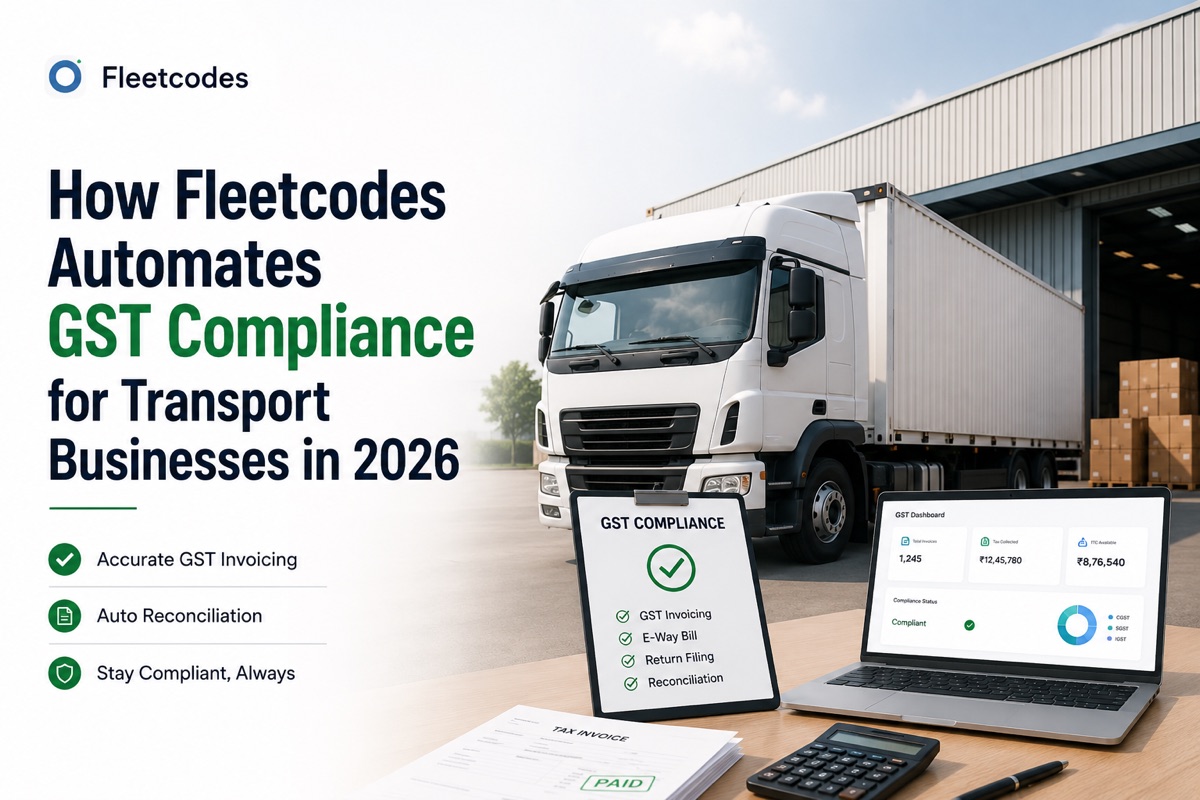
If you run a transport business in India, GST compliance is probably one of three things: a monthly headache, a job you've outsourced to an accountant who's always a week behind, or a risk you're quietly hoping doesn't catch up with you. For most fleet owners, it's all three.
The GST framework for Goods Transport Agencies is more complex than for almost any other sector — reverse charge mechanism, e-way bill generation, HSN classification for freight, and invoice matching across dozens or hundreds of trips a month. Get it wrong, and you're looking at penalties, blocked input tax credit, or delayed payments from customers who won't clear an invoice until the paperwork is airtight.
Why GST Compliance Is Uniquely Hard for Transport Businesses
Unlike a retailer or manufacturer, a transport business generates a GST event with every single trip — not every sale. A fleet running 40 vehicles might complete 200+ trips a month, each one needing:
- A GST-compliant invoice, correctly classified under the applicable HSN/SAC code
- Correct application of the reverse charge mechanism (RCM), versus forward charge where the GTA itself is liable
- A matching e-way bill for any consignment above the threshold value, generated before the vehicle moves
- Accurate GSTIN capture for both consignor and consignee, since a single error here can block the destination party's input tax credit
When this is done manually — often days after the delivery, from a paper trip sheet — errors multiply. Missed e-way bills alone are one of the most common reasons Indian transporters face roadside detentions and penalties.
How Fleetcodes Handles It End to End
1. E-Way Bill Integration
Fleetcodes connects directly to the GST portal's API. As soon as a trip is created and consignment details are entered, the e-way bill is generated straight from trip data — no separate login, no re-typing. The platform also tracks validity windows and alerts before expiry mid-route.
2. Automated, GST-Compliant Invoicing
Once a Proof of Delivery is confirmed in the driver app — signature, photo, geotag, timestamp — Fleetcodes automatically generates the invoice using the stored customer rate card, applying the correct GSTIN, HSN classification, and RCM or forward charge treatment every time.
3. Same-Day Billing
Because invoicing is tied to POD confirmation instead of a monthly reconciliation cycle, billing happens the same day a delivery is completed — not three to seven days later.
4. Audit-Ready Records
Every invoice, e-way bill, and POD is stored against the trip record, timestamped and geotagged, so a GST audit means pulling up a complete paper trail in seconds.
The Real Cost of Manual GST Handling
- 3-8% revenue leakage from missed surcharges, expired rate cards, or invoices that never got raised
- 3-7 day billing delays, directly slowing cash collection
- 6-10 hours a day of combined dispatcher and accounts time spent reconciling trip sheets and invoices manually
Built for How Indian Transport Actually Works
Fleetcodes isn't a generic logistics platform with GST bolted on. E-way bill generation, GST invoicing, FASTag toll integration, and multi-state permit tracking are native — not adapted from a global product built for another market.
For a fleet owner, the outcome is simple: trips get billed the day they're completed, e-way bills are generated without a separate process, and audit season stops being a fire drill.
Ready to see automated GST compliance in action? Request a demo and our team will show you how Fleetcodes handles your trip data in real time.