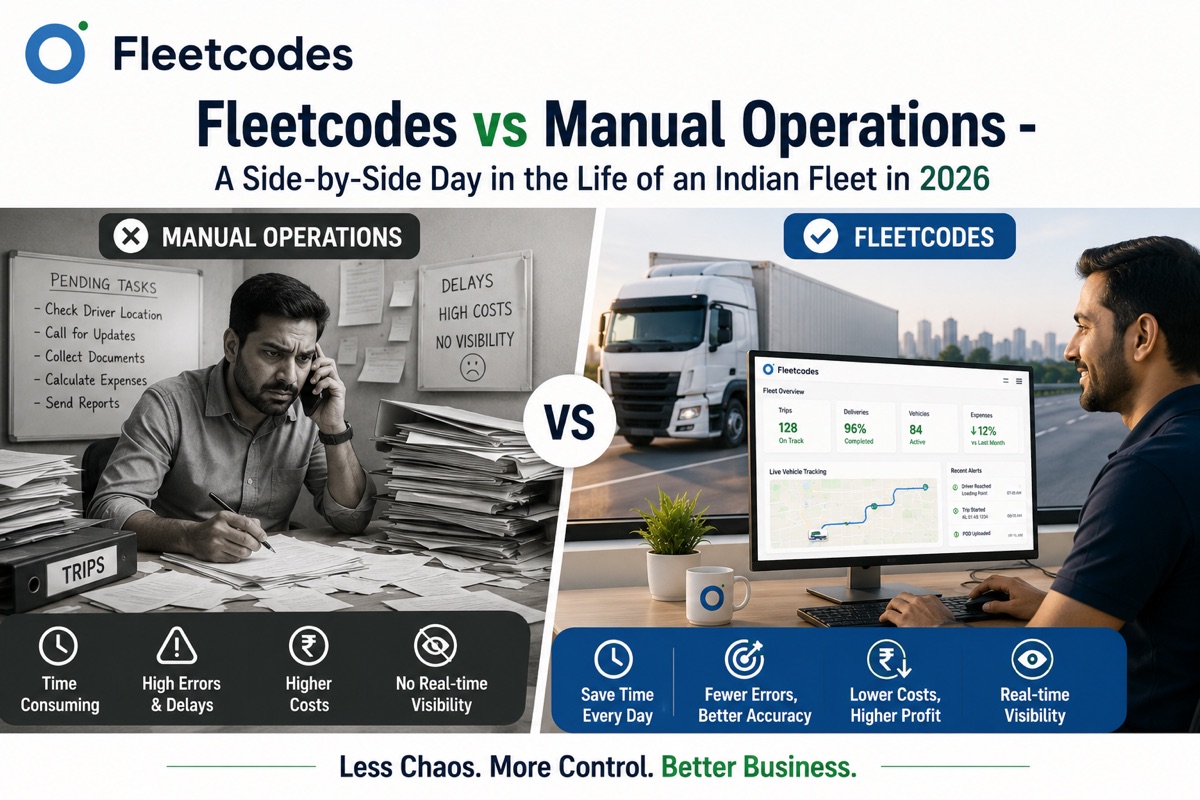
It's one thing to talk about "automation" and "efficiency gains" in the abstract. It's another to actually see what a working day looks like — hour by hour — with and without a connected TMS running underneath it. Here's that comparison, for a mid-sized fleet running roughly 50 vehicles.
6:00 AM — Planning the Day's Dispatch
Manual Operations: The dispatcher checks yesterday's WhatsApp messages, a spreadsheet of confirmed loads, and starts manually matching vehicles to loads from memory and phone calls. This takes 60-90 minutes before a single truck moves.
With Fleetcodes: The dispatcher opens a live dashboard showing every vehicle's location and status, with AI-recommended load-to-vehicle assignments already generated. Review and confirmation takes 10-15 minutes.
8:00 AM — Vehicles Depart
Manual Operations: Once a driver leaves the yard, visibility drops to whatever the driver reports by phone or WhatsApp.
With Fleetcodes: Real-time GPS tracking shows live position, trip status, and ETA for every vehicle on the road — no phone calls needed.
11:00 AM — A Customer Calls Asking Where Their Shipment Is
Manual Operations: The dispatcher calls the driver directly, interrupting them mid-route, before calling the customer back. This happens dozens of times a day.
With Fleetcodes: The customer checks the visibility portal themselves — live status, dynamic ETA, milestone updates.
1:00 PM — A Vehicle Deviates from Its Planned Route
Manual Operations: Nobody notices unless the driver mentions it or the delivery runs late enough to prompt a call.
With Fleetcodes: A route deviation alert fires automatically, and the dispatcher can act within minutes.
3:00 PM — A Delivery Is Completed
Manual Operations: The driver collects a signed paper POD that stays with them until they're back at the yard — sometimes days later on a long-haul route.
With Fleetcodes: The driver captures signature, photo, geotag, and timestamp in the app. A GST-compliant invoice generates automatically the moment POD is confirmed.
5:00 PM — Checking Fleet Fuel and Maintenance Status
Manual Operations: Fuel and maintenance tracking typically happens reactively — after a breakdown or an unusually high month-end fuel bill.
With Fleetcodes: The analytics dashboard shows live fuel consumption against per-vehicle baselines, flagging anomalies as they happen.
7:00 PM — End of Day Reconciliation
Manual Operations: The accounts team starts matching completed trips against trip sheets and rate cards — a process that can take days to close out.
With Fleetcodes: Same-day billing means most of the day's deliveries are already invoiced. The team reviews revenue, profit per trip, and utilization on the dashboard.
9:00 PM — Vehicle Documents and Compliance
Manual Operations: Document expiry is tracked manually, often discovered at a checkpoint rather than before.
With Fleetcodes: Compliance tracking runs continuously, with advance alerts before any document is due to expire.
The Difference, Added Up
None of these individual moments look dramatic on their own. But across 50 vehicles and hundreds of trips a month, these small manual steps compound into the 6-10 hours of daily dispatcher time, 3-7 day billing delays, and 3-8% revenue leakage that most transport businesses have simply learned to accept as normal.
See what a day on your fleet could look like with Fleetcodes running underneath it. Request a demo and our team will show you in 20 minutes.